Gutscheinbedingungen

**Gültig bis 06.07.2026 auf fremdsprachige Bücher online auf thalia.at, in der Thalia App ab einem Mindestbestellwert von 30€ und in allen Thalia Buchhandlungen in Österreich. In den Buchhandlungen nur gültig auf lagernde Ware. Einzelne Artikel können ausgeschlossen sein. Ausgenommen sind preisgebundene Artikel & eBooks. Pro Einkauf einmal einlösbar. Nur gültig gegen Vorlage oder im Onlineshop hinterlegter Bonuscard. Infos zur Einlösung in der Buchhandlung sind auf der Bonuscard-Vorteilspreisseite zu finden. Click & Collect nur bei Onlinevorabzahlung möglich. Keine Einlösung bei Scan & Go-Bezahlung. Keine Barauszahlung. Nicht kombinierbar mit anderen Aktionen und Gutscheinen. Gutschein wird auf max. 500€ Bestellwert angerechnet. Nicht gültig für Versandkosten und Services.

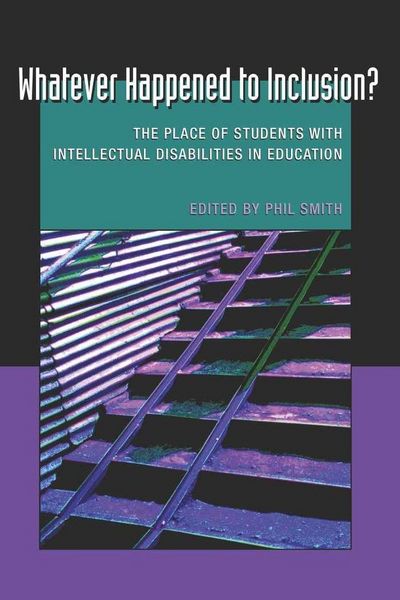
  • Produktbild: Whatever Happened to Inclusion?
  • Produktbild: Whatever Happened to Inclusion?
Band 7

Whatever Happened to Inclusion? The Place of Students with Intellectual Disabilities in Education

41,65 €

inkl. gesetzl. MwSt., Versandkostenfrei


Beschreibung

Produktdetails

Einband

Taschenbuch

Erscheinungsdatum

04.12.2009

Herausgeber

Philip Smith

Verlag

Peter Lang Publishing Inc. New York

Seitenzahl

264

Maße (L/B/H)

22,5/15/1,5 cm

Gewicht

390 g

Auflage

1

Sprache

Englisch

ISBN

978-1-4331-0434-3

Beschreibung

Rezension

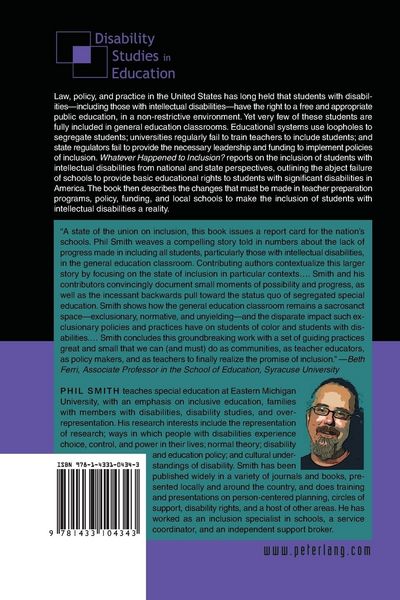
«A state of the union on inclusion, this book issues a report card for the nation’s schools. Phil Smith weaves a compelling story told in numbers about the lack of progress made in including all students, particularly those with intellectual disabilities, in the general education classroom. Contributing authors contextualize this larger story by focusing on the state of inclusion in particular contexts…. Smith and his contributors convincingly document small moments of possibility and progress, as well as the incessant backwards pull toward the status quo of segregated special education. Smith shows how the general education classroom remains a sacrosanct space – exclusionary, normative, and unyielding – and the disparate impact such exclusionary policies and practices have on students of color and students with disabilities.… Smith concludes this groundbreaking work with a set of guiding practices great and small that we can (and must) do as communities, as teacher educators, as policy makers, and as teachers to finally realize the promise of inclusion.» (Beth Ferri, Associate Professor in the School of Education, Syracuse University)

Portrait

The Editor: Phil Smith teaches special education at Eastern Michigan University, with an emphasis on inclusive education, families with members with disabilities, disability studies, and overrepresentation. His research interests include the representation of research; ways in which people with disabilities experience choice, control, and power in their lives; normal theory; disability and education policy; and cultural understandings of disability. Smith has been published widely in a variety of journals and books, presented locally and around the country, and does training and presentations on person-centered planning, circles of support, disability rights, and a host of other areas. He has worked as an inclusion specialist in schools, a service coordinator, and an independent support broker.
Produktdetails

Einband

Taschenbuch

Erscheinungsdatum

04.12.2009

Herausgeber

Philip Smith

Verlag

Peter Lang Publishing Inc. New York

Seitenzahl

264

Maße (L/B/H)

22,5/15/1,5 cm

Gewicht

390 g

Auflage

1

Sprache

Englisch

ISBN

978-1-4331-0434-3

EU-Ansprechpartner

Zeitfracht Medien GmbH
Ferdinand-Jühlke-Straße 7|99095|Erfurt|DE
produktsicherheit@zeitfracht.de

Herstelleradresse

Peter Lang
Avenue du Théâtre 7|1005|Lausanne|CH
orders@peterlang.com

Noch keine Bewertungen vorhanden

Verfassen Sie die erste Bewertung zu diesem Artikel

Helfen Sie anderen Kundinnen und Kunden durch Ihre Meinung.

Kundinnen und Kunden meinen

Bewertungen (0)

  • Produktbild: Whatever Happened to Inclusion?
  • Produktbild: Whatever Happened to Inclusion?
  • Contents: Phil Smith: Whatever Happened to Inclusion? The Place of Students with Intellectual Disabilities in General Education Classrooms – Phil Smith: Trends for Including Students with Intellectual Disabilities in General Education Classrooms – Phil Smith: Defining Inclusion: What Is It? Who Does It Benefit? – Phil Smith: Barriers to Inclusion: Does Special Education Work? – Valerie Owen/Susan Gabel: Lack of Vision? Lack of Respect? Exclusion in Illinois – Barbara LeRoy/Krim Lacey: The Inclusion of Students with Intellectual Disabilities in Michigan – Emily A. Nusbaum: Fighting Professional Opinions: Stories of Segregation by Three California Families – Kagendo Mutua/Jim Siders: «What Is This Inclusion Thing? Who Dumped These Kids on Me? How Am I Supposed to Do This? Tracing the Contours of Inclusion in Alabama – David Connor: Adding Urban Complexities into the Mix: Continued Resistance to the Inclusion of Students with Cognitive Impairments ( or New York, New York: So Bad They Segregated It Twice) – Phil Smith: The Story(s) of the States: What Does It All Mean? – Phil Smith: Preparing Educators for Inclusion: What We’re Doing Right, What We’re Doing Wrong – Phil Smith: Future Directions: Policy, Practice, and Research.