KI-Beratung Beta

Gutscheinbedingungen

**Gültig bis 09.11.2026 auf tolino shine color (4016621130473), tolino vision color (4016621130183) und tolino vision color weiß (4016621131456) online auf thalia.at, in der Thalia App und in allen Thalia Buchhandlungen in Österreich. In den Buchhandlungen nur gültig auf lagernde Ware. Pro Einkauf einmal einlösbar. Nur gültig gegen Vorlage oder im Onlineshop hinterlegter Bonuscard. Infos zur Einlösung in der Buchhandlung sind auf der Bonuscard-Vorteilspreisseite zu finden. Click & Collect nur bei Onlinevorabzahlung möglich. Keine Einlösung bei Scan & Go-Bezahlung. Keine Barauszahlung. Nicht kombinierbar mit anderen Aktionen und Gutscheinen. Nicht gültig für Geschenkkarten, Versandkosten und Services. Nur solange der Vorrat reicht.

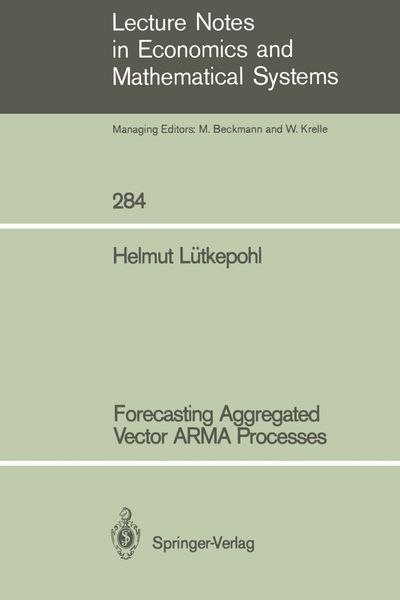
  • Produktbild: Forecasting Aggregated Vector ARMA Processes
  • Produktbild: Forecasting Aggregated Vector ARMA Processes
Band 284

Forecasting Aggregated Vector ARMA Processes

51,99 €

inkl. gesetzl. MwSt., Versandkostenfrei


Beschreibung

Produktdetails

Einband

Taschenbuch

Erscheinungsdatum

01.01.1987

Abbildungen

X, 323 p.

Verlag

Springer Berlin

Seitenzahl

323

Maße (L/B/H)

25,4/17,8/1,9 cm

Gewicht

641 g

Auflage

1987

Sprache

Englisch

ISBN

978-3-540-17208-6

Beschreibung

Produktdetails

Einband

Taschenbuch

Erscheinungsdatum

01.01.1987

Abbildungen

X, 323 p.

Verlag

Springer Berlin

Seitenzahl

323

Maße (L/B/H)

25,4/17,8/1,9 cm

Gewicht

641 g

Auflage

1987

Sprache

Englisch

ISBN

978-3-540-17208-6

Herstelleradresse

Springer-Verlag GmbH
Tiergartenstr. 17
69121 Heidelberg
DE

Email: ProductSafety@springernature.com

Noch keine Bewertungen vorhanden

Verfassen Sie die erste Bewertung zu diesem Artikel

Helfen Sie anderen Kundinnen und Kunden durch Ihre Meinung.

Kundinnen und Kunden meinen

Bewertungen (0)

  • Produktbild: Forecasting Aggregated Vector ARMA Processes
  • Produktbild: Forecasting Aggregated Vector ARMA Processes
  • 1. Prologue.- 1.1 Objective of the Study.- 1.2 Survey of the Study.- 2. Vector Stochastic Processes.- 2.1 Discrete-Time, Stationary Vector Stochastic Processes.- 2.2 Nonstationary Processes.- 2.3 Vector Autoregressive Moving Average Processes.- 2.4 Estimation.- 2.5 Model Specification.- 2.6 Summary.- 3. Forecasting Vector Stochastic Processes.- 3.1 Forecasting Known Processes.- 3.2 Forecasting Vector ARMA Processes with Estimated Coefficients.- 3.3 Forecasting Autoregressive Processes of Unknown Order.- 3.4 Forecasting Nonstationary Processes.- 3.5 Comparing Forecasts.- 3.6 Summary.- 4. Forecasting Contemporaneously Aggregated Known Processes.- 4.1 Linear Transformations of Vector Stochastic Processes.- 4.2 Forecasting Linearly Transformed Stationary Vector Stochastic Processes.- 4.3 Forecasting Linearly Transformed Nonstationary Processes.- 4.4 Linearly Transformed Vector ARMA Processes.- 4.5 Summary and Comments.- 5. Forecasting Contemporaneously Aggregated Estimated Processes.- 5.1 Summary of Assumptions and Predictors.- 5.2 Estimated Coefficients.- 5.3 Unknown Orders and Estimated Coefficients.- 5.4 Nonstationary Processes.- 5.5 Small Sample Results.- 5.6 An Empirical Example.- 5.7 Conclusions.- 6. Forecasting Temporally and Contemporaneously Aggregated Known Processes.- 6.1 Macro Processes.- 6.2 Six Predictors.- 6.3 Comparison of Predictors.- 6.4 Nonstationary Processes.- 6.5 Temporally and Contemporaneously Aggregated Vector ARMA Processes.- 6.6 Conclusions and Comments.- 7. Temporal Aggregation of Stock Variables - Systematically Missing Observations.- 7.1 Forecasting Known Processes with Systematically Missing Observations.- 7.2 Processes With Estimated Coefficients.- 7.3 Processes With Unknown Orders and Estimated Coefficients.- 7.4 Nonstationary Time Series with Systematically Missing Observations.- 7.5 Monte Carlo Results.- 7.6 Empirical Examples.- 7.7 Concluding Remarks.- 7.A Appendix: Proof of Relation (7.2.18).- 8. Temporal Aggregation of Flow Variables.- 8.1 Forecasting with Known Processes.- 8.2 Forecasts Based on Processes with Estimated Coefficients.- 8.3 Forecasting with Autoregressive Processes of Unknown Order.- 8.4 Temporally Aggregated Nonstationary Processes.- 8.5 Small Sample Comparison.- 8.6 Examples.- 8.7 Summary and Conclusions.- 8.A Appendix: Proof of Relation (8.2.23).- 9. Joint tTemporal and Contemporaneous Aggregation.- 9.1 Summary of Processes and Predictors.- 9.2 Prediction Based on Processes with Estimated Coefficients.- 9.3 Prediction Based on Estimated Processes with Unknown Orders.- 9.4 Monte Carlo Comparison of Predictors.- 9.5 Forecasts of U.S. Gross Private Domestic Investment.- 9.6 Summary and Conclusions.- 10. Epilogue.- 10.1 Summary and Conclusions.- 10.2 Some Remaining Problems.- Appendix. Data Used for Examples.