Beschreibung
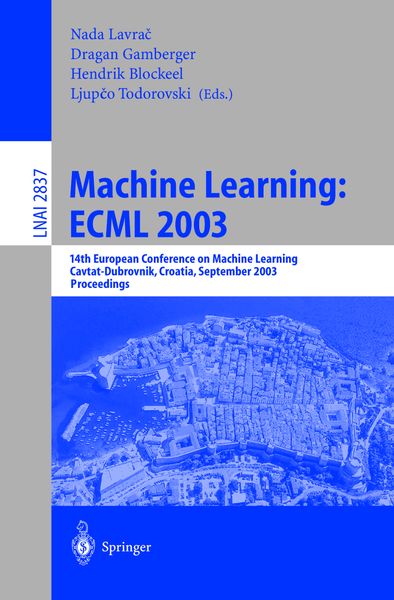
The proceedings of ECML/PKDD2003 are published in two volumes: the P- ceedings of the 14th European Conference on Machine Learning (LNAI 2837) and the Proceedings of the 7th European Conference on Principles and Practice of Knowledge Discovery in Databases (LNAI 2838). The two conferences were held on September 22–26, 2003 in Cavtat, a small tourist town in the vicinity of Dubrovnik, Croatia. As machine learning and knowledge discovery are two highly related ?elds, theco-locationofbothconferencesisbene?cialforbothresearchcommunities.In Cavtat, ECML and PKDD were co-located for the third time in a row, following the successful co-location of the two European conferences in Freiburg (2001) and Helsinki (2002). The co-location of ECML2003 and PKDD2003 resulted in a joint program for the two conferences, including paper presentations, invited talks, tutorials, and workshops. Out of 332 submitted papers, 40 were accepted for publication in the ECML2003proceedings,and40wereacceptedforpublicationinthePKDD2003 proceedings. All the submitted papers were reviewed by three referees. In ad- tion to submitted papers, the conference program consisted of four invited talks, four tutorials, seven workshops, two tutorials combined with a workshop, and a discovery challenge.
Portrait
Prof. Nada Lavrac (Jozef Stefan Institute, Slovenia) is Senior researcher at the Department of Knowledge Technologies at JSI (was Head of Department in 2014-2020), and Full Professor at University of Nova Gorica and International Postgraduate School Jozef Stefan (was Vice-Dean in 2016-2020). Her research interests are machine learning, data mining, text mining, knowledge management and computational creativity. She was chair of several conferences ICCC 2014, ILP 2012, AIME 2011, ..., co-chair of conferences including SOKD 2008-2010, ILP 2008, IDA 2007, DS 2006, ..., keynote speaker at KI2020, ADBIS2019, ISWC 2017, LPNMR 2015, JSMI 2014, ... She is/was member of editorial boards of Artificial Intelligence in Medicine, AI Communications, New Generation Computing, Applied AI, Machine Learning Journal and Data Mining and Knowledge Discovery. She is ECCAI/EurAI Fellow, was vice-president of ECCAI (1996-98), and served as member of the International Machine Learning Society board and Artificial Intelligence in Medicine board.Vid Podpecan, PhD, is a research associate at the Department of Knowledge Technologies at the Jozef Stefan Institute. He obtained his BSc in computer science from the University of Ljubljana in 2007, and his PhD from the Joz ef Stefan International Postgraduate School in 2013. His research interests include machine learning, computational systems biology, text mining and natural language processing, and robotics. He co-authored a scientific monograph and published the results of his research in more than 50 scientific publications. He is also actively involved in promoting STEAM with a focus on robotics, programming, and art for which he received an award by the Slovene Science Foundation.Prof Marko Robnik-Sikonja is Professor of Computer Science and Informatics at University of Ljubljana, Faculty of Computer and Information Science. His research interests span machine learning, data mining, natural languageprocessing, network analytics, and application of data science techniques. His most notable scientific results are from the areas of feature evaluation, ensemble learning, explainable artificial intelligence, data generation, and natural language analytics. He is (co)author of over 150 scientific publications that were cited more than 5,000 times, and three open-source R data mining packages. He participates in several national and international projects, regularly serves as programme committees member of top artificial intelligence and machine learning conferences, and is an editorial board member of seven international journals.Prof. Dr. Johannes Fürnkranz is a professor of knowledge engineering at the Technische Universität Darmstadt. He has chaired and served on the boards of the main journals and conferences in this field. His research interests include inductive rule learning, preference learning, game playing, web mining, and data mining in social science. Dr. Dragan Gamberger heads the Laboratory for Information Systems at the Rudjer Boskovic Institute in Zagreb. He has chaired the main related conference ECML/PKDD, and is a coauthor of the publicly available Data Mining Server. His research interests include data mining and the medical applications of descriptive rule induction. Prof. Dr. Nada Lavrac heads the Department of Knowledge Technologies at the Jozef Stefan Institute in Ljubljana. She is the author and editor of several books and proceedings in the field of data mining and machine learning, and she has chaired or served on the boards of the main related journals and conferences. Her research interests include machine learning, data mining, and inductive logic programming, and related applications in medicine, public health, bioinformatics, and the management of virtual enterprises. In 1997 she was awarded the Ambassador of Science of Slovenia prize, and in 2007 she was elected as an ECCAI Fellow.