KI-Beratung Beta

Gutscheinbedingungen

**Gültig bis 03.11.2026 auf fremdsprachige Bücher online auf thalia.at und in der Thalia App. Einzelne Artikel können ausgeschlossen sein. Ausgenommen sind preisgebundene Artikel & eBooks. Pro Einkauf einmal einlösbar. Click & Collect nur bei Onlinevorabzahlung möglich. Keine Barauszahlung. Nicht kombinierbar mit anderen Aktionen und Gutscheinen. Gutschein wird auf max. 500€ Bestellwert angerechnet. Nicht gültig für Geschenkkarten, Versandkosten und Services.

  • Produktbild: Diatoms and Lake Acidity
  • Produktbild: Diatoms and Lake Acidity
Band 29

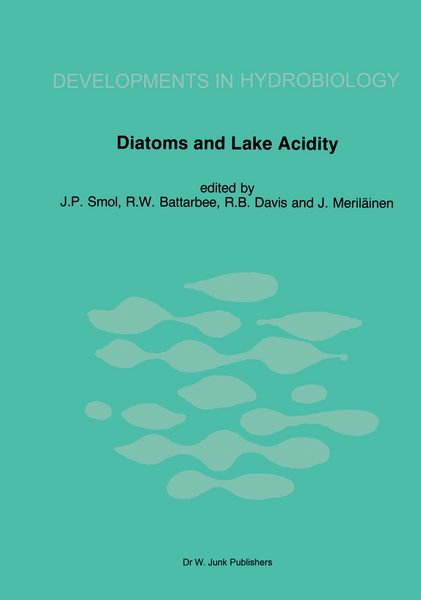
Diatoms and Lake Acidity Reconstructing pH from siliceous algal remains in lake sediments

219,99 €

inkl. gesetzl. MwSt., Versandkostenfrei


Beschreibung

Produktdetails

Einband

Gebundene Ausgabe

Erscheinungsdatum

31.03.1986

Abbildungen

VIII, 308 p.

Herausgeber

John P. Smol + weitere

Verlag

Springer Netherland

Seitenzahl

308

Maße (L/B/H)

26/18,3/2,2 cm

Gewicht

730 g

Auflage

1. Auflage

Sprache

Englisch

ISBN

978-90-6193-536-0

Beschreibung

Rezension

`
This book should be read by anyone interested in current methods, data, and conclusions in this area of investigation.
Diatoms and Lake

Acidity
is recommended reading for anyone wishing to assess current understanding of lake acidification, and especially recommended for those who wish to improve it.
'


Bioscience, 37 (1987)


`
Researchers and advanced students of lake acidification, paleolimnology, and phycology will find this book a valuable addition to their libraries.
'


The Quarterly Review of Biology, 62 (1987)


Produktdetails

Einband

Gebundene Ausgabe

Erscheinungsdatum

31.03.1986

Abbildungen

VIII, 308 p.

Herausgeber

Verlag

Springer Netherland

Seitenzahl

308

Maße (L/B/H)

26/18,3/2,2 cm

Gewicht

730 g

Auflage

1. Auflage

Sprache

Englisch

ISBN

978-90-6193-536-0

Herstelleradresse

Springer-Verlag GmbH
Europaplatz 3
69115 Heidelberg
DE

Email: ProductSafety@springernature.com

Noch keine Bewertungen vorhanden

Verfassen Sie die erste Bewertung zu diesem Artikel

Helfen Sie anderen Kundinnen und Kunden durch Ihre Meinung.

Kundinnen und Kunden meinen

Bewertungen (0)

  • Produktbild: Diatoms and Lake Acidity
  • Produktbild: Diatoms and Lake Acidity
  • 1. Gunnar Nygaard: A guiding influence on paleolimnological research.- 2. Diatoms as indicators of pH: An historical review.- one: Taxonomy.- 3. The genus Melosira from soft-water lakes with special reference to northern Michigan, Wisconsin and Minnesota.- 4. A new diatom species, Fragilaria acidobiontica, from acidic lakes in northeastern North America.- 5. Two forms of Tabellaria binalis (Ehr.) Grun. in two acid lakes in Galloway, Scotland.- two: Extant floras.- 6. Phytoplankton in selected LaCloche (Ontario) lakes, pH4.2–7.0, with special reference to algae as indicators of chemical characteristics.- 7. The representation of living diatom communities in deep-water sedimentary diatom assemblages in two Maine (U.S.A.) lakes.- 8. Spatial and temporal variability in periphytic diatom communities: Palaeoecological significance in an acidified lake.- three: Paleolimnological applications.- 9. Relationships between diatom assemblages in lake surface-sediments and limnological characteristics in southern Norway.- 10. Diatom evidence for neutralization in acid surface mine lakes.- 11. The recent history of a naturally acidic lake (Cone Pond, N.H.).- 12. East african diatoms and water pH.- 13. Acidification of small lakes in Finland documented by sedimentary diatom and chrysophycean remains.- 14. Applications of multivariate techniques to infer limnological conditions from diatom assemblages.- 15. A sedimentary diatom record of severe acidification in Lake Blamissusjon, N. Sweden, through natural soil processes.- 16. Diatom responses to acidification and lime treatment in a clear-water lake: Comparison of two methods of analysis of a diatom stratigraphy.- 17. Acidification of four lakes in the Federal Republic of Germany as reflected by diatom assemblages, cladoceran remainsand sediment chemistry.- 18. Late-glacial and Holocene acidity changes in Adirondack (N.Y.) lakes.- 19. Chrysophycean microfossils as indicators of lakewater pH.- four: Overview.- 20. The use of sedimentary remains of siliceous algae for inferring past chemistry of lake water – problems, potential and research needs.- Indices.- Index of lakes.- Index of genera.