KI-Beratung Beta

Gutscheinbedingungen

**Gültig bis 11.11.2026 auf Spielzeug, Schreibwaren, Filme, Geschenke & Trends, Musik, tolino eReader & Zubehör, Hörbücher und Hörbuch-Downloads, nicht preisgebundene Bücher und Kalender online auf thalia.at und in der Thalia App. Einzelne Artikel können ausgeschlossen sein. Aufgrund der Buchpreisbindung sind deutschsprachige Bücher und eBooks ausgenommen. Zusätzlich ausgenommen sind Abos & Flatrates, Games, Geschenkkarten/-boxen, Shelfies, Software, Zeitschriften sowie einzelne Artikel von tonies®. Pro Einkauf einmal einlösbar. Click & Collect nur bei Onlinevorabzahlung möglich. Keine Barauszahlung. Nicht kombinierbar mit anderen Aktionen und Gutscheinen. Gutschein wird auf max. 500€ Bestellwert angerechnet. Nicht gültig für Versandkosten und Services.

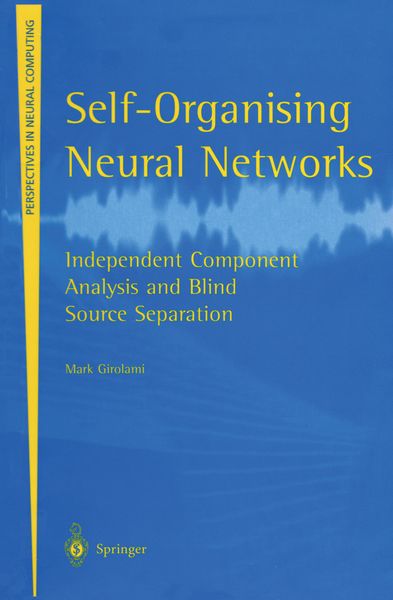
  • Produktbild: Self-Organising Neural Networks
  • Produktbild: Self-Organising Neural Networks

Self-Organising Neural Networks Independent Component Analysis and Blind Source Separation

99,99 €

inkl. gesetzl. MwSt., Versandkostenfrei


Beschreibung

The conception of fresh ideas and the development of new techniques for Blind Source Separation and Independent Component Analysis have been rapid in recent years. It is also encouraging, from the perspective of the many scientists involved in this fascinating area of research, to witness the growing...

Beschreibung

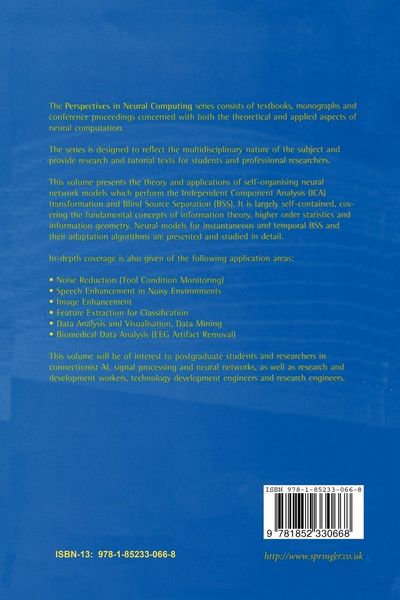
The conception of fresh ideas and the development of new techniques for Blind Source Separation and Independent Component Analysis have been rapid in recent years. It is also encouraging, from the perspective of the many scientists involved in this fascinating area of research, to witness the growing list of successful applications of these methods to a diverse range of practical everyday problems. This growth has been due, in part, to the number of promising young and enthusiastic researchers who have committed their efforts to expanding the current body of knowledge within this field of research. The author of this book is among one of their number. I trust that the present book by Dr. Mark Girolami will provide a rapid and effective means of communicating some of these new ideas to a wide international audience and that in turn this will expand further the growth of knowledge. In my opinion this book makes an important contribution to the theory of Independent Component Analysis and Blind Source Separation. This opens a range of exciting methods, techniques and algorithms for applied researchers and practitioner engineers, especially from the perspective of artificial neural networks and information theory. It has been interesting to see how rapidly the scientific literature in this area has grown.

Produktdetails

Einband

Taschenbuch

Erscheinungsdatum

25.06.1999

Abbildungen

IX, 271 p. 9 illus.

Verlag Springer London

Produktdetails

Einband

Taschenbuch

Erscheinungsdatum

25.06.1999

Abbildungen

IX, 271 p. 9 illus.

Verlag Springer London
Seitenzahl

271

Maße (L/B/H)

23,5/15,5/1,6 cm

Gewicht

435 g

Auflage

1st Edition

Sprache

Englisch

ISBN

978-1-85233-066-8

Herstelleradresse

Springer-Verlag KG
Sachsenplatz 4-6
1201 Wien
AT

Email: ProductSafety@springernature.com

Noch keine Bewertungen vorhanden

Verfassen Sie die erste Bewertung zu diesem Artikel

Helfen Sie anderen Kundinnen und Kunden durch Ihre Meinung.

Kundinnen und Kunden meinen

Bewertungen (0)

  • Produktbild: Self-Organising Neural Networks
  • Produktbild: Self-Organising Neural Networks
  • 1. Introduction.- 1.1 Self-Organisation and Blind Signal Processing.- 1.2 Outline of Book Chapters.- 2. Background to Blind Source Separation.- 2.1 Problem Formulation.- 2.2 Entropy and Information.- 2.3 A Contrast Function for ICA.- 2.4 Cumulant Expansions of Probability Densities and Higher Order Statistics.- 2.5 Gradient Based Function Optimisation.- 3. Fourth Order Cumulant Based Blind Source Separation.- 3.1 Early Algorithms and Techniques.- 3.2 The Method of Contrast Minimisation.- 3.3 Adaptive Source Separation Methods.- 3.4 Conclusions.- 4. Self-Organising Neural Networks.- 4.1 Linear Self-Organising Neural Networks.- 4.2 Non-Linear Self-Organising Neural Networks.- 4.3 Conclusions.- 5. The Non-Linear PCA Algorithm and Blind Source Separation.- 5.1 Introduction.- 5.2 Non-Linear PCA Algorithm and Source Separation.- 5.3 Non-Linear PCA Algorithm Cost Function.- 5.4 Non-Linear PCA Algorithm Activation Function.- 5.5 Conclusions.- 6. Non-Linear Feature Extraction and Blind Source Separation.- 6.1 Introduction.- 6.2 Structure Identification in Multivariate Data.- 6.3 Neural Network Implementation of Exploratory Projection Pursuit.- 6.4 Neural Exploratory Projection Pursuit and Blind Source Separation.- 6.5 Kurtosis Extrema.- 6.6 Finding Interesting and Independent Directions.- 6.7 Finding Multiple Interesting and Independent Directions Using Symmetric Feedback and Adaptive Whitening.- 6.8 Finding Multiple Interesting and Independent Directions Using Hierarchic Feedback and Adaptive Whitening.- 6.9 Simulations.- 6.10 Adaptive BSS Using a Deflationary EPP Network.- 6.11 Conclusions.- 7. Information Theoretic Non-Linear Feature Extraction And Blind Source Separation.- 7.1 Introduction.- 7.2 Information Theoretic Indices for EPP.- 7.3 Maximum Negentropy Learning.- 7.4 General Maximum Negentropy Learning.- 7.5 Stability Analysis of Generalised Algorithm.- 7.6 Simulation Results.- 7.7 Conclusions.- 8. Temporal Anti-Hebbian Learning.- 8.1 Introduction.- 8.2 Blind Source Separation of Convolutive Mixtures.- 8.3 Temporal Linear Anti-Hebbian Model.- 8.4 Comparative Simulation.- 8.5 Review of Existing Work on Adaptive Separation of Convolutive Mixtures.- 8.6 Maximum Likelihood Estimation and Source Separation.- 8.7 Temporal Anti-Hebbian Learning Based on Maximum Likelihood Estimation.- 8.8 Comparative Simulations Using Varying PDF Models.- 8.9 Conclusions.- 9. Applications.- 9.1 Introduction.- 9.2 Industrial Applications.- 9.3 Biomedical Applications.- 9.4 ICA: A Data Mining Tool.- 9.5 Experimental Results.- 9.6 Conclusions.- References.