• Produktbild: Quantum Physics
  • Produktbild: Quantum Physics
- 11%

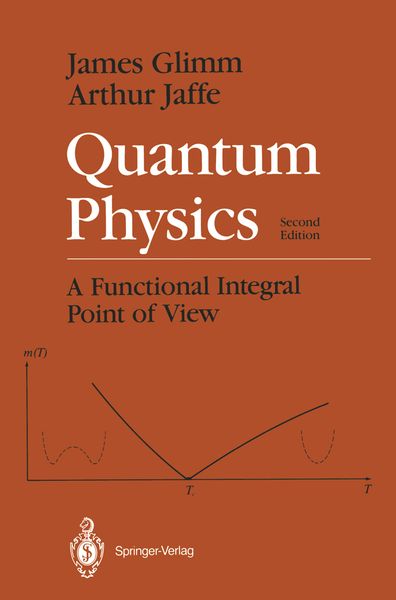
Quantum Physics A Functional Integral Point of View

11% sparen

154,99 € UVP 175,99 €

inkl. gesetzl. MwSt., Versandkostenfrei


Beschreibung

Produktdetails

Einband

Taschenbuch

Erscheinungsdatum

04.05.1987

Verlag

Springer Us

Seitenzahl

535

Maße (L/B/H)

23,5/15,5/3 cm

Gewicht

838 g

Auflage

Second Edition 1987

Sprache

Englisch

ISBN

978-0-387-96477-5

Beschreibung

Produktdetails

Einband

Taschenbuch

Erscheinungsdatum

04.05.1987

Verlag

Springer Us

Seitenzahl

535

Maße (L/B/H)

23,5/15,5/3 cm

Gewicht

838 g

Auflage

Second Edition 1987

Sprache

Englisch

ISBN

978-0-387-96477-5

Herstelleradresse

Springer-Verlag GmbH
Tiergartenstr. 17
69121 Heidelberg
DE

Email: ProductSafety@springernature.com

Kundinnen und Kunden meinen

0 Bewertungen

Informationen zu Bewertungen

Zur Abgabe einer Bewertung ist eine Anmeldung im Konto notwendig. Die Authentizität der Bewertungen wird von uns nicht überprüft. Wir behalten uns vor, Bewertungstexte, die unseren Richtlinien widersprechen, entsprechend zu kürzen oder zu löschen.

Die Bewertungen sind nach Format, Anzahl Sterne und Datum sortiert.

Verfassen Sie die erste Bewertung zu diesem Artikel

Helfen Sie anderen Kund*innen durch Ihre Meinung

Kundinnen und Kunden meinen

0 Bewertungen filtern

  • Produktbild: Quantum Physics
  • Produktbild: Quantum Physics
  • I An Introduction to Modern Physics.- 1 Quantum Theory.- 1.1 Overview.- 1.2 Classical Mechanics.- 1.3 Quantum Mechanics.- 1.4 Interpretation.- 1.5 The Simple Harmonic Oscillator.- 1.6 Coulomb Potentials.- 1.7 The Hydrogen Atom.- 1.8 The Need for Quantum Fields.- 2 Classical Statistical Mechanics.- 2.1 Introduction.- 2.2 The Classical Ensembles.- 2.3 The Ising Model and Lattice Fields.- 2.4 Series Expansion Methods.- 3 The Feynman-Kac Formula.- 3.1 Wiener Measure.- 3.2 The Feynman-Kac Formula.- 3.3 Uniqueness of the Ground State.- 3.4 The Renormalized Feynman-Kac Formula.- 4 Correlation Inequalities and the Lee-Yang Theorem.- 4.1 Griffiths Inequalities.- 4.2 The Infinite Volume Limit.- 4.3 ?4 Inequalities.- 4.4 The FKG Inequality.- 4.5 The Lee-Yang Theorem.- 4.6 Analyticity of the Free Energy.- 4.7 Two Component Spins.- 5 Phase Transitions and Critical Points.- 5.1 Pure and Mixed Phases.- 5.2 The Mean Field Picture.- 5.3 Symmetry, Breaking.- 5.4 The Droplet Model and Peierls’ Argument.- 5.5 Some Examples.- 6 Field Theory.- 6.1 Axioms.- (i) Euclidean Axioms.- (ii) Minkowski Space Axioms.- 6.2 The Free Field.- 6.3 Fock Space and Wick Ordering.- 6.4 Canonical Quantization.- 6.5 Fermions.- 6.6 Interacting Fields.- Appendix to Part I. Hilbert Space Operators and Functional Integrals.- A.1 Bounded and Unbounded Operators on Hilbert Space.- A.2 Positive Operators and Bilinear Forms.- A.3 Trace Class Operators and Nuclear Spaces.- A.4 Gaussian Measures.- A.5 The Lie Product Theorem.- A.6 The Bochner-Minlos Theorem.- A.7 Stochastic Integrals.- A.8 Stochastic Differential Equations.- II Function Space Integrals.- 7 Covariance Operator = Green’s Function = Resolvent Kernel = Euclidean Propagator = Fundamental Solution.- 7.1 Introduction.- 7.2 The Free Covariance.- 7.3 Periodic Boundary Conditions.- 7.4 Neumann Boundary Conditions.- 7.5 Dirichlet Boundary Conditions.- 7.6 Change of Boundary Conditions.- 7.7 Covariance Operator Inequalities.- 7.8 More General Dirichlet Data.- 7.9 Regularity of CB.- 7.10 Reflection Positivity.- 8 Quantization = Integration over Function Space.- 8.1 Introduction.- 8.2 Feynman Graphs.- 8.3 Wick Products.- 8.4 Formal Perturbation Theory.- 8.5 Estimates on Gaussian Integrals.- 8.6 Non-Gaussian Integrals, d = 2.- 8.7 Finite Dimensional Approximations.- 9 Calculus and Renormalization on Function Space.- 9.1 A Compilation of Useful Formulas.- (i) Wick Product Identities.- (ii) Gaussian Integrals.- (iii) Integration by Parts.- (iv) Limits of Measures.- 9.2 Infinitesimal Change of Covariance.- 9.3 Quadratic Perturbations.- 9.4 Perturbative Renormalization.- 9.5 Lattice Laplace and Covariance Operators.- 9.6 Lattice Approximation of P(?)2 Measures.- 10 Estimates Independent of Dimension.- 10.1 Introduction.- 10.2 Correlation Inequalities for P(?)2 Fields.- 10.3 Dirichlet or Neumann Monotonicity and Decoupling.- 10.4 Reflection Positivity.- 10.5 Multiple Reflections.- 10.6 Nonsymmetric Reflections.- 11 Fields Without Cutoffs.- 11.1 Introduction.- 11.2 Monotone Convergence.- 11.3 Upper Bounds.- 12 Regularity and Axioms.- 12.1 Introduction.- 12.2 Integration by Parts.- 12.3 Nonlocal ?j Bounds.- 12.4 Uniformity in the Volume.- 12.5 Regularity of the P(?)2 Field.- III The Physics of Quantum Fields.- 13 Scattering Theory: Time-Dependent Methods.- 13.1 Introduction.- 13.2 Multiparticle Potential Scattering.- 13.3 The Wave Operator for Quantum Fields.- 13.4 Wave Packets for Free Particles.- 13.5 The Haag-Ruelle Theory.- 14 Scattering Theory: Time-Independent Methods.- 14.1 Time-Ordered Correlation Functions.- 14.2 The S Matrix.- 14.3 Renormalization.- 14.4 The Bethe-Salpeter Kernel.- 15 The Magnetic Moment of the Electron.- 15.1 Classical Magnetic Moments.- 15.2 The Fine Structure of the Hydrogen Atom and the Dirac Equation.- 15.3 The Dirac Theory.- 15.4 The Anomalous Moment.- 15.5 The Hyperfine Structure and the Lamb Shift of the Hydrogen Atom.- 16 Phase Transitions.- 16.1 Introduction.- 16.2 The Two Phase Region.- 16.3 Symmetry Unbroken, d = 2.- 16.4 Symmetry Broken, 3 ? d.- 17 The ?4 Critical Point.- 17.1 Elementary Considerations.- 17.2 The Absence of Even Bound States.- 17.3 A Bound on the Coupling Constant ?phys.- 17.4 Existence of Particles and a Bound on dm2/ d?.- 17.5 Existence of the ?4 Critical Point.- 17.6 Continuity of dµ at the Critical Point.- 17.7 Critical Exponents.- 17.8 ? ? 1.- 17.9 The Scaling Limit.- 17.10 The Conjecture ?(6) ? 0.- 18 The Cluster Expansion.- 18.1 Introduction.- 18.2 The Cluster Expansion.- 18.3 Clustering and Analyticity.- 18.4 Convergence: The Main Ideas.- 18.5 An Equation of Kirkwood-Salsburg Type.- 18.6 Covariance Operators.- 18.7 Convergence: The Proof Completed.- 19 From Path Integrals to Quantum Mechanics.- 19.1 Reconstruction of Quantum Fields.- 19.2 The Feynman-Kac Formula.- 19.3 Self-Adjoint Fields.- 19.4 Commutators.- 19.5 Lorentz Covariance.- 19.6 Locality.- 19.7 Uniqueness of the Vacuum.- 20 The Polymer Expansion.- 20.1 Introduction.- 20.2 Activity Expansions and Connected Polymers.- 20.3 Convergence of the Polymer Expansion.- 20.4 The Tree Graph Decay of Correlations and the Existence of the Free Energy.- 20.5 Polymer Expansion Examples.- (i) The High Temperature Ising Model.- (ii) The Weak Coupling of Euclidean Quantum Fields.- (iii) Mayer Expansion of the Grand Canonical Partition Function.- (iv) Low Temperature Ising Model.- 21 Random Path Representations.- 21.1 Random Walks and the Laplacian.- 21.2 Local Stopping Times.- 21.3 Gaussian Integration by Parts.- 21.4 Non-Gaussian Integration by Parts.- 21.5 ?4Correlation Inequalities.- 21.6 The ?4 Noninteraction Theorem.- 22 Constructive Gauge Theory and Phase Cell Localization.- 22.1 Introduction.- 22.2 Regularization and Lattice Approximations.- 22.3 Reflection Positivity of the Lattice Approximation.- 22.4 Phase Cell Localization and Exact Renormalization Transformations.- 22.5 Infra-Red Behavior.- 22.6 Lattice Maxwell Theory—An Example of Renormalization.- 22.7 Nonabelian Gauge Models.- 23 Further Directions.- 23.1 The $$\phi _3^4 $$ Model.- 23.2 Borel Summability.- 23.3 Euclidean Fermi Fields.- 23.4 Yukawa Interactions.- 23.5 Low Temperature Expansions and Phase Transitions.- 23.6 Debye Screening and the Sine-Gordon Transformation.- 23.7 Dipoles Don’t Screen.- 23.8 Solitons.