KI-Beratung Beta

Gutscheinbedingungen

**Gültig am 25.11.2026 auf fremdsprachige Bücher online auf thalia.at und in der Thalia App. Einzelne Artikel können ausgeschlossen sein. Ausgenommen sind preisgebundene Artikel & eBooks. Pro Einkauf einmal einlösbar. Click & Collect nur bei Onlinevorabzahlung möglich. Keine Barauszahlung. Nicht kombinierbar mit anderen Aktionen und Gutscheinen. Gutschein wird auf max. 500€ Bestellwert angerechnet. Nicht gültig für Geschenkkarten, Versandkosten und Services.

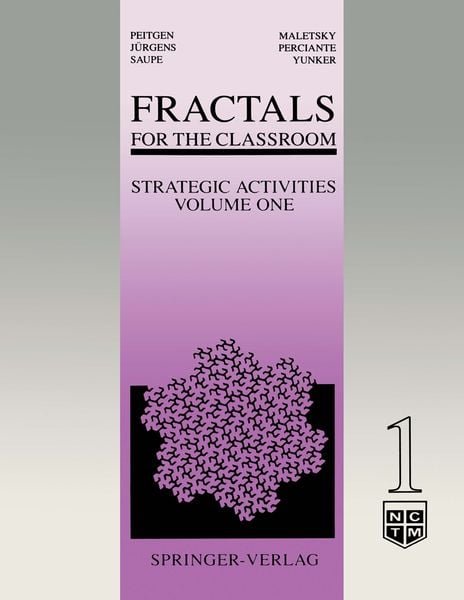
  • Produktbild: Fractals for the Classroom: Strategic Activities Volume One
  • Produktbild: Fractals for the Classroom: Strategic Activities Volume One

Fractals for the Classroom: Strategic Activities Volume One

49,99 €

inkl. gesetzl. MwSt., Versandkostenfrei


Beschreibung

There are many reasons for writing this first volume of strategic activities on fractals. The most pervasive is the compelling desire to provide students of mathematics with a set of accessible, hands-on experiences with fractals and their underlying mathematical principles and characteristics. Another...

Beschreibung

There are many reasons for writing this first volume of strategic activities on fractals. The most pervasive is the compelling desire to provide students of mathematics with a set of accessible, hands-on experiences with fractals and their underlying mathematical principles and characteristics. Another is to show how fractals connect to many different aspects of mathematics and how the study of fractals can bring these ideas together. A third is to share the beauty of their structure and shape both through what the eye sees and what the mind visualizes. Fractals have captured the attention, enthusiasm, and interest of many people around the world. To the casual observer, their color, beauty, and geometric structure captivates the visual senses like few other things they have ever experienced in mathematics. To the computer scientist, fractals offer a rich environment in which to explore, create, and build a new visual world as an artist creating a new work. To the student, fractals bring mathematics out of past history and into the twenty-first century. To the mathematics teacher, fractals offer a unique, new opportunity to illustrate both the dynamics of mathematics and its many connecting links.

Produktdetails

Einband

Taschenbuch

Erscheinungsdatum

18.04.1991

Abbildungen

XII, 129 p. 37 illus. With 9 slides.

Verlag Springer Us

Produktdetails

Einband

Taschenbuch

Erscheinungsdatum

18.04.1991

Abbildungen

XII, 129 p. 37 illus. With 9 slides.

Verlag Springer Us
Seitenzahl

129

Maße (L/B/H)

27,9/21/0,9 cm

Gewicht

370 g

Auflage

Softcover reprint of the original 1st ed. 1991

Sprache

Englisch

ISBN

978-0-387-97346-3

Herstelleradresse

Springer-Verlag KG
Sachsenplatz 4-6
1201 Wien
AT

Email: ProductSafety@springernature.com

Noch keine Bewertungen vorhanden

Verfassen Sie die erste Bewertung zu diesem Artikel

Helfen Sie anderen Kundinnen und Kunden durch Ihre Meinung.

Kundinnen und Kunden meinen

Bewertungen (0)

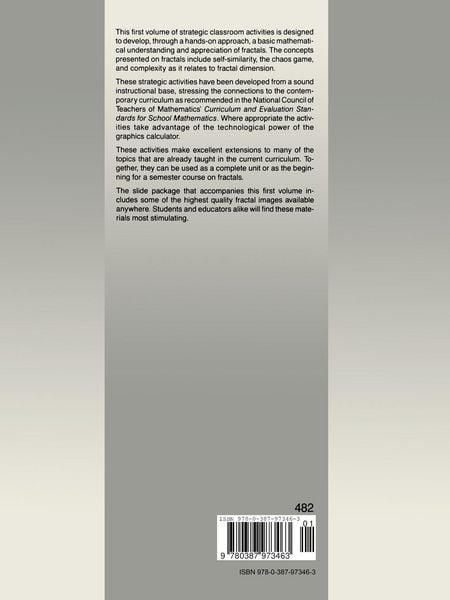
  • Produktbild: Fractals for the Classroom: Strategic Activities Volume One
  • Produktbild: Fractals for the Classroom: Strategic Activities Volume One
  • Unit 1 Self-Similarity.- Key Objectives, Notions, and Connections.- Mathematical Background.- Using the Activities Sheets.- 1.1 Sierpinski Triangle and Variations.- 1.2 Number Patterns and Variations.- 1.3 Square Gasket.- 1.4 Sierpinski Tetrahedron.- 1.5 Trees.- 1.6 Self-Similarity: Basic Properties.- 1.7 Self-Similarity: Specifics.- 1.8 Box Self-Similarity: Grasping the Limit.- 1.9 Pascal’s Triangle.- 1.10 Sierpinski Triangle Revisited.- 1.11 New Coloring Rules and Patterns.- 1.12 Cellular Automata.- Unit 2 The Chaos Game.- Key Objectives, Notions, and Connections.- Mathematical Background.- Using the Activities Sheets.- 2.1 The Chaos Game.- 2.2 Simulating the Chaos Game.- 2.3 Addresses in Triangles and Trees.- 2.4 Chaos Game and Sierpinski Triangle.- 2.5 Chaos Game Analysis.- 2.6 Sampling and the Chaos Game.- 2.7 Probability and the Chaos Game.- 2.8 Trees and the Cantor Set.- 2.9 Trees and the Sierpinski Triangle.- Unit 3 Complexity.- Key Objectives, Notions, and Connections.- Mathematical Background.- Using the Activities Sheets.- 3.1 Construction and Complexity.- 3.2 Fractal Curves.- 3.3 Curve Fitting.- 3.4 Curve Fitting Using Logs.- 3.5 Curve Fitting Using Technology.- 3.6 Box Dimension.- 3.7 Box Dimension and Coastlines.- 3.8 Box Dimension for Self-Similar Objects.- 3.9 Similarity Dimension.- Answers.