KI-Beratung Beta

Gutscheinbedingungen

**Gültig am 20.11.2026 ab einem Mindestbestellwert von 30€ auf Spielzeug, Schreibwaren, Filme, Geschenke & Trends, Musik, tolino eReader & Zubehör, Hörbücher und Hörbuch-Downloads, nicht preisgebundene Bücher und Kalender online auf thalia.at und in der Thalia App. Einzelne Artikel können ausgeschlossen sein. Aufgrund der Buchpreisbindung sind deutschsprachige Bücher und eBooks ausgenommen. Zusätzlich ausgenommen sind Abos & Flatrates, Games, Geschenkkarten/-boxen, Shelfies, Software, Zeitschriften sowie einzelne Artikel von tonies®. Pro Einkauf einmal einlösbar. Click & Collect nur bei Onlinevorabzahlung möglich. Keine Barauszahlung. Nicht kombinierbar mit anderen Aktionen und Gutscheinen. Gutschein wird auf max. 500€ Bestellwert angerechnet. Nicht gültig für Versandkosten und Services. Preisgebundene Artikel sind vom Mindestbestellwert ausgeschlossen.

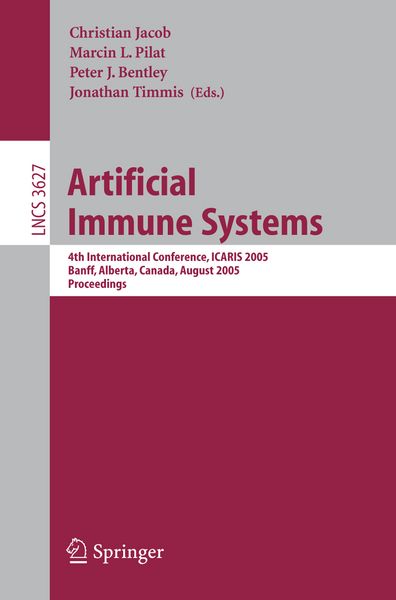
Produktbild: Artificial Immune Systems
Band 3627

Artificial Immune Systems 4th International Conference, ICARIS 2005, Banff, Alberta, Canada, August 14-17, 2005, Proceedings

51,99 €

inkl. gesetzl. MwSt., Versandkostenfrei


Beschreibung

Your immune system is unique. It is in many waysas complex as your brain,but itisnotcentredinonelocation,likethebrain.Itisnotasingleorgan itconsists ofmanydi?erentcelltypes,diversemethods ofintercellularcommunication,and many di?erent organs. Its functionality is blurred throughout you we can t extract...

Beschreibung

Your immune system is unique. It is in many waysas complex as your brain,but itisnotcentredinonelocation,likethebrain.Itisnotasingleorgan itconsists ofmanydi?erentcelltypes,diversemethods ofintercellularcommunication,and many di?erent organs. Its functionality is blurred throughout you we can t extract the immune system, or point to where it begins and ends. The immune system is not separablefrom the system it protects. It has integrallinks to every organ of our bodies. Thishasradicalimplicationsforthe?eldofArti?cialImmuneSystems(AIS), that we are only now beginning to comprehend. One of the ?rst insights is that modelling the immune system, or developing any kind of immune algorithm, is di?cult. The immune system is one aspect of biology that we ?nd di?cult to apply simple reductionist explanations to. We can very successfully extract s- processes of the whole and create immune algorithms based on those processes. But we are always aware that we are missing the whole story. This is leading to more holistic views of immune algorithm development: theoretical analyses of how the sub-components contribute to the whole, and identi?cation of missing elements. Arti?cial immune systems are now beginning to incorporate ideas of innate as well as adaptive immunity, more complex intercellular communication mechanisms, endocrine and neural interfaces, concepts of tissue and broader ideas of organism and environment. SoperhapsthemostexcitingimplicationforthefutureofAISisthatthese- searchersareontheforefrontofunconventionalcomputing mergingthe bou- aries between biology and traditional computation to achieve new emergent, embodied and distributed processing capabilities.

Produktdetails

Einband

Taschenbuch

Erscheinungsdatum

04.08.2005

Abbildungen

XII, 508 p.

Herausgeber Christian Jacob + weitere

Produktdetails

Einband

Taschenbuch

Erscheinungsdatum

04.08.2005

Abbildungen

XII, 508 p.

Herausgeber
Verlag Springer Berlin
Seitenzahl

508

Maße (B/H)

15,5/23,5 cm

Gewicht

788 g

Sprache

Englisch

ISBN

978-3-540-28175-7

Herstelleradresse

Springer-Verlag GmbH
Heidelberger Platz 3
14197 Berlin
Deutschland
Email: sdc-bookservice@springer.com
Url: www.springer.com
Telephone: +49 30 827870
Fax: +49 30 8214091

Noch keine Bewertungen vorhanden

Verfassen Sie die erste Bewertung zu diesem Artikel

Helfen Sie anderen Kundinnen und Kunden durch Ihre Meinung.

Kundinnen und Kunden meinen

Bewertungen (0)

  • Produktbild: Artificial Immune Systems
  • Conceptual, Formal, and Theoretical Frameworks.- Fugue: An Interactive Immersive Audiovisualisation and Artwork Using an Artificial Immune System.- Clonal Selection Algorithms: A Comparative Case Study Using Effective Mutation Potentials.- Not All Balls Are Round: An Investigation of Alternative Recognition-Region Shapes.- A Generic Framework for Population-Based Algorithms, Implemented on Multiple FPGAs.- An AIS-Based Dynamic Routing (AISDR) Framework.- Biomolecular Immune-Computer: Theoretical Basis and Experimental Simulator.- What Have Gene Libraries Done for AIS?.- Why the First Glass of Wine Is Better Than the Seventh.- Towards a Conceptual Framework for Innate Immunity.- Inspiration for the Next Generation of Artificial Immune Systems.- Two Ways to Grow Tissue for Artificial Immune Systems.- Introducing Dendritic Cells as a Novel Immune-Inspired Algorithm for Anomaly Detection.- Cooperative Automated Worm Response and Detection ImmuNe ALgorithm(CARDINAL) Inspired by T-Cell Immunity and Tolerance.- Immunoinformatics.- Mathematical Modeling of Immune Suppression.- Evaluating Theories of Immunological Memory Using Large-Scale Simulations.- The Quaternion Model of Artificial Immune Response.- A Comparative Study on Modeling Strategies for Immune System Dynamics Under HIV-1 Infection.- Theoretical and Experimental Studies on Artificial Immune Systems.- Handling Constraints in Global Optimization Using an Artificial Immune System.- Multiobjective Optimization by a Modified Artificial Immune System Algorithm.- A Comparative Study of Real-Valued Negative Selection to Statistical Anomaly Detection Techniques.- Immunity from Spam: An Analysis of an Artificial Immune System for Junk Email Detection.- Adaptive Radius Immune Algorithm for Data Clustering.- Quantum-Inspired Immune Clonal Algorithm.- A Markov Chain Model of the B-Cell Algorithm.- Fuzzy Continuous Petri Net-Based Approach for Modeling Helper T Cell Differentiation.- A Peer-to-Peer Blacklisting Strategy Inspired by Leukocyte-Endothelium Interaction.- Self-regulating Method for Model Library Based Artificial Immune Systems.- Polymorphism and Danger Susceptibility of System Call DASTONs.- Applications of Artificial Immune Systems.- General Suppression Control Framework: Application in Self-balancing Robots.- Application of an Artificial Immune System in a Compositional Timbre Design Technique.- Immunising Automated Teller Machines.- Fault Detection Algorithm for Telephone Systems Based on the Danger Theory.- Design and Simulation of a Biological Immune Controller Based on Improved Varela Immune Network Model.- Applying the Clonal Selection Principle to Find Flexible Job-Shop Schedules.- The Medical Applications of Attribute Weighted Artificial Immune System (AWAIS): Diagnosis of Heart and Diabetes Diseases.- Designing Ensembles of Fuzzy Classification Systems: An Immune-Inspired Approach.- Application Areas of AIS: The Past, The Present and The Future.