Gutscheinbedingungen

**Gültig bis 06.07.2026 auf fremdsprachige Bücher online auf thalia.at, in der Thalia App ab einem Mindestbestellwert von 30€ und in allen Thalia Buchhandlungen in Österreich. In den Buchhandlungen nur gültig auf lagernde Ware. Einzelne Artikel können ausgeschlossen sein. Ausgenommen sind preisgebundene Artikel & eBooks. Pro Einkauf einmal einlösbar. Nur gültig gegen Vorlage oder im Onlineshop hinterlegter Bonuscard. Infos zur Einlösung in der Buchhandlung sind auf der Bonuscard-Vorteilspreisseite zu finden. Click & Collect nur bei Onlinevorabzahlung möglich. Keine Einlösung bei Scan & Go-Bezahlung. Keine Barauszahlung. Nicht kombinierbar mit anderen Aktionen und Gutscheinen. Gutschein wird auf max. 500€ Bestellwert angerechnet. Nicht gültig für Versandkosten und Services.

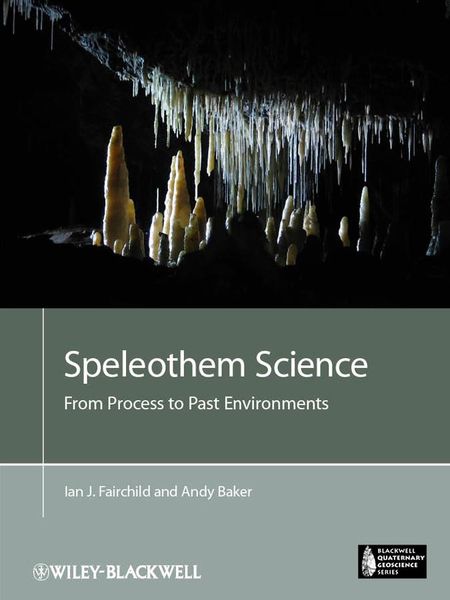
Produktbild: Speleothem Science

Speleothem Science From Process to Past Environments

149,99 €

inkl. gesetzl. MwSt., Versandkostenfrei


Beschreibung

Produktdetails

Einband

Gebundene Ausgabe

Erscheinungsdatum

30.04.2012

Verlag

John Wiley & Sons

Seitenzahl

448

Maße (L/B/H)

25,4/19,5/2,7 cm

Gewicht

1181 g

Auflage

1. Auflage

Sprache

Englisch

ISBN

978-1-4051-9620-8

Beschreibung

Rezension

"Speleothem Science sets high standards for any successor. It is a must-have for researchers working on karst geology and terrestrial Quaternary palaeoclimatology. For all those who always wanted to know how dripstones "grow", why speleothems rival ice cores as top climate archives, or just want to learn the difference between a stalagmite and a stalactite: get your hands on this book." (Zeitschrift für Geomorphologie, 1 December 2013)
 
"The book is comprehensive; it brings together all the relevant disciplines (geology, biology, hydrology, chemistry...) and, whichever way you cut it, Fairchild and Baker have succeeded in bringing an important subject to a wider readership. Speleothem Science is highly recommended." (Descent, 1 August 2013)
 
"The target readership of Speleothem Science is threefold. First, researchers who are already working with the stalagmite archive can widen and considerably deepen their knowledge in sub-disciplines not already covered in their own training. Second, climate researchers who are not yet working on speleothem should be catapulted to the front-end once they will have studied the book together with the relating bench mark papers. Third, graduate students who are looking for a topic for their PhD dissertation. They might have found their textbook." (Computers & Geosciences, 27 January 2013)
 
"The volume will no doubt serve as a fine textbook and reference volume. A companion website provides access to slides of all figures and tables. Summing Up: Essential. Upper-division undergraduates through professionals." (Choice, 1 December 2012) "I highly recommend the landmark and very thorough book Speleothem Science: From Process to Past Environments by Ian J. Fairchild, Ph.D., and Andy Baker, Ph.D., to any students and professional scientists from a wide range of disciplines, who are seeking a holistic and comprehensive examination of the many topics and areas of research and study surrounding speleothems, climate, caves, and Quaternary science." (Blog Business World, 8 May 2012)

Zitat

"The book is comprehensive; it brings together all the relevant disciplines (geology, biology, hydrology, chemistry...) and, whichever way you cut it, Fairchild and Baker have succeeded in bringing an important subject to a wider readership. Speleothem Science is highly recommended." ( Descent , 1 August 2013) "The target readership of Speleothem Science is threefold. First, researchers who are already working with the stalagmite archive can widen and considerably deepen their knowledge in sub-disciplines not already covered in their own training. Second, climate researchers who are not yet working on speleothem should be catapulted to the front-end once they will have studied the book together with the relating bench mark papers. Third, graduate students who are looking for a topic for their PhD dissertation. They might have found their textbook." ( Computers & Geosciences , 27 January 2013) "The volume will no doubt serve as a fine textbook and reference volume. A companion website provides access to slides of all figures and tables. Summing Up: Essential. Upper-division undergraduates through professionals." ( Choice , 1 December 2012) "I highly recommend the landmark and very thorough book Speleothem Science: From Process to Past Environments by Ian J. Fairchild, Ph.D., and Andy Baker, Ph.D., to any students and professional scientists from a wide range of disciplines, who are seeking a holistic and comprehensive examination of the many topics and areas of research and study surrounding speleothems, climate, caves, and Quaternary science." ( Blog Business World , 8 May 2012)

Produktdetails

Einband

Gebundene Ausgabe

Erscheinungsdatum

30.04.2012

Verlag

John Wiley & Sons

Seitenzahl

448

Maße (L/B/H)

25,4/19,5/2,7 cm

Gewicht

1181 g

Auflage

1. Auflage

Sprache

Englisch

ISBN

978-1-4051-9620-8

Herstelleradresse

Libri GmbH
Europaallee 1
36244 Bad Hersfeld
DE

Email: GPSR Kontakt

Noch keine Bewertungen vorhanden

Verfassen Sie die erste Bewertung zu diesem Artikel

Helfen Sie anderen Kundinnen und Kunden durch Ihre Meinung.

Kundinnen und Kunden meinen

Bewertungen (0)

Die Leseprobe wird geladen.
  • Produktbild: Speleothem Science
  • Preface, xi

    Acknowledgements, xiii

    I Scientifi c and geological context, 1

    1 Introduction to speleothems and systems, 3

    1.1 What is all the fuss about?, 3

    1.2 How is this book organized?, 11

    1.3 Concepts and approaches of system science, 13

    1.4 The speleothem factory within the karst system, 18

    2 Carbonate and karst cave geology, 28

    2.1 Carbonates in the Earth system over geological time, 28

    2.2 Lithologies of carbonate host rocks, 34

    2.3 Carbonate diagenesis and eogenetic karst, 47

    2.4 Speleogenesis in mesogenetic and telogenetic karst (with contributions from John Gunn and David J Lowe), 55

    2.5 Cave infilling, 64

    2.6 Conclusion, 71

    3 Surface environments: climate, soil and vegetation, 73

    3.1 The modern climate system, 73

    3.2 Water isotopes in the atmosphere, 84

    3.3 Soils of karst regions, 94

    3.4 Vegetation of karst regions, 102

    3.5 Synthesis: inputs to the incubator, 104

    II Transfer processes in karst, 105

    4 The speleothem incubator, 107

    4.1 Introduction to speleophysiology, 107

    4.2 Physical parameters and fl uid behaviour, 109

    4.3 Water movement, 114

    4.4 Air circulation, 122

    4.5 Heat flux (authored by David Domínguez-Villar), 137

    4.6 Synthesis: cave climatologies, 145

    5 Inorganic water chemistry, 148

    5.1 Sampling protocols for water chemistry, 148

    5.2 The carbonate system, 152

    5.3 Weathering, trace elements and isotopes, 156

    5.4 Carbon isotopes, 173

    5.5 Evolution of cave water chemistry: modelling sources and environmental signals, 180

    6 Biogeochemistry of karstic environments, 187

    6.1 Introduction, 187

    6.2 Organic macromolecules, 188

    6.3 Pollen and spores, 198

    6.4 Cave faunal remains, 199

    6.5 Synthesis and research gaps, 200

    III Speleothem properties, 205

    7 The architecture of speleothems, 207

    7.1 Introduction, 207

    7.2 Theoretical models of stalagmite growth and of stalagmite and stalactite shapes, 207

    7.3 Geometrical classifi cation of speleothems, 213

    7.4 Mineralogy and petrology, 223

    7.5 Synthesis, 241

    8 Geochemistry of speleothems, 245

    8.1 Analysis and the sources of uncertainty, 245

    8.2 The growth interface, 249

    8.3 Trace element partitioning, 255

    8.4 Oxygen and carbon isotope fractionation, 263

    8.5 Evolution of dripwater and speleothem chemistry along water flowlines, 277

    8.6 Process models of variability over time, 281

    9 Dating of speleothems, 290

    9.1 Introduction, 290

    9.2 Dating techniques, 291

    9.3 Age-distance models, 300

    9.4 Conclusions, 301

    IV Palaeoenvironments, 303

    10 The instrumental era: calibration and validation of proxy-environment relationships, 305

    10.1 Available instrumental and derived series, 306

    10.2 Methodologies, 311

    10.3 Case studies of calibrated speleothem proxies, 316

    10.4 Questions raised and future directions, 323

    11 The Holocene epoch: testing the climate and environmental proxies, 324

    11.1 A brief overview of the Holocene, 325

    11.2 The past millennium, 327

    11.3 Holocene environmental changes: speleothem responses, 334

    11.4 Questions raised and future directions, 351

    12 The Pleistocene and beyond, 353

    12.1 Pleistocene proxy records (ice-age climate fl uctuations defined and drawn), 353

    12.2 Insights into pre-Quaternary palaeoenvironments, 361

    12.3 Questions raised and looking to the future, 365

    APPENDIX 1 Archiving speleothems and speleothem data, 368

    References, 371

    Index, 421