KI-Beratung Beta

Gutscheinbedingungen

**Gültig bis 11.11.2026 auf Spielzeug, Schreibwaren, Filme, Geschenke & Trends, Musik, tolino eReader & Zubehör, Hörbücher und Hörbuch-Downloads, nicht preisgebundene Bücher und Kalender online auf thalia.at und in der Thalia App. Einzelne Artikel können ausgeschlossen sein. Aufgrund der Buchpreisbindung sind deutschsprachige Bücher und eBooks ausgenommen. Zusätzlich ausgenommen sind Abos & Flatrates, Games, Geschenkkarten/-boxen, Shelfies, Software, Zeitschriften sowie einzelne Artikel von tonies®. Pro Einkauf einmal einlösbar. Click & Collect nur bei Onlinevorabzahlung möglich. Keine Barauszahlung. Nicht kombinierbar mit anderen Aktionen und Gutscheinen. Gutschein wird auf max. 500€ Bestellwert angerechnet. Nicht gültig für Versandkosten und Services.

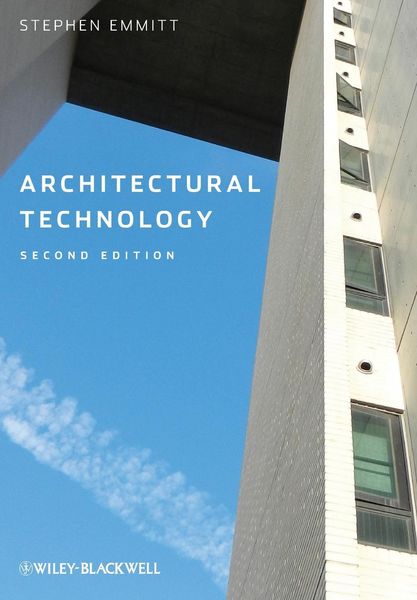
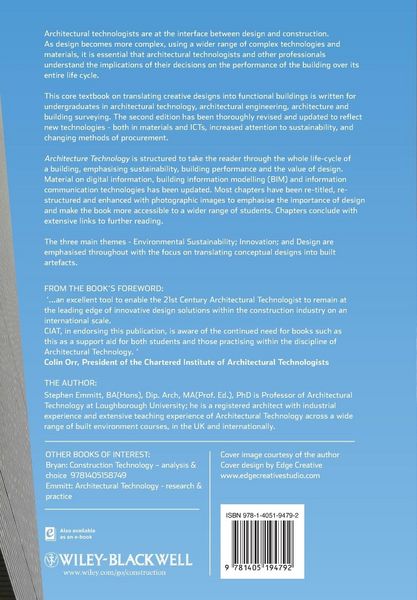
  • Produktbild: Architectural Technology
  • Produktbild: Architectural Technology

Architectural Technology

73,99 €

inkl. gesetzl. MwSt., Versandkostenfrei


Beschreibung

Since the publication of the first edition of Architectural Technology, in 2002, there have been significant developments in the number of courses, the profile of the discipline as well as significant changes in the Construction sector.   The Second edition of Architectural Technology addresses these challenges...

Beschreibung

Since the publication of the first edition of Architectural Technology, in 2002, there have been significant developments in the number of courses, the profile of the discipline as well as significant changes in the Construction sector.
 
The Second edition of Architectural Technology addresses these challenges directly. Much greater emphasis is given to the three core themes of the book - Environmental Sustainability; Innovation; and Design. An increase in the visual material included reinforces the critical role of Design, aiding students to better translate conceptual designs into built artefacts.
 
Building upon solid teaching practice from the previous edition, Architectural Technology is now more concisely structured to take the reader through the whole life cycle of a building, emphasising sustainability and building performance. Material on digital information, building information modelling (BIM) and information communication technologies has been updated. Most chapters have been re-titled to emphasise the importance of design and make the book more accessible to a wider range of students. Chapters conclude with updated/more extensive links to further reading.
 
Architectural Technology, 2nd Edition:
* Bridges the knowledge gap between design and construction
* Tackles the core subjects of management, technologies and design from a sustainable building angle
* Addresses the buildability and performance of a design from a whole life perspective
 
Thoroughly revised and updated this undergraduate level textbook is essential for Architectural Technology courses. Students studying Architectural Engineering, Architecture, Building Surveying; and more general Construction courses, will find the material invaluable.

Produktdetails

Einband

Taschenbuch

Erscheinungsdatum

14.05.2012

Verlag John Wiley & Sons
Seitenzahl

264

Produktdetails

Einband

Taschenbuch

Erscheinungsdatum

14.05.2012

Verlag John Wiley & Sons
Seitenzahl

264

Maße (L/B/H)

24,4/17/1,4 cm

Gewicht

462 g

Auflage

2nd Revised edition

Sprache

Englisch

ISBN

978-1-4051-9479-2

Herstelleradresse

Libri GmbH
Europaallee 1
36244 Bad Hersfeld
DE

Email: gpsr@libri.de

Noch keine Bewertungen vorhanden

Verfassen Sie die erste Bewertung zu diesem Artikel

Helfen Sie anderen Kundinnen und Kunden durch Ihre Meinung.

Kundinnen und Kunden meinen

Bewertungen (0)

Die Leseprobe wird geladen.
  • Produktbild: Architectural Technology
  • Produktbild: Architectural Technology
  • Foreword
     
    CIAT President (Colin Orr)

    Introduction

    Chapter 1 - Fundamentals
     
    Sensory engagement
     
    Building innovation
     
    Building characteristics
     
    Enclosure and functional requirements
     
    Philosophies and approaches
     
    Further reading

    Chapter 2 - Physical design generators
     
    The physical context: a sense of place
     
    Micro climates and weathering
     
    Structure and fabric
     
    Materials
     
    Services
     
    Further reading

    Chapter 3 - Social design generators
     
    The social context
     
    Communication and language
     
    Design decisions
     
    Risk
     
    Quality
     
    Added value
     
    Further reading

    Chapter 4 - Regulatory design generators
     
    Town planning and development control
     
    The building regulations
     
    Standards and codes of practice
     
    Trade associations
     
    Testing and research reports
     
    Further reading

    Chapter 5 - Humane design generators
     
    Perception of our buildings
     
    Physiology and usability
     
    Healthy environments
     
    Safe environments
     
    Secure environments
     
    Fire safety
     
    Further reading

    Chapter 6 - Physical interfaces
     
    Typologies
     
    Transitions
     
    Joints and connections
     
    Tolerances
     
    Further reading

    Chapter 7 - The art of detailing
     
    Detailing principles
     
    Environmental issues
     
    Performance of the joint
     
    Detailing criteria
     
    Designing the details
     
    Further reading

    Chapter 8 - The art of specifying
     
    Specification methods
     
    Selection criteria - fitness for purpose
     
    Writing the specification
     
    Contents of a written specification
     
    Further reading

    Chapter 9 - The art of informing
     
    Media
     
    Coordinated project information
     
    Drawings
     
    Physical models
     
    Bills of quantities
     
    Digital information and virtual details
     
    Information flow and design changes
     
    Further reading

    Chapter 10 - Assembling the parts
     
    The designer-contractor interface
     
    Flows
     
    Quality of work
     
    Design changes
     
    Practical completion and hand-over
     
    Learning from building projects
     
    Further reading

    Chapter 11 - Living with buildings
     
    Durability and decay
     
    Preservation, restoration, and conservation
     
    Principles of conservation, repair and maintenance
     
    Upgrading existing buildings
     
    Learning from buildings
     
    Further reading

    Chapter 12 - Disassembly and reuse
     
    Reusing redundant buildings
     
    Demolition and disassembly
     
    Reclamation, reuse, and recycling
     
    Stretching the tradition
     
    Further reading

    References

    Index