KI-Beratung Beta

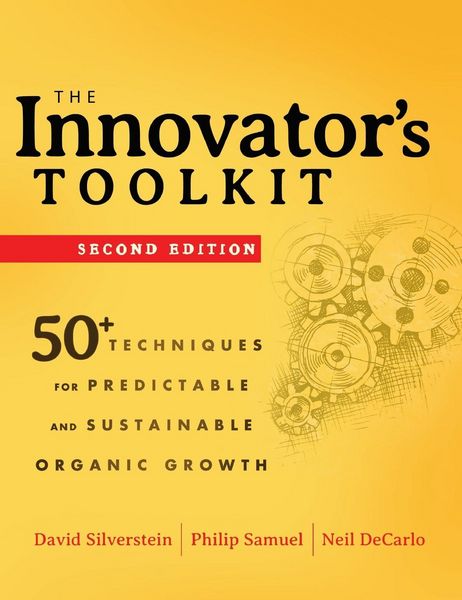
Produktbild: The Innovator's Toolkit

The Innovator's Toolkit

34,99 €

inkl. gesetzl. MwSt., Versandkostenfrei


Beschreibung

Produktdetails

Einband

Gebundene Ausgabe

Erscheinungsdatum

01.10.2012

Verlag

John Wiley & Sons Inc

Seitenzahl

432

Maße (L/B/H)

24,1/19,6/2,7 cm

Gewicht

987 g

Auflage

2nd edition

Sprache

Englisch

ISBN

978-1-118-29810-7

Beschreibung

Produktdetails

Einband

Gebundene Ausgabe

Erscheinungsdatum

01.10.2012

Verlag

John Wiley & Sons Inc

Seitenzahl

432

Maße (L/B/H)

24,1/19,6/2,7 cm

Gewicht

987 g

Auflage

2nd edition

Sprache

Englisch

ISBN

978-1-118-29810-7

Herstelleradresse

Libri GmbH
Europaallee 1
36244 Bad Hersfeld
DE

Email: gpsr@libri.de

Noch keine Bewertungen vorhanden

Verfassen Sie die erste Bewertung zu diesem Artikel

Helfen Sie anderen Kundinnen und Kunden durch Ihre Meinung.

Kundinnen und Kunden meinen

Bewertungen (0)

Die Leseprobe wird geladen.
  • Produktbild: The Innovator's Toolkit
  • DOWNLOADABLE EXHIBITS xiii

    PREFACE xv

    INTRODUCTION xvii

    P A R T I Define the Opportunity 1

    TECHNIQUE 1 Jobs to be Done 3

    Highlight the human need you're trying to fulfill

    TECHNIQUE 2 Job Mapping 13

    Determine how customers are getting jobs done

    TECHNIQUE 3 Outcome Expectations 20

    Give customers more of what they desire

    TECHNIQUE 4 Value Quotient 27

    Identify opportunity gaps in the marketplace

    TECHNIQUE 5 Ethnography 34

    Observe your customers to uncover unarticulated needs

    TECHNIQUE 6 Scenario Planning 41

    Paint visions of possible change

    TECHNIQUE 7 Heuristic Redefinition 49

    Draw a picture of your system and its parts to focus ideation

    TECHNIQUE 8 Nine Windows 57

    Looking at your opportunity through nine different lenses

    TECHNIQUE 9 Job Scoping 64

    Broaden or narrow your innovation focus

    TECHNIQUE 10 Stakeholder Management 68

    Get key influencers involved and on your side

    TECHNIQUE 11 Cognitive Style 74

    Leverage the diversity of your exploiters and explorers

    TECHNIQUE 12 Project Charter 82

    Keep your innovation team focused and on track

    TECHNIQUE 13 Innovation Financial Management 90

    Constantly improve your assumption-to-knowledge ratio

    P A R T II Discover the Ideas 99

    TECHNIQUE 14 Resource Optimization 101

    Make sure you use all available resources

    TECHNIQUE 15 Functional Analysis 108

    Scrutinize your system for innovation

    TECHNIQUE 16 Trend Prediction 115

    Learn from evolution's genetic code

    TECHNIQUE 17 Creative Challenge 125

    Sacrifice the sacred cows

    TECHNIQUE 18 HIT Matrix 130

    Compare existing solutions to spark new breakthroughs

    TECHNIQUE 19 SCAMPER 133

    Ask eight important questions

    TECHNIQUE 20 Brainwriting 6-3-5 137

    Encourage equal opportunity ideation

    TECHNIQUE 21 Imaginary Brainstorming 140

    Get silly for the sake of creativity

    TECHNIQUE 22 Concept Tree 144

    Leverage current ideas to generate many ideas

    TECHNIQUE 23 Random Stimulus 147

    Use an unrelated picture or word to spawn new ideas

    TECHNIQUE 24 Provocation and Movement 153

    Bust through the roadblocks in your thinking

    TECHNIQUE 25 Forced Association 159

    Hone in on solutions from other industries

    TECHNIQUE 26 Structured Abstraction 164

    Guide your innovation using 40 proven principles

    TECHNIQUE 27 Separation Principles 173

    Split your innovation problem in four ways

    TECHNIQUE 28 Substance Field Analysis 179

    Learn how substances interact with fields to form solutions

    TECHNIQUE 29 Biomimicry 189

    Seek nature's eons of experience to find answers

    TECHNIQUE 30 KJ Method 195

    Group and organize ideas by their natural affinities

    TECHNIQUE 31 Idea Sorting and Refinement 199

    Organize and shape ideas to improve their yield

    TECHNIQUE 32 Six Thinking Modes 206

    Evaluate your solution ideas in six different ways

    P A R T III Develop the Designs 215

    TECHNIQUE 33 Functional Requirements 217

    Identify what customers want in your solution

    TECHNIQUE 34 Axiomatic Design 223

    Transform what customers want into the best products and services

    TECHNIQUE 35 Function Structure 231

    Identify how the solution functions in its whole and its parts

    TECHNIQUE 36 Morphological Matrix 236

    Generate solution concepts by combining design alternatives

    TECHNIQUE 37 TILMAG 241

    Pair ideal solution elements to create new design concepts

    TECHNIQUE 38 Work Cell Design 245

    Configure the workspace for flow and optimization

    TECHNIQUE 39 Paired Comparison Analysis 253

    Rank design concepts against each other in pairs

    TECHNIQUE 40 Pugh