Gutscheinbedingungen

**Gültig bis 06.07.2026 auf fremdsprachige Bücher online auf thalia.at, in der Thalia App ab einem Mindestbestellwert von 30€ und in allen Thalia Buchhandlungen in Österreich. In den Buchhandlungen nur gültig auf lagernde Ware. Einzelne Artikel können ausgeschlossen sein. Ausgenommen sind preisgebundene Artikel & eBooks. Pro Einkauf einmal einlösbar. Nur gültig gegen Vorlage oder im Onlineshop hinterlegter Bonuscard. Infos zur Einlösung in der Buchhandlung sind auf der Bonuscard-Vorteilspreisseite zu finden. Click & Collect nur bei Onlinevorabzahlung möglich. Keine Einlösung bei Scan & Go-Bezahlung. Keine Barauszahlung. Nicht kombinierbar mit anderen Aktionen und Gutscheinen. Gutschein wird auf max. 500€ Bestellwert angerechnet. Nicht gültig für Versandkosten und Services.

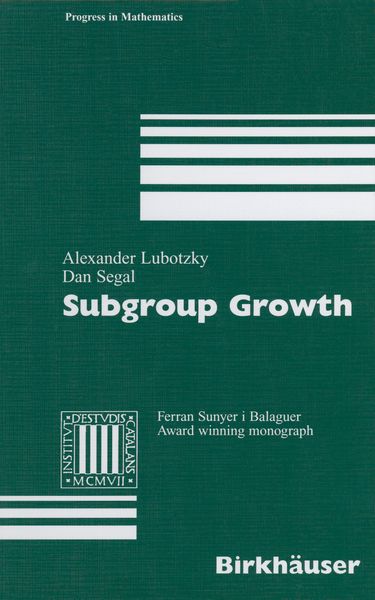
Produktbild: Subgroup Growth
Band 212

Subgroup Growth Ferran Sunyer i Balaguer Award winning monograph

Aus der Reihe Progress in Mathematics

49,99 €

inkl. gesetzl. MwSt., Versandkostenfrei


Beschreibung

Produktdetails

Einband

Gebundene Ausgabe

Erscheinungsdatum

01.04.2003

Verlag

Springer Basel

Seitenzahl

454

Maße (L/B/H)

24,1/16/3,2 cm

Gewicht

824 g

Auflage

2003

Sprache

Englisch

ISBN

978-3-7643-6989-7

Beschreibung

Rezension

Subgroup Growth
is an extremely well-written book and is a delight to read. It has a wealth of information making a rich and timely contribution to an emerging area in the theory of groups which has come to be known as Asymptotic Group Theory. This monograph and the challenging open problems with which it concludes are bound to play a fundamental role in the development of the subject for many years to come.


—Journal Indian Inst of Science


"[Subgroup growth] is one of the first books on Asymptotic Group Theory – a new, quickly developing direction in modern mathematics…The book of A. Lubotzky and D.Segal, leading specialists in group theory, answers…questions in a beautiful way .…It was natural to expect a text on the subject that would summarize the achievements in the field and we are very lucky to witness the appearance of this wonderful book. …Readers will be impressed with the encyclopedic scope of the text. It includes all, or almost all, topics related to subgroup growth ….The book also includes plenty of general information on topics that are well known to algebraic audiences and should be part of the background for every modern researcher in mathematics. …a wonderful methodological tool introduced by the authors. …


The book ends [with] a section on open problems, which contains 35 problems related to subgroup growth. The list will be useful and interesting to both established mathematicians and young researchers. There is no doubt that the list includes the most important and illuminating problems in the area, and we eagerly anticipate solutions of at least some of them in the near future.


The book will surely have [a] big impact on all readers interested in Group Theory, as well as in Algebra and Number Theory in general."


—Bulletin of the AMS


"The proofs in this book employ a remarkable variety of tools, from all branches of group theory,certainly, but also from number theory, logic, and analysis…. The authors supply surveys, and some proofs, of necessary results, in the "windows" at the end of the book. These comprise about one quarter of the full book, and they give the needy reader a handy reference, without interrupting the flow of argument in the main text…. Since the subject of this book is an active area of current research, there are many open problems in it…."


—Mathematical Reviews

Produktdetails

Einband

Gebundene Ausgabe

Erscheinungsdatum

01.04.2003

Verlag

Springer Basel

Seitenzahl

454

Maße (L/B/H)

24,1/16/3,2 cm

Gewicht

824 g

Auflage

2003

Sprache

Englisch

ISBN

978-3-7643-6989-7

Herstelleradresse

Springer-Verlag GmbH
Tiergartenstr. 17
69121 Heidelberg
DE

Email: GPSR Kontakt

Noch keine Bewertungen vorhanden

Verfassen Sie die erste Bewertung zu diesem Artikel

Helfen Sie anderen Kundinnen und Kunden durch Ihre Meinung.

Kundinnen und Kunden meinen

Bewertungen (0)

  • Produktbild: Subgroup Growth
  • 0 Introduction and Overview.- 0.1 Preliminary comments and definitions.- 0.2 Overview of the chapters.- 0.3 On CFSG.- 0.4 The windows.- 0.5 The ‘notes’.- 1 Basic Techniques of Subgroup Counting.- 1.1 Permutation representations.- 1.2 Quotients and subgroups.- 1.3 Group extensions.- 1.4 Nilpotent and soluble groups.- 1.5 Abelian groups I.- 1.6 Finite p-groups.- 1.7 Sylow’s theorem.- 1.8 Rest riet ing to soluble subgroups.- 1.9 Applications of the ‘minimal index’.- 1.10 Abelian groups II.- 1.11 Growth types.- Notes.- 2 Free Groups.- 2.1 The subgroup growth of free groups.- 2.2 Subnormal subgroups.- 2.3 Counting d-generator finite groups.- Notes.- 3 Groups with Exponential Subgroup Growth.- 3.1 Upper bounds.- 3.2 Lower bounds.- 3.3 Free pro-p groups.- 3.4 Normal subgroups in free pro-p groups.- 3.5 Relations in p-groups and Lie algebras.- Notes.- 4 Pro-p Groups.- 4.1 Pro-p groups with polynomial subgroup growth.- 4.2 Pro-p groups with slow subgroup growth.- 4.3 The groups $$SL_r^1({\mathbb{F}_p}[[t]])$$.- 4.4 A-perfect groups.- 4.5 The Nottingham group.- 4.6 Finitely presented pro-p groups.- Notes.- 5 Finitely Generated Groups with Polynomial Subgroup Growth.- 5.1 Preliminary observations.- 5.2 Linear groups with PSG.- 5.3 Upper chief factors.- 5.4 Groups of prosoluble type.- 5.5 Groups of finite upper rank.- 5.6 The degree of polynomial subgroup growth.- Notes.- 6 Congruence Subgroups.- 6.1 The characteristic 0 case.- 6.2 The positive characteristic case.- 6.3 Perfect Lie algebras.- 6.4 Normal congruence subgroups.- Notes.- 7 The Generalized Congruence Subgroup Problem.- 7.1 The congruence subgroup problem.- 7.2 Subgroup growth of lattices.- 7.3 Counting hyperbolic manifolds.- Notes.- 8 Linear Groups.- 8.1 Subgroup growth, characteristic 0.- 8.2 Residually nilpotent groups.- 8.3 Subgroup growth, characteristic p.- 8.4 Normal subgroup growth.- Notes.- 9 Soluble Groups.- 9.1 Metabelian groups.- 9.2 Residually nilpotent groups.- 9.3 Some finitely presented metabelian groups.- 9.4 Normal subgroup growth in metabelian groups.- Notes.- 10 Profinite Groups with Polynomial Subgroup Growth.- 10.1 Upper rank.- 10.2 Profinite groups with wPSG: structure.- 10.3 Quasi-semisimple groups.- 10.4 Profinite groups with wPSG: characterization.- 10.5 Weak PSG = PSG.- Notes.- 11 Probabilistic Methods.- 11.1 The probability measure.- 11.2 Generation probabilities.- 11.3 Maximal subgroups.- 11.4 Further applications.- 11.5 Pro-p groups.- Notes.- 12 Other Growth Conditions.- 12.1 Rank and bounded generation.- 12.2 Adelic groups.- 12.3 The structure of finite linear groups.- 12.4 Composition factors.- 12.5 BG, PIG and subgroup growth.- 12.6 Residually nilpotent groups.- 12.7 Arithmetic groups and the CSP.- 12.8 Examples.- Notes.- 13 The Growth Spectrum.- 13.1 Products of alternating groups.- 13.2 Some finitely generated permutation groups.- 13.3 Some profinite groups with restricted composition factors.- 13.4 Automorphisms of rooted trees.- Notes.- 14 Explicit Formulas and Asymptotics.- 14.1 Free groups and the modular group.- 14.2 Free products of finite groups.- 14.3 Modular subgroup arithmetic.- 14.4 Surface groups.- Notes.- 15 Zeta Functions I: Nilpotent Groups.- 15.1 Local zeta functions as p-adic integrals.- 15.2 Alternative methods.- 15.3 The zeta function of a nilpotent group.- Notes.- 16 Zeta Functions II: p-adic Analytic Groups.- 16.1 Integration on pro-p groups.- 16.2 Counting subgroups in a p-adic analytic group.- 16.3 Counting orbits.- 16.4 Counting p-groups.- Notes.- Windows.- 1 Finite Group Theory.- 1 Hall subgroups and Sylow bases.- 2 Carter subgroups.- 3 The Fitting subgroup.- 4 The generalized Fitting subgroup.- 5 Tate’s theorem.- 6 Rank and p-rank.- 7 Schur multiplier.- 8 Powerful p-groups.- 9 GLn and Sym(n).- 2 Finite Simple Groups.- 1 The list.- 2 Generators.- 3 Subgroups.- 4 Representations.- 5 Automorphisms.- 6 Schur multipliers.- 7 An elementary proof.- 3 Permutation Groups.- 1 Primitive groups.- 2 Groups with restricted sections.- 3 Subgroups of alternating groups.- 4 Profinite Groups.- 1 Completions.- 2 Free profinite groups.- 3 Profinite presentations.- 5 Pro-p Groups.- 1 Generators and relations.- 2 Pro-p groups of finite rank.- 3 Linear pro-p groups over local fields.- 4 Automorphisms of finite p-groups.- 5 Hall’s enumeration principle.- 6 Soluble Groups.- 1 Nilpotent groups.- 2 Soluble groups of finite rank.- 3 Finitely generated metabelian groups.- 7 Linear Groups.- 1 Soluble groups.- 2 Jordan’s theorem.- 3 Monomial groups.- 4 Finitely generated groups.- 5 Lang’s theorem.- 8 Linearity Conditions for Infinite Groups.- 1 Variations on Mal’cev’s local theorem.- 2 Groups that are residually of bounded rank.- 3 Applications of Ado’s theorem.- 9 Strong Approximation for Linear Groups.- 1 A variant of the Strong Approximation Theorem.- 2 Subgroups of SLn(Fp).- 3 The ‘Lubotzky alternative’.- 4 Strong approximation in positive characteristic.- 10 Primes.- 1 The Prime Number Theorem.- 2 Arithmetic progressions and the Bombieri-Vinogradov theorem.- 3 Global fields and Chebotarev’s theorem.- 11 Probability.- 12 p-adic Integrals and Logic.- 1 Results.- 2 A peek inside the black box.- Open Problems.- 1 ‘Growth spectrum’.- 2 Normal subgroup growth in pro-p groups and metabelian groups.- 3 The degree of f.g. nilpotent groups.- 4 Finite extensions.- 5 Soluble groups.- 6 Isospectral groups.- 7 Congruence subgroups, lattices in Lie groups.- 8 Other growth conditions.- 9 Zeta functions.