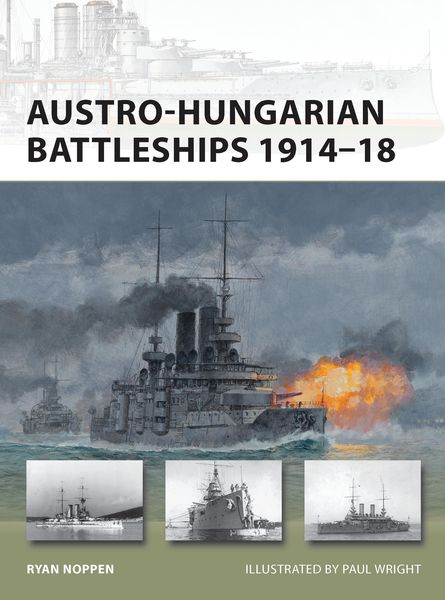
Austro-Hungarian Battleships 1914-18
-
- Taschenbuch ausgewählt
- eBook
-
Sprache:Englisch
16,99 €
inkl. gesetzl. MwSt.,
- Kostenlose Lieferung ab 30 € Einkaufswert
- Versandkostenfrei für Bonuscard-Kund*innen
Beschreibung
Produktdetails
Einband
Taschenbuch
Erscheinungsdatum
20.09.2012
Abbildungen
40 b/w; 7 col
Illustriert von
Paul Wright
Verlag
Osprey PublishersSeitenzahl
48
Maße (L/B/H)
25,7/18,7/0,8 cm
Gewicht
164 g
Sprache
Englisch
ISBN
978-1-84908-688-2
Despite imperial politics, a modern Austro-Hungarian battleship fleet was built and contested Italian dominance of the Adriatic and the Mediterranean through a series of daring naval raids that netted greater success than anything the German High Seas Fleet accomplished in the North Sea.
The nineteenth century saw the assertion of Habsburg sea power over the Adriatic from the Austrian inheritance of the Venetian fleet in 1797 to Rear Admiral Wilhelm von Tegetthoff's stunning victory over a superior Italian force at the Battle of Lissa in 1866 to the gradual creation of a modern battle fleet beginning in the 1890s. Austria-Hungary did not have an overseas empire; its empire lay within its own boundaries and the primary purpose of its navy until the beginning of the twentieth century was the defense of its coastline. As its merchant marine dramatically grew in the late nineteenth century, Austro-Hungarian admirals believed that the navy should take a more proactive policy of defense, defending not only the coastline but the greater Adriatic and even the Mediterranean waters which the empire's merchant ships plied. The 1890s saw the beginning of a series of naval building programs that would create a well-balanced modern fleet. Cruisers were constructed for the protection of overseas trade and for "showing the flag" but the decisive projection of Austria-Hungary's commitment to control the Adriatic was the construction of a force of modern battleships. Compared to the British, French, Germans, and even Italians, the Austro-Hungarians were relative latecomers to the design and construction of battleships. Austro-Hungarian naval policy tended to be reactionary rather than proactive; its admirals closely followed Italian naval developments and sought appropriate countermeasures even though the two nations were tenuously bound together by the Triple Alliance pact of 1882. Despite the naval arms race throughout Europe at the time, the navy had difficulty obtaining funds for new ships as the Hungarian government was reluctant to fund a fleet that principally served the maritime interests of the ethnically German portion of the empire. The difficulties experienced in battleship funding and construction mirrored the political difficulties and ethnic rivalries within the empire. Nevertheless by August of 1914, the Austro-Hungarian fleet had a force of nine battleships, three pre-dreadnoughts, and one dreadnought (three more in the final stages of construction). This book will survey the five classes of Austro-Hungarian battleships in service during the First World War.
Noch keine Bewertungen vorhanden
Verfassen Sie die erste Bewertung zu diesem Artikel
Helfen Sie anderen Kundinnen und Kunden durch Ihre Meinung.
Kurze Frage zu unserer Seite
Vielen Dank für Ihr Feedback
Wir nutzen Ihr Feedback, um unsere Produktseiten zu verbessern. Bitte haben Sie Verständnis, dass wir Ihnen keine Rückmeldung geben können. Falls Sie Kontakt mit uns aufnehmen möchten, können Sie sich aber gerne an unseren Kund*innenservice wenden.
zum Kundenservice