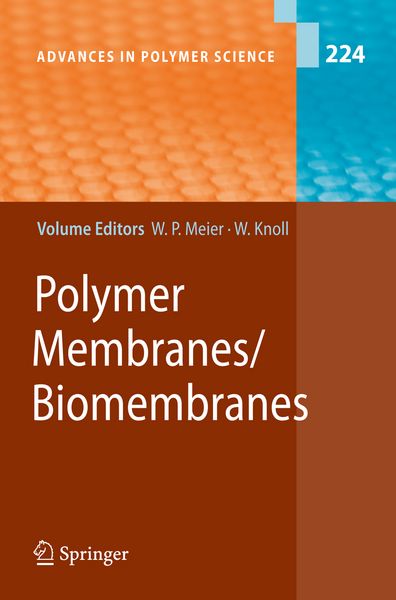
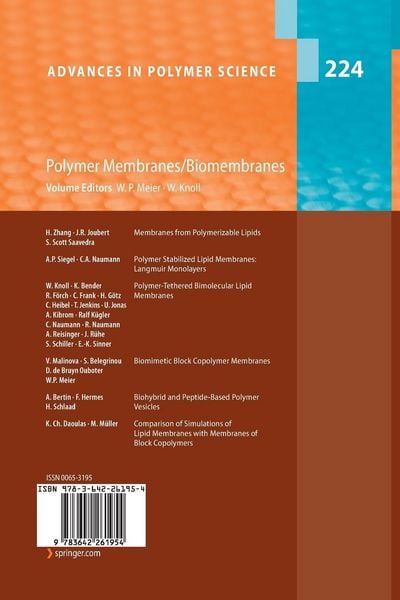
Polymer Membranes/Biomembranes
-
- Hardcover
- Taschenbuch ausgewählt
-
Sprache:Englisch
302,99 €
inkl. gesetzl. MwSt.,
Beschreibung
Produktdetails
Einband
Taschenbuch
Erscheinungsdatum
01.03.2012
Abbildungen
XII, 124 illus., 47 illus. in color., farbige Illustrationen, schwarz-weiss Illustrationen
Herausgeber
Wolfgang Peter Meier + weitereVerlag
Springer BerlinSeitenzahl
238
Maße (L/B/H)
23,5/15,5/1,4 cm
Gewicht
388 g
Auflage
2010
Sprache
Englisch
ISBN
978-3-642-26195-4
Themulticomponentnatureofbiologicalmembranesandtheirintra- andextracel- lar interactions make direct investigations on the membrane structure and processes nearly impossible. Clearly, a better understanding of the membrane properties and the mechanisms determining membrane protein functions is crucial to the imp- mentation of biosensors, bioreactors and novel platforms for medical therapy. For this reason, the interest in model systems suitable for the construction and study of complex lipid/protein membrane architectures has increased steadily over the years. The classical portfolio of model membranes used for biophysical and - terfacial studies of lipid (bi)layers and lipid/protein composites includes Langmuir monolayers assembled at the water/air interface, (uni- and multi-lamellar) vesicles in bulk (liposomal) dispersion, bimolecular lipid membranes (BLMs), and various types of solid-supported membranes. All these have speci?c advantages but also suffer from serious drawbacksthat limit their technical applications. Polymer m- branes comprised of entirely synthetic or hybrid (synthetic polymer/biopolymer) block copolymersappeared to be an attractive alternative to the lipid-based models. Generally, the synthetic block copolymer membranes are thicker and more stable and the versatility of polymer chemistry allows the adoption of relevant properties for a wide range of applications. This volume provides a vast overview of the physico-chemical and synthetic - pectsofarti?cial membranes. Numerousmembranemodelsaredescribed,including their properties(i. e. swelling, drying,lateral mobility,stability, electrical conduct- ity, etc. ), advantages, and drawbacks. The potential applications of these models are discussed and supported by real examples. Chapter 1 summarizesmethodsfor the stabilizationof arti?cial lipid membranes.
Kundinnen und Kunden meinen
Verfassen Sie die erste Bewertung zu diesem Artikel
Helfen Sie anderen Kund*innen durch Ihre Meinung
Kurze Frage zu unserer Seite
Vielen Dank für Ihr Feedback
Wir nutzen Ihr Feedback, um unsere Produktseiten zu verbessern. Bitte haben Sie Verständnis, dass wir Ihnen keine Rückmeldung geben können. Falls Sie Kontakt mit uns aufnehmen möchten, können Sie sich aber gerne an unseren Kund*innenservice wenden.
zum Kundenservice