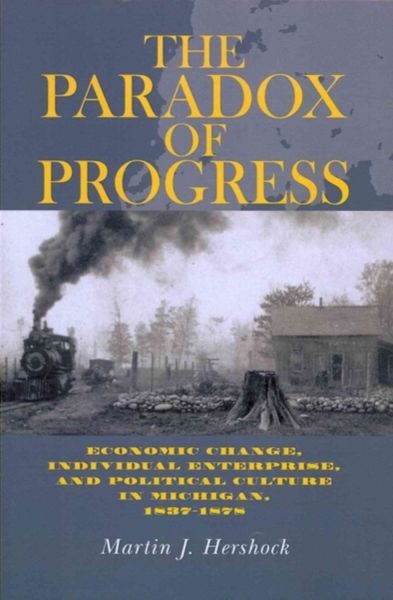
Paradox of Progress Economic Change, Individual Enterprise, and Political Culture in Michigan, 1837-1878
-
- Englisch ausgewählt
28,99 €
inkl. gesetzl. MwSt.,
- Kostenlose Lieferung ab 30 € Einkaufswert
- Versandkostenfrei für Bonuscard-Kund*innen
Beschreibung
Produktdetails
Einband
Taschenbuch
Erscheinungsdatum
30.12.2003
Verlag
Ohio University PressSeitenzahl
277
Maße (L/B/H)
22,9/15,3/2 cm
Gewicht
499 g
Sprache
Englisch
ISBN
978-0-8214-1988-5
Americans have long recognized the central importance of the nineteenth-century Republican party in preserving the Union, ending slavery, and opening the way for industrial capitalism. On the surface, the story seems straightforward-the party's "free labor" ethos, embracing the opportunity that free soil presented for social and economic mobility, and condemning the danger that slavery in the territories posed for that mobility, foreshadowed the GOP's later devotion to unfettered enterprise and industrial capitalism. In reality, however, the narrative thread is not so linear. This work examines the contradiction that lay at the heart of the supremely influential ideology of the early Republican party. The Paradox of Progress explores one of the most profound changes in American history-the transition from the anti-market, anti-monopoly, and democratic ideology of Jacksonian America to the business-dominated politics and unregulated excesses of Gilded Age capitalism.
Guiding this transformation was the nineteenth-century Republican party. Drawing heavily from both the pro-market commitments of the early Whig party and the anti-capitalist culture of Jackson's Democratic party, the early Republican party found itself torn between these competing values. Nowhere was this contested process more obvious or more absorbing than in Civil War-era Michigan, the birthplace of the Republican party.
In The Paradox of Progress, a fascinating look at the central factors underlying the history of the GOP, Martin Hershock reveals how in their determination to resolve their ideological dilemma, Republicans of the Civil War era struggled to contrive a formula that would enable them to win popular elections and to model America's acceptance of Gilded Age capitalism.
Noch keine Bewertungen vorhanden
Verfassen Sie die erste Bewertung zu diesem Artikel
Helfen Sie anderen Kundinnen und Kunden durch Ihre Meinung.
Kurze Frage zu unserer Seite
Vielen Dank für Ihr Feedback
Wir nutzen Ihr Feedback, um unsere Produktseiten zu verbessern. Bitte haben Sie Verständnis, dass wir Ihnen keine Rückmeldung geben können. Falls Sie Kontakt mit uns aufnehmen möchten, können Sie sich aber gerne an unseren Kund*innenservice wenden.
zum Kundenservice