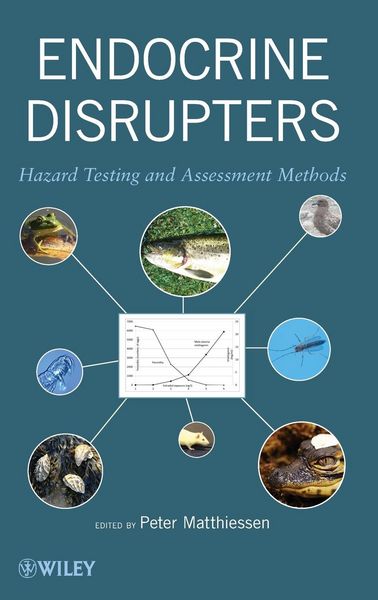
Produktbild: Endocrine Disrupters

Endocrine Disrupters Hazard Testing and Assessment Methods

174,99 €

inkl. gesetzl. MwSt., Versandkostenfrei


Beschreibung

Produktdetails

Einband

Gebundene Ausgabe

Erscheinungsdatum

25.03.2013

Verlag

John Wiley & Sons

Seitenzahl

416

Maße (L/B/H)

24/16,1/2,7 cm

Gewicht

708 g

Auflage

1. Auflage

Sprache

Englisch

ISBN

978-0-470-93209-4

Beschreibung

Produktdetails

Einband

Gebundene Ausgabe

Erscheinungsdatum

25.03.2013

Verlag

John Wiley & Sons

Seitenzahl

416

Maße (L/B/H)

24/16,1/2,7 cm

Gewicht

708 g

Auflage

1. Auflage

Sprache

Englisch

ISBN

978-0-470-93209-4

Herstelleradresse

Libri GmbH
Europaallee 1
36244 Bad Hersfeld
DE

Email: gpsr@libri.de

Kundinnen und Kunden meinen

0 Bewertungen

Informationen zu Bewertungen

Zur Abgabe einer Bewertung ist eine Anmeldung im Konto notwendig. Die Authentizität der Bewertungen wird von uns nicht überprüft. Wir behalten uns vor, Bewertungstexte, die unseren Richtlinien widersprechen, entsprechend zu kürzen oder zu löschen.

Die Bewertungen sind nach Format, Anzahl Sterne und Datum sortiert.

Verfassen Sie die erste Bewertung zu diesem Artikel

Helfen Sie anderen Kund*innen durch Ihre Meinung

Kundinnen und Kunden meinen

0 Bewertungen filtern

Die Leseprobe wird geladen.
  • Produktbild: Endocrine Disrupters
  • Preface ix

    Contributors xi

    1 Ecotoxicity Test Methods for Endocrine-Disrupting Chemicals: An Introduction 1
    Peter Matthiessen

    1.1 Background 1

    1.2 Regulatory Concerns 2

    1.3 Invertebrates 2

    1.4 Vertebrates 3

    1.5 Testing Schemes for EDCs 5

    Reference 6

    2 Endocrine Disruption inWildlife: Background, Effects, and Implications 7
    Dick Vethaak and Juliette Legler

    2.1 Background to Endocrine Disruption 8

    2.2 Effects of EDCs on Wildlife 19

    2.3 Weight of Evidence and Ecological Significance of ED Effects 32

    2.4 Implications for Effect Assessment and Toxicity Testing 36

    2.5 Need for More Field Studies and an Integrated Approach 38

    2.6 Concluding Points 39

    References 40

    3 The Regulatory Need for Tests to Detect EDCs and Assess Their Hazards toWildlife 59
    Hans-Christian Stolzenberg, Tobias Frische, Vicki L. Dellarco, Gary Timm, Anne Gourmelon, Taisen Iguchi, Flemming Ingerslev, and Mike Roberts

    3.1 Emerging Concerns and Policy Responses: Focusing on EDCs as a Large Pseudo-Uniform Group of Substances 60

    3.2 General Approaches in Substance-Related Regulatory Frameworks (EU) 80

    3.3 How to Make EDC Definitions Operational for Substance-Related Regulatory Work 87

    3.4 Future Perspectives 91

    3.5 Conclusions 92

    References 93

    4 Techniques for Measuring Endocrine Disruption in Insects 100
    Lennart Weltje

    4.1 Introduction 100

    4.2 Methods 105

    4.3 Discussion 108

    4.4 Conclusion 110

    4.5 Acknowledgments 110

    References 110

    5 Crustaceans 116
    Magnus Breitholtz

    5.1 Introduction 116

    5.2 Background to Crustacean Endocrinology 118

    5.3 State of the Art: What Do We Know About Endocrine Disruption in Crustaceans? 121

    5.4 Available Subchronic/Chronic Standard Test Protocols 128

    5.5 Complementary Tools for Identification of Endocrine Disruption 129

    5.6 Summary and Conclusions 132

    References 134

    6 Endocrine Disruption in Molluscs: Processes and Testing 143
    Patricia D. McClellan-Green

    6.1 Background and Introduction 143

    6.2 What Constitutes the Endocrine System in Molluscs? 145

    6.3 End Points and Biomarkers of Endocrine Disruption 154

    6.4 Current Test Methods Using Molluscs 164

    6.5 Proposed Test Methods 167

    6.6 Conclusions 171

    References 172

    7 Using Fish to Detect Endocrine Disrupters and Assess Their Potential Environmental Hazards 185
    Peter Matthiessen

    7.1 Introduction 185

    7.2 International Efforts to Standardize Fish-Based Methods for Screening and Testing Endocrine-Disrupting

    7.3 Fish-Based Screens Developed by OECD for Endocrine-Disrupting Chemicals 189

    7.4 Progress with Developing Fish Partial Life Cycle Tests for Endocrine Disrupters 194

    7.5 Prospects for the Standardization of Fish Full Life Cycle and Multigeneration Tests 195

    7.6 Strengths and Weaknesses of a Hazard Evaluation Strategy Based Partly on Available and Proposed Fish Screens and Tests 197

    7.7 Conclusions 198

    References 198

    8 Screening and Testing for Endocrine-Disrupting Chemicals in Amphibian Models 202
    Daniel B. Pickford

    8.1 Introduction 202

    8.2 Potential Uses of Amphibians in Endocrine Disrupter Screening and Testing Programs 203

    8.3 Embryonic Development 205

    8.4 Hatching 208

    8.5 Larval Development 209

    8.6 Higher-Tier Tests with Amphibians 224

    8.7 Other and Emerging Test Methods 227

    8.8 Summary and Conclusions 229

    References 232

    9 Endocrine Disruption and Reptiles: Using the Unique Attributes of Temperature-Dependent Sex Determination to Assess Impacts 245
    Satomi Kohno and Louis J. Guillette, Jr.

    9.1 Introduction 245

    9.2 Approaches to Examine Effects of EDCs 252

    9.3 Induction of Sex Reversal In Ovo 255

    9.4 Analysis of Sex-Reversed Animals 260

    9.5 Conclusions 265

    References 266

    10 Birds 272
    Paul D. Jones, Markus Hecker, Steve Wiseman, and John P. Giesy

    10.1 Introduction 272

    10.2 Differences Between Birds and Mammals and Among Bird Species 275

    10.3 In Vitro Techniques 278

    10.4 Studies with Embryos 280

    10.5 In Vivo Techniques 280

    10.6 Examples of EDC Effects from Field Studies 285

    10.7 Proposed Two-Generation Test 288

    10.8 Conclusions 291

    References 292

    11 Mammalian Methods for Detecting and Assessing Endocrine-Active Compounds 304
    M. Sue Marty

    11.1 Introduction 304

    11.2 Mammalian Tier 1 Screening Assays 306

    11.3 Tier 2 Tests 326

    11.4 Human and Wildlife Relevance of Estrogen, Androgen, and Thyroid Screening Assays 329

    11.5 Potential Future Assays for Endocrine Screening 330

    References 332

    12 Application of the OECD Conceptual Framework for Assessing the Human Health and Ecological Effects of Endocrine Disrupters 341
    Thomas H. Hutchinson, Jenny Odum, and Anne Gourmelon

    12.1 Introduction 342

    12.2 Overview of the OECD Revised CF 343

    12.3 Application of the Klimisch Criteria to the EE2 and VIN Case Studies 346

    12.4 Case Study: Data Examples for 17-Ethynylestradiol 346

    12.5 Case Study: Data Examples for Vinclozolin 357

    12.6 Conclusions 367

    References 368

    13 The Prospects for Routine Testing of Chemicals for Endocrine-Disrupting Properties and Potential Ecological Impacts 373
    Peter Matthiessen

    13.1 Introduction 373

    13.2 Are There Gaps in the Test Suite for EDCs? 374

    13.3 "New" Modes of Endocrine-Disrupting Action 376

    13.4 How Should Tests for EDCs Be Deployed in an Integrated Fashion? 377

    13.5 Use of Weight of Evidence when Assessing Possible EDCs 380

    13.6 Conclusions 382

    References 382

    Index 385