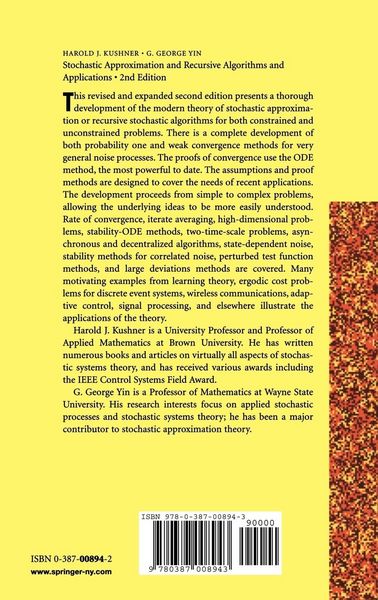
• Produktbild: Stochastic Approximation and Recursive Algorithms and Applications
  • Produktbild: Stochastic Approximation and Recursive Algorithms and Applications
Band 35 - 13%

Stochastic Approximation and Recursive Algorithms and Applications

13% sparen

189,99 € UVP 219,99 €

inkl. gesetzl. MwSt., Versandkostenfrei


Beschreibung

Produktdetails

Einband

Gebundene Ausgabe

Erscheinungsdatum

17.07.2003

Verlag

Springer Us

Seitenzahl

478

Maße (L/B/H)

24,1/16,2/3 cm

Gewicht

834 g

Auflage

2003. Corr. 2nd

Sprache

Englisch

ISBN

978-0-387-00894-3

Beschreibung

Rezension

From the reviews of the second edition:


"This is the second edition of an excellent book on stochastic approximation, recursive algorithms and applications … . Although the structure of the book has not been changed, the authors have thoroughly revised it and added additional material … ." (Evelyn Buckwar, Zentralblatt MATH, Vol. 1026, 2004)


"The book attempts to convince that … algorithms naturally arise in many application areas … . I do not hesitate to conclude that this book is exceptionally well written. The literature citation is extensive, and pertinent to the topics at hand, throughout. This book could be well suited to those at the level of the graduate researcher and upwards." (A. C. Brooms, Journal of the Royal Statistical Society Series A: Statistics in Society, Vol. 169 (3), 2006)

Produktdetails

Einband

Gebundene Ausgabe

Erscheinungsdatum

17.07.2003

Verlag

Springer Us

Seitenzahl

478

Maße (L/B/H)

24,1/16,2/3 cm

Gewicht

834 g

Auflage

2003. Corr. 2nd

Sprache

Englisch

ISBN

978-0-387-00894-3

Herstelleradresse

Libri GmbH
Europaallee 1
36244 Bad Hersfeld
DE

Email: gpsr@libri.de

Noch keine Bewertungen vorhanden

Verfassen Sie die erste Bewertung zu diesem Artikel

Helfen Sie anderen Kundinnen und Kunden durch Ihre Meinung.

Kundinnen und Kunden meinen

Bewertungen (0)

  • Produktbild: Stochastic Approximation and Recursive Algorithms and Applications
  • Produktbild: Stochastic Approximation and Recursive Algorithms and Applications
  • Introduction
    1 Review of Continuous Time Models
    1.1 Martingales and Martingale Inequalities
    1.2 Stochastic Integration
    1.3 Stochastic Differential Equations: Diffusions
    1.4 Reflected Diffusions
    1.5 Processes with Jumps
    2 Controlled Markov Chains
    2.1 Recursive Equations for the Cost
    2.2 Optimal Stopping Problems
    2.3 Discounted Cost
    2.4 Control to a Target Set and Contraction Mappings
    2.5 Finite Time Control Problems
    3 Dynamic Programming Equations
    3.1 Functionals of Uncontrolled Processes
    3.2 The Optimal Stopping Problem
    3.3 Control Until a Target Set Is Reached
    3.4 A Discounted Problem with a Target Set and Reflection
    3.5 Average Cost Per Unit Time
    4 Markov Chain Approximation Method: Introduction
    4.1 Markov Chain Approximation
    4.2 Continuous Time Interpolation
    4.3 A Markov Chain Interpolation
    4.4 A Random Walk Approximation
    4.5 A Deterministic Discounted Problem
    4.6 Deterministic Relaxed Controls
    5 Construction of the Approximating Markov Chains
    5.1 One Dimensional Examples
    5.2 Numerical Simplifications
    5.3 The General Finite Difference Method
    5.4 A Direct Construction
    5.5 Variable Grids
    5.6 Jump Diffusion Processes
    5.7 Reflecting Boundaries
    5.8 Dynamic Programming Equations
    5.9 Controlled and State Dependent Variance
    6 Computational Methods for Controlled Markov Chains
    6.1 The Problem Formulation
    6.2 Classical Iterative Methods
    6.3 Error Bounds
    6.4 Accelerated Jacobi and Gauss-Seidel Methods
    6.5 Domain Decomposition
    6.6 Coarse Grid-Fine Grid Solutions
    6.7 A Multigrid Method
    6.8 Linear Programming
    7 The Ergodic Cost Problem: Formulation and Algorithms
    7.1 Formulation of the Control Problem
    7.2 A Jacobi Type Iteration
    7.3 Approximation in Policy Space
    7.4 Numerical Methods
    7.5 The Control Problem
    7.6 The Interpolated Process
    7.7 Computations
    7.8 Boundary Costs and Controls
    8 Heavy Traffic and Singular Control
    8.1 Motivating Examples
    &nb