KI-Beratung Beta

Produktbild: Incomplete Information: Structure, Inference, Complexity

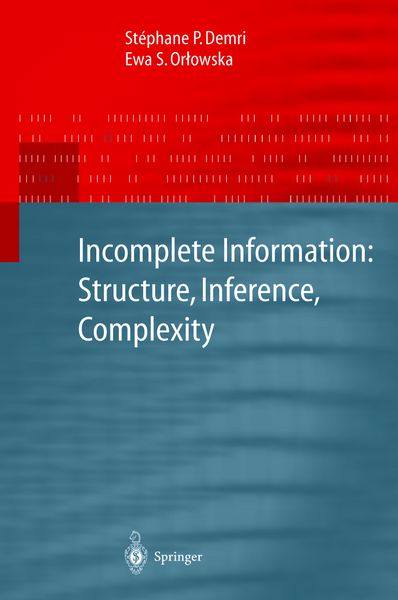
Incomplete Information: Structure, Inference, Complexity

144,99 €

inkl. gesetzl. MwSt., Versandkostenfrei


Beschreibung

The construction of any broadly understood theory of information or infor mation processing system involves two major methodological processes: (1) abstraction and analysis, (2) reasoning and computing. This monograph is a realisation of these two processes in relation to the study of incompleteness...

Beschreibung

The construction of any broadly understood theory of information or infor mation processing system involves two major methodological processes: (1) abstraction and analysis, (2) reasoning and computing. This monograph is a realisation of these two processes in relation to the study of incompleteness of information. The paradigm we are working with is inspired by a rough-set approach to data analysis: the formalisms we develop enable the use of a non invasive data representation. This means that the only information which is and must be used in the process of analysis is the actual information that is to be analysed; we do not require any additional sources of information. An abstraction is formed in the process of conception, design, and develop ment of structures. Then analysis leads to a selection of a class of structures. In this book we delineate a class of informational structures that enable us to represent both numerical and non-numerical information and we analyse var ious manifestations of its incompleteness. We discuss several general types of incompleteness of information which are grounded in a rough-set-style view of imprecision and uncertainty. Manifestations of these types of incompleteness in information systems are investigated.

Rezension

From the reviews of the first edition:


"This monograph presents a systematic, exhaustive and up to date overview of formal methods and theories related to data analysis and inference using the concept of rough sets. … In a nutshell, it is an interesting book for researchers and scientists in the area of information structure." (Prabhat Kumar Mahanti, Zentralblatt MATH, Vol. 1016, 2003)


"The present monograph gives a systematic presentation of the theory related to the … relation-based knowledge representation and the underlying logics and algebras. … The structure of this book is clear. … The book is written to be self-contained … . The references section of this book is excellent … . The book can be recommended to researchers and graduate students interested in rough-set-style reasoning and knowledge representation. Also for lecturers this provides a great source … ." (Jouni Järvinen, Studia Logica, Vol. 89 (3), 2006)

Produktdetails

Einband

Gebundene Ausgabe

Erscheinungsdatum

03.07.2002

Abbildungen

XVIII, 408 p.

Verlag Springer Berlin

Produktdetails

Einband

Gebundene Ausgabe

Erscheinungsdatum

03.07.2002

Abbildungen

XVIII, 408 p.

Verlag Springer Berlin
Seitenzahl

408

Maße (B/H)

15,5/23,5 cm

Gewicht

800 g

Auflage

2002

Sprache

Englisch

ISBN

978-3-540-41904-4

Herstelleradresse

Springer-Verlag GmbH
Heidelberger Platz 3
14197 Berlin
Deutschland
Email: sdc-bookservice@springer.com
Url: www.springer.com
Telephone: +49 30 827870
Fax: +49 30 8214091

Noch keine Bewertungen vorhanden

Verfassen Sie die erste Bewertung zu diesem Artikel

Helfen Sie anderen Kundinnen und Kunden durch Ihre Meinung.

Kundinnen und Kunden meinen

Bewertungen (0)

  • Produktbild: Incomplete Information: Structure, Inference, Complexity
  • 1. Mathematical Prerequisites.- I. Structures with Incomplete Information.- 2. Structures of Information.- 3. Information Relations Derived from Information Systems.- 4. Information Operators Derived from Information Systems.- II. Introduction to Information Logics.- 5. Towards Information Logics.- 6. Techniques for Information Logics.- III. Proof Systems for Information Logics.- 7. Reasoning About Similarity.- 8. Reasoning About Indiscernibility.- 9. Reasoning About Knowledge.- IV. Computational Aspects of Information Logics.- 10. Information Logics Versus Standard Modal Logics.- 11. Decidability of Information Logics.- 12. Complexity of Information Logics.- V. Representability and Duality.- 13. Informational Representability.- 14. Informational Interpretation of Standard Algebraic Structures.- 15. Information Algebras.- References.