KI-Beratung Beta

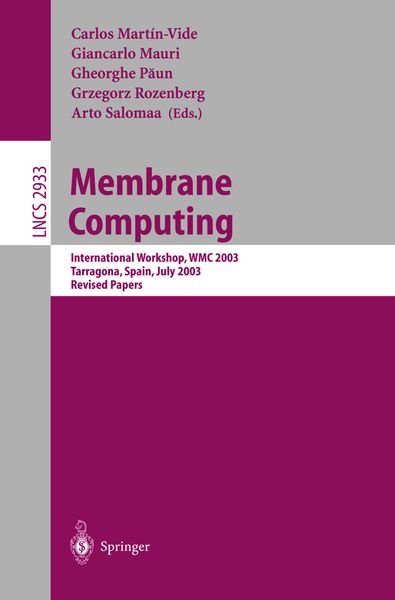
  • Produktbild: Membrane Computing
  • Produktbild: Membrane Computing
Band 2933

Membrane Computing International Workshop, WMC 2003, Tarragona, Spain, July 17-22, 2003, Revised Papers

51,99 €

inkl. gesetzl. MwSt., Versandkostenfrei


Beschreibung

Proton Pumping P Systems.- A Binary Data Structure for Membrane Processors: Connectivity Arrays.- Parsing with Active P Automata.- Universality of Minimal Symport/Antiport: Five Membranes Suffice.- Collapsing Hierarchies of Parallel Rewriting P Systems without Target Conflicts.- Evolution and Observation:...

Beschreibung

Proton Pumping P Systems.- A Binary Data Structure for Membrane Processors: Connectivity Arrays.- Parsing with Active P Automata.- Universality of Minimal Symport/Antiport: Five Membranes Suffice.- Collapsing Hierarchies of Parallel Rewriting P Systems without Target Conflicts.- Evolution and Observation: A New Way to Look at Membrane Systems.- Tiling Rectangular Pictures with P Systems.- Simulating Boolean Circuits with P Systems.- P Systems Running on a Cluster of Computers.- Implementing in Prolog an Effective Cellular Solution to the Knapsack Problem.- On the Dynamics of PB Systems: A Petri Net View.- P Systems Generating Hexagonal Picture Languages.- A Membrane System for the Leukocyte Selective Recruitment.- P Systems with Cutting/Recombination Rules Assigned to Membranes.- ? -P Automata with Communication Rules.- The Number of Membranes Matters.- An Agent-Based Behavioural Model of Monomorium Pharaonis Colonies.- Can Hyperbolic Geometry Be of Help for P Systems?.- A Linear-Time Solution to the Knapsack Problem Using P Systems with Active Membranes.- A Reconfigurable Hardware Membrane System.- P Systems and Petri Nets.- Simulation of Mobile Ambients by P Systems. Part 1.- Computing Partial Recursive Functions by Transition P Systems.- P Systems with External Input and Learning Strategies.- A Distributed Simulation of Transition P Systems.- About Splicing P Systems with Immediate Communication and Non-extended Splicing P Systems.

Produktdetails

Einband

Taschenbuch

Erscheinungsdatum

28.01.2004

Abbildungen

VIII, 382 p.

Herausgeber Carlos Martín-Vide + weitere

Produktdetails

Einband

Taschenbuch

Erscheinungsdatum

28.01.2004

Abbildungen

VIII, 382 p.

Herausgeber
Verlag Springer Berlin
Seitenzahl

382

Maße (L/B/H)

23,5/15,5/2,2 cm

Gewicht

604 g

Sprache

Englisch

ISBN

978-3-540-20895-2

Herstelleradresse

Springer-Verlag KG
Sachsenplatz 4-6
1201 Wien
AT

Email: ProductSafety@springernature.com

Noch keine Bewertungen vorhanden

Verfassen Sie die erste Bewertung zu diesem Artikel

Helfen Sie anderen Kundinnen und Kunden durch Ihre Meinung.

Kundinnen und Kunden meinen

Bewertungen (0)

  • Produktbild: Membrane Computing
  • Produktbild: Membrane Computing
  • Proton Pumping P Systems.- A Binary Data Structure for Membrane Processors: Connectivity Arrays.- Parsing with Active P Automata.- Universality of Minimal Symport/Antiport: Five Membranes Suffice.- Collapsing Hierarchies of Parallel Rewriting P Systems without Target Conflicts.- Evolution and Observation: A New Way to Look at Membrane Systems.- Tiling Rectangular Pictures with P Systems.- Simulating Boolean Circuits with P Systems.- P Systems Running on a Cluster of Computers.- Implementing in Prolog an Effective Cellular Solution to the Knapsack Problem.- On the Dynamics of PB Systems: A Petri Net View.- P Systems Generating Hexagonal Picture Languages.- A Membrane System for the Leukocyte Selective Recruitment.- P Systems with Cutting/Recombination Rules Assigned to Membranes.- ? -P Automata with Communication Rules.- The Number of Membranes Matters.- An Agent-Based Behavioural Model of Monomorium Pharaonis Colonies.- Can Hyperbolic Geometry Be of Help for P Systems?.- A Linear-Time Solution to the Knapsack Problem Using P Systems with Active Membranes.- A Reconfigurable Hardware Membrane System.- P Systems and Petri Nets.- Simulation of Mobile Ambients by P Systems. Part 1.- Computing Partial Recursive Functions by Transition P Systems.- P Systems with External Input and Learning Strategies.- A Distributed Simulation of Transition P Systems.- About Splicing P Systems with Immediate Communication and Non-extended Splicing P Systems.