Gutscheinbedingungen

**Gültig bis 06.07.2026 auf fremdsprachige Bücher online auf thalia.at, in der Thalia App ab einem Mindestbestellwert von 30€ und in allen Thalia Buchhandlungen in Österreich. In den Buchhandlungen nur gültig auf lagernde Ware. Einzelne Artikel können ausgeschlossen sein. Ausgenommen sind preisgebundene Artikel & eBooks. Pro Einkauf einmal einlösbar. Nur gültig gegen Vorlage oder im Onlineshop hinterlegter Bonuscard. Infos zur Einlösung in der Buchhandlung sind auf der Bonuscard-Vorteilspreisseite zu finden. Click & Collect nur bei Onlinevorabzahlung möglich. Keine Einlösung bei Scan & Go-Bezahlung. Keine Barauszahlung. Nicht kombinierbar mit anderen Aktionen und Gutscheinen. Gutschein wird auf max. 500€ Bestellwert angerechnet. Nicht gültig für Versandkosten und Services.

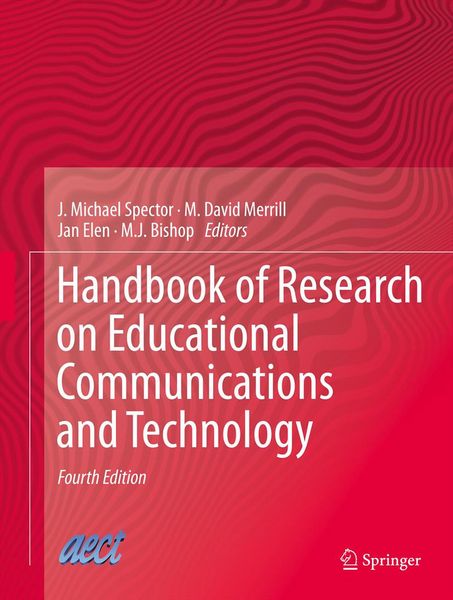
Produktbild: Handbook of Research on Educational Communications and Technology
- 12%

Handbook of Research on Educational Communications and Technology

Aus der Reihe AECT Series
12% sparen

269,99 € UVP 307,99 €

inkl. gesetzl. MwSt., Versandkostenfrei


Beschreibung

Produktdetails

Einband

Gebundene Ausgabe

Erscheinungsdatum

04.07.2013

Abbildungen

250 schwarz-weiße Abbildungen

Herausgeber

J. Michael Spector + weitere

Verlag

Springer Us

Seitenzahl

1005

Maße (L/B/H)

28,5/21,5/6 cm

Gewicht

3020 g

Auflage

4. Auflage

Sprache

Englisch

ISBN

978-1-4614-3184-8

Beschreibung

Rezension

"The Handbook aims to provide the most comprehensive, definitive, and accurate single-volume overview available in the field of educational communication and technology. ... this book is not only a sign of the field's development, but also a reflection on the dynamic state of mainstream educational research. Because of that, it is a mandatory read and reference for all educationalists and researchers of education." (Tamara Savelyeva, Technology Knowledge and Learning, Vol. 20, 2015)

"The volume updates the findings from the third edition, published in 2008, and will stand for several years as a summary of research in the field of educational technology or educational communications technology (ECT). ... The volume serves a valuable purpose of scholars seeking specific research findings in their areas of interest. ... My kudos to the editors and contributors of this outstanding volume!" (Brent G. Wilson, Educational Technology, Vol. 54 (6), November-December, 2014)

Portrait

J. Michael Spector is Research Scientist at the Learning and Performance Support Laboratory and Professor in the Educational Psychology and Instructional Technology Department at the University of Gerogia. His recent research is in the areas of intelligent support for instructional design, system dynamics based learning environments, assessing learning in complex domains, distance learning, and technology integration in education. M. David Merrill is retired Professor Emeritus, Utah State University. Since retiring, he has worked as a visiting Research professor at Florida State University and Research Consultant and Professor in Residence at Brigham Young University-Hawaii. He led the team which developed the authoring system for TICCIT (Time-shared Interactive Computer Controlled Information Television). Dr. Merrill further developed component display theory in association with the TICCIT system and refined that theory in the form of both elaboration theory and instructional transaction theory. Jan Elen is Professor in the Department of Educational Sciences of the Katholieke University of Leuven. His research is oriented towards the design and use of computer-supported learning environments in educational settings. He is the coordinator of the newly- founded School of Education of the Association at Katholieke University of Leuven. MJ Bishop is Associate Professor in the College of Education at Lehigh University. Her research interests are in understanding the fundamental components and the psychology behind instructional media and delivery systems in order to discover their pedagogical capabilities and limitations. Her goals are to devise more effective ways to design instructional technologies that enhance learning.

Produktdetails

Einband

Gebundene Ausgabe

Erscheinungsdatum

04.07.2013

Abbildungen

250 schwarz-weiße Abbildungen

Herausgeber

Verlag

Springer Us

Seitenzahl

1005

Maße (L/B/H)

28,5/21,5/6 cm

Gewicht

3020 g

Auflage

4. Auflage

Sprache

Englisch

ISBN

978-1-4614-3184-8

Herstelleradresse

Springer US, New York, N.Y.
Heidelberger Platz 3
14197 Berlin
Deutschland
Email: sdc-bookservice@springer.com
Fax: +49 6221 3454229

Noch keine Bewertungen vorhanden

Verfassen Sie die erste Bewertung zu diesem Artikel

Helfen Sie anderen Kundinnen und Kunden durch Ihre Meinung.

Kundinnen und Kunden meinen

Bewertungen (0)

Weitere Artikel finden Sie in

Die Leseprobe wird geladen.
  • Produktbild: Handbook of Research on Educational Communications and Technology
  •  Foundations of educational communications and technology.- Historical overview.- Research-based perspectives.- Examples.- Research methods.- Research approaches.-Design research.-Developmental research.- Activity research.- Classroom action research.- Quantitative methods.- Qualitative methods.- Strategies and models.- Formal learning.- Informal learning.- Adult learners.- Instructional design and development models.- Model-based learning and performance.- Motivational models.- Models for personalized learning.- Planning and implementation of educational technology.- Change agency in learning.- Cultural considerations.- Distributed educational practice.- Policies governing educational technology implementation, participatory planning and implementation of educational technology.- Emerging technologies.- Mobile technologies.- Tools and technologies for learning in complex domains.- Adaptive technologies.- Virtual/synthetic learning.-  Emerging representation technologies.- Web 2.0 communications tools and technologies.- Technology integration.- TPACK.- Technology integration in schools.- Technology integration in work settings.- Technology integration in health care.- Technology integration in public service contexts.- Technology integration in multi-cultural settings.- Technology integration for problem solving and decision making.-  Technology integration and generational differences.- Assessment and evaluation.- Collecting and analyzing data.- Program evaluation and research.- Assessing educational technologies in various domains.- Model-centered assessment.- Formative assessments.- Looking forward: Innovative educational technology around the globe.- Educational technology, funding opportunities and programs.- The learning sciences and instructional design technologies.- Costs and benefits of educational technology.- Educational technology and developing countries.- The philosophy of science and educational technologies.- The future of educational technology research.       ​