Gutscheinbedingungen

**Gültig bis 25.06.2026 auf fremdsprachige Bücher online auf thalia.at und in der Thalia App. Einzelne Artikel können ausgeschlossen sein. Ausgenommen sind preisgebundene Artikel & eBooks. Pro Einkauf einmal einlösbar. Click & Collect nur bei Onlinevorabzahlung möglich. Keine Barauszahlung. Nicht kombinierbar mit anderen Aktionen und Gutscheinen. Gutschein wird auf max. 500€ Bestellwert angerechnet. Nicht gültig für Geschenkkarten, Versandkosten und Services.

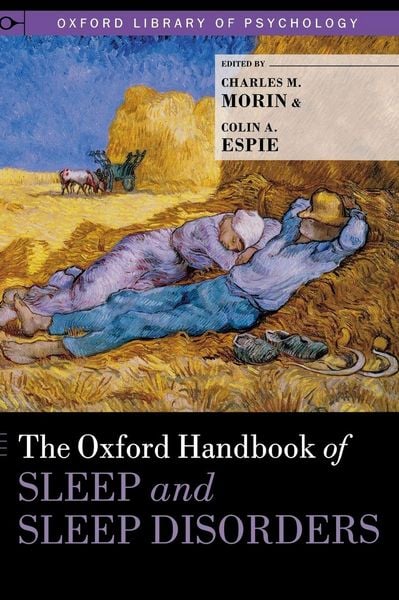
Produktbild: Oxford Handbook of Sleep and Sleep Disorders

Oxford Handbook of Sleep and Sleep Disorders

329,99 €

inkl. gesetzl. MwSt., Versandkostenfrei


Beschreibung

Produktdetails

Einband

Gebundene Ausgabe

Erscheinungsdatum

01.03.2012

Herausgeber

Morin Charles M. + weitere

Verlag

Oxford Academic

Seitenzahl

924

Maße (L/B/H)

26/18,3/5,4 cm

Gewicht

1746 g

Sprache

Englisch

ISBN

978-0-19-537620-3

Beschreibung

Zitat

this book is a rather clever mix of the psychological and empirical research on sleep, with a focus on special populations or difficulties with sleep. I would recommend this book as something of a tour de force; it is up-to-date, authoritative and extremely intriguing. The Journal of Critical Psychology, Counselling and Psychotherapy, April 2013

Produktdetails

Einband

Gebundene Ausgabe

Erscheinungsdatum

01.03.2012

Herausgeber

Verlag

Oxford Academic

Seitenzahl

924

Maße (L/B/H)

26/18,3/5,4 cm

Gewicht

1746 g

Sprache

Englisch

ISBN

978-0-19-537620-3

Herstelleradresse

Libri GmbH
Europaallee 1
36244 Bad Hersfeld
DE

Email: gpsr@libri.de

Kundinnen und Kunden meinen

0 Bewertungen

Informationen zu Bewertungen

Zur Abgabe einer Bewertung ist eine Anmeldung im Konto notwendig. Die Authentizität der Bewertungen wird von uns nicht überprüft. Wir behalten uns vor, Bewertungstexte, die unseren Richtlinien widersprechen, entsprechend zu kürzen oder zu löschen.

Die Bewertungen sind nach Format, Anzahl Sterne und Datum sortiert.

Verfassen Sie die erste Bewertung zu diesem Artikel

Helfen Sie anderen Kund*innen durch Ihre Meinung

Kundinnen und Kunden meinen

0 Bewertungen filtern

Die Leseprobe wird geladen.
  • Produktbild: Oxford Handbook of Sleep and Sleep Disorders
    • Introduction

    • Charles M. Morin and Colin Espie

    • Section I. Sleep

    • 1. Sleep and the brain

    • Philippe Peigneux, Charline Urbain, and Remy Schmitz

    • 2. The regulation of human sleep and wakefulness: Sleep Homeostasis and Circadian Rhythmicity

    • Derk-Jan Dijkn and Alpar Lazar

    • 3. The functions of sleep

    • Yvonne Harrison

    • 4. Sleep and human development

    • Kathryn A. Lee and Elisabeth A. Rosen

    • 5. Sleep and human performance

    • Timothy H. Monk

    • 6. The role of sleep in neurocognitive function

    • Matthew P. Walker

    • 7. Sleep and emotion

    • Martica Hall, Jessica Levenson, and Brant Hasler

    • 8. Sleep, Dreams, and Dreaming

    • Joseph De Koninck

    • 9. Sleep and psychopathology

    • Polina Eidelman, Anda Gershon, Eleanor McGlinchey, and Allison G. Harvey

    • 10. Sleep and psychotropic drugs

    • Dieter Riemann and Christoph Nissen

    • 11. Sleep and society

    • Sara Arber, Robert Meadows, and Susan Venn

    • 12. Sleep, work, and occupational stress

    • Torbjörn Ã…kerstedt and Göran Kecklund

    • 13. Sleep and gender: the paradox of sex and sleep?

    • Helen S. Driver

    • 14. Sleep and the psychology curriculum

    • Jason Ellis

    • Section II. Sleep Disorders

    • Epidemiology, Classification, and Assessment

    • 15. Epidemiology of sleep

    • Kevin Morgan

    • 16. A socio-economic perspective on sleep disorders

    • Damien Leger

    • 17. Forensic aspects of sleep disorders

    • Rosalind D. Cartwright

    • 18. Sleep disorders classification and diagnosis

    • Jack D. Edinger and Charles M. Morin

    • 19. Clinical assessment of sleep-wake complaints

    • James K. Wyatt, Jamie A. Cvengros, and Jason C. Ong

    • Sleep/Wake Disorders

    • 20. Insomnia I: Etiology and conceptualization

    • Philip Gehrman, James Findley, and Michael Perlis

    • 21. Insomnia II: Behavioral and physiological assessment

    • CÃ(c)lyne H. Bastien, Isabelle Turcotte, and Geneviÿve St-Jean

    • 22. Insomnia III: Therapeutic Approaches

    • Kenneth L. Lichstein, Gregory S. Vander Wal, and Haley R. Dillon

    • 23. Sleep and psychiatric disorders

    • Rachel Manber, Tricia Haynes, and Allison T. Siebern

    • 24. Sleep and medical disorders

    • Leanne Fleming and Judith R. Davidson

    • 25. Sleep and substance abuse disorders

    • J. Todd Arnedt, Deirdre A. Conroy, and Kirk J. Brower

    • 26. Parasomnias I: Nightmares

    • Anne Germain

    • 27. Parasomnias II: Night terrors and somnambulism

    • Antonio Zadra and Mathieu Pilon

    • 28. Circadian rhythm disorders I: Phase-advanced and phase-delayed syndromes

    • Leon C. Lack and Helen R. Wright

    • 29. Circadian rhythm disorders II: Shift-work and jet-lag

    • Annie Valliÿres and Emmanuelle Bastille-Denis

    • 30. Sleep-related breathing disorders

    • Terri E. Weaver and Lichuan Ye

    • 31. Hypersomnia and narcolepsy

    • Yves Dauvilliers and Sophie Bayard

    • 32. Restless legs syndrome and periodic limb movements

    • Richard P. Allen

    • Section III. Sleep and Special Populations

    • 33. Sleep-related problems in childhood

    • Melisa Moore and Jodi A. Mindell

    • 34. Sleep-related problems in adolescence

    • Amy R. Wolfson and Edward B. O'Malley

    • 35. Sleep disturbances in elderly

    • Jeanne E. Maglione and Sonia Ancoli-Israel

    • 36. Sleep disturbances and learning disability (mental retardation)

    • Luci D. Wiggs

    • 37. Sleep-Wake Disturbances and Fatigue in Individuals with Traumatic Brain Injury

    • Marie-Christine Ouellet, Simon Beaulieu-Bonneau, and Charles M. Morin

    • 38. Sleep Disturbance and Chronic Pain: Biobehavioral Interactions

    • Michael T. Smith, Adeel Nasir, Claudia M. Campbell, and Renata Okonkwo

    • Conclusion