
Gutscheinbedingungen

**Gültig nur für Bestellungen an die Wunsch-Poststation bis 10.06.2026 auf Spielzeug, Schreibwaren, Filme, Geschenke & Trends, Musik, tolino eReader & Zubehör, Hörbücher und Hörbuch-Downloads (außer Abo), nicht preisgebundene Bücher und Kalender online auf thalia.at und in der Thalia App. Einzelne Artikel können ausgeschlossen sein. Aufgrund der Buchpreisbindung sind deutschsprachige Bücher und eBooks ausgenommen. Zusätzlich ausgenommen sind preisgebundene Artikel, Abos & Flatrates, eBooks, Games, Geschenkkarten/-boxen, Shelfies, Software, Zeitschriften sowie einzelne Artikel von tonies®. Pro Einkauf einmal einlösbar. Kein Click & Collect möglich. Keine Barauszahlung. Nicht kombinierbar mit anderen Aktionen und Gutscheinen. Gutschein wird auf max. 500€ Bestellwert angerechnet. Nicht gültig für Versandkosten und Services.

  • Produktbild: Philosophy Without Intuitions
  • Produktbild: Philosophy Without Intuitions

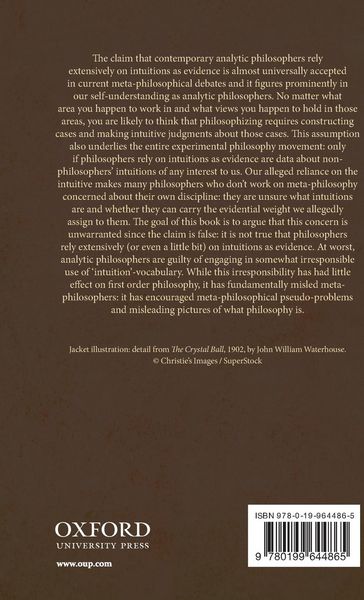
Philosophy Without Intuitions

124,99 €

inkl. gesetzl. MwSt., Versandkostenfrei


Beschreibung

Produktdetails

Einband

Gebundene Ausgabe

Erscheinungsdatum

01.05.2012

Verlag

Oxford University Press

Seitenzahl

256

Maße (L/B/H)

22,2/14,5/1,9 cm

Gewicht

438 g

Sprache

Englisch

ISBN

978-0-19-964486-5

Beschreibung

Zitat

Cappelen's book is a wonderfully clear, largely well-argued case against a central assumption of many contemporary metaphilosophers ... it makes the prospect of a general metaphilosophy look very dim ... this is a well-argued, interesting book, challenging contemporary metaphilosophy fundamentally; I highly recommend it. Daniel Cohnitz, Disputatio This is an engaging and exciting book. .. Whether one is convinced by its conclusion or not, Philosophy Without Intutions represents a clear jolt to contemporary metaphilosophical orthodoxy. It is a vivid and powerful call for philosophers to examine their assumptions about philosophy. Anyone interested in the role of intuitions in philosophy or the proper description of contemporary philosophical practice will benefit from studying it. Jonathan Ichikawa, International Journal for Philosophical Studies If you're interested in the role of intuitions in philosophy, you need to read this book. Even if you're not particularl concerned by this metaphilosophical issue youwould probably still benefit from reading this book, for it may well convince you to change theway in which you articulate your arguments and interpret other authors. Cappelen has made anexcellent contribution to the ongoing debate over the importance of intuitions in philosophy. Stephen Ingram, Metaphilosophy Experimental results on the variability and intra-personal instability of philosophical intuitions have recently sparked a lively methodological debate about the reliability of the philosophical method. In his new book, Herman Cappelen argues that this entire debate is misguided. The reason is simple: philosophers dont rely on intuitions, so there is no reason for philosophers to worry about their reliability. Cappelens case for this claim amounts to one of the most original and well-argued contributions to recent discussions about philosophical methodology. His book should be essential reading for anyone interested in the debate. Kristoffer AHlstrom-Vij, Philosophical Quarterly I'm glad that Cappelen wrote this book ... It's important because it (indirectly but effectively) draws attention to some challenging questions that it would be very good for meta-philosophy to get clearer on ... it's a refreshing and provocative leftfield attack - one that we probably deserve. Anna-Sara Malmgren, Notre Dame Philosophical Reviews

Produktdetails

Einband

Gebundene Ausgabe

Erscheinungsdatum

01.05.2012

Verlag

Oxford University Press

Seitenzahl

256

Maße (L/B/H)

22,2/14,5/1,9 cm

Gewicht

438 g

Sprache

Englisch

ISBN

978-0-19-964486-5

Herstelleradresse

Libri GmbH
Europaallee 1
36244 Bad Hersfeld
DE

Email: gpsr@libri.de

Kundinnen und Kunden meinen

0 Bewertungen

Informationen zu Bewertungen

Zur Abgabe einer Bewertung ist eine Anmeldung im Konto notwendig. Die Authentizität der Bewertungen wird von uns nicht überprüft. Wir behalten uns vor, Bewertungstexte, die unseren Richtlinien widersprechen, entsprechend zu kürzen oder zu löschen.

Die Bewertungen sind nach Format, Anzahl Sterne und Datum sortiert.

Verfassen Sie die erste Bewertung zu diesem Artikel

Helfen Sie anderen Kund*innen durch Ihre Meinung

Kundinnen und Kunden meinen

0 Bewertungen filtern

  • Produktbild: Philosophy Without Intuitions
  • Produktbild: Philosophy Without Intuitions
    • Preface and Acknowledgements

    • 1: Intuitions in Philosophy: Overview and Taxonomy

    • Part I: The Argument from 'Intuition'-Talk

    • Introduction to Part I

    • 2: 'Intuitive', 'Intuitively', 'Intuition', and 'Seem' in English

    • 3: Philosophers' Use of 'Intuitive' (I): A Defective Practice and the Verbal Virus Theory

    • 4: Philosophers' Use of 'Intuitive' (II): Some Strategies for Charitable Interpretation

    • Appendix to Chapter 4: Williamson on Intuition as Belief and Inclination to Believe

    • 5: Philosophers' Use of 'Intuitive' (III): Against the Explaining Away of Intuitions

    • Part II: The Argument from Philosophical Practice

    • Introduction to Part II

    • 6: Centrality and Philosophical Practice

    • 7: Diagnostics for Intuitiveness

    • 8: Case Studies

    • 9: Lessons Learned, Replies to Objections, and Comparison to Williamson

    • 10: Conceptual Analysis and Intuitions

    • 11: A Big Mistake: Experimental Philosophy

    • Bibliography

    • Index