KI-Beratung Beta

Gutscheinbedingungen

**Gültig bis 09.11.2026 auf tolino shine color (4016621130473), tolino vision color (4016621130183) und tolino vision color weiß (4016621131456) online auf thalia.at, in der Thalia App und in allen Thalia Buchhandlungen in Österreich. In den Buchhandlungen nur gültig auf lagernde Ware. Pro Einkauf einmal einlösbar. Nur gültig gegen Vorlage oder im Onlineshop hinterlegter Bonuscard. Infos zur Einlösung in der Buchhandlung sind auf der Bonuscard-Vorteilspreisseite zu finden. Click & Collect nur bei Onlinevorabzahlung möglich. Keine Einlösung bei Scan & Go-Bezahlung. Keine Barauszahlung. Nicht kombinierbar mit anderen Aktionen und Gutscheinen. Nicht gültig für Geschenkkarten, Versandkosten und Services. Nur solange der Vorrat reicht.

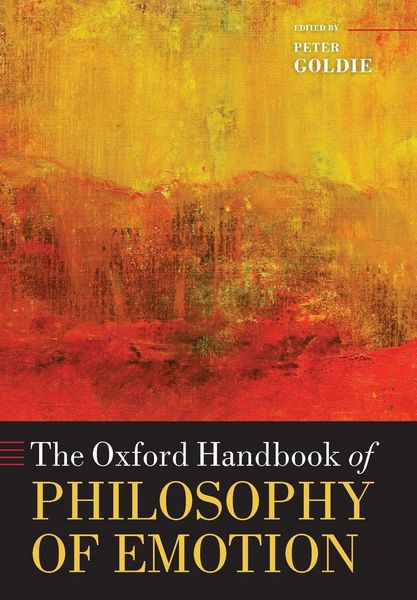
  • Produktbild: THE OXFORD HANDBOOK OF PHILOSOPHY OF EMOTION
  • Produktbild: THE OXFORD HANDBOOK OF PHILOSOPHY OF EMOTION

THE OXFORD HANDBOOK OF PHILOSOPHY OF EMOTION

Aus der Reihe Oxford Handbooks

101,99 €

inkl. gesetzl. MwSt., Versandkostenfrei


Beschreibung

Produktdetails

Einband

Taschenbuch

Erscheinungsdatum

16.07.2013

Herausgeber

Goldie Peter

Verlag

Oxford University Press

Seitenzahl

738

Maße (L/B/H)

24,4/17/4 cm

Gewicht

1250 g

Sprache

Englisch

ISBN

978-0-19-965437-6

Beschreibung

Produktdetails

Einband

Taschenbuch

Erscheinungsdatum

16.07.2013

Herausgeber

Goldie Peter

Verlag

Oxford University Press

Seitenzahl

738

Maße (L/B/H)

24,4/17/4 cm

Gewicht

1250 g

Sprache

Englisch

ISBN

978-0-19-965437-6

Herstelleradresse

Libri GmbH
Europaallee 1
36244 Bad Hersfeld
DE

Email: gpsr@libri.de

Noch keine Bewertungen vorhanden

Verfassen Sie die erste Bewertung zu diesem Artikel

Helfen Sie anderen Kundinnen und Kunden durch Ihre Meinung.

Kundinnen und Kunden meinen

Bewertungen (0)

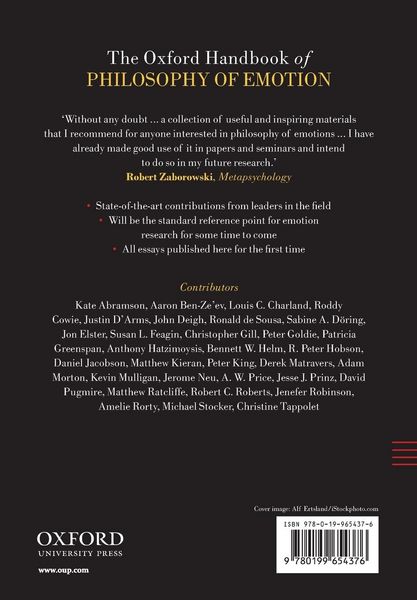
  • Produktbild: THE OXFORD HANDBOOK OF PHILOSOPHY OF EMOTION
  • Produktbild: THE OXFORD HANDBOOK OF PHILOSOPHY OF EMOTION
    • Introduction
    • Part 1: What Emotions Are
    • 1: John Deigh: Concepts of Emotion in Modern Philosophy and Psychology
    • 2: Aaron Ben-Ze'ev: The Thing Called Emotion
    • 3: Roddy Cowie: Describing the Forms of Emotional Colouring that Pervade Everyday Life
    • 4: Ronald de Sousa: The Mind's Bermuda Triangle: Philosophy of Emotions and Empirical Science
    • Part 2: The History of Emotion
    • 5: Anthony Price: Emotions in Plato and Aristotle
    • 6: Christopher Gill: Stoicism and Epicureanism
    • 7: Peter King: Emotion in Medieval Thought
    • 8: Kate Abramson: A Sentimentalist defence of Contempt, Shame, and Disdain
    • 9: Anthony Hatzimoysis: Emotions in Heidegger and Sartre
    • 10: Louis C. Charland: Reinstating the Passions: Arguments from History of Psychopathology
    • Part 3: Emotions and Practical Reason
    • 11: Jon Elster: Emotional Choice and Rational Choice
    • 12: Sabine Döring: Why be Emotional?
    • 13: Bennett Helm: Emotions and Motivation: Reconsidering Neo-Jamesian Accounts
    • 14: Christine Tappolet: Emotions and Motivation: The Case of Fear
    • Part 4: Emotions and the Self
    • 15: Matthew Ratcliffe: The Phenomenology of Mood and the Meaning of Life
    • 16: David Pugmire: Saying It
    • 17: Adam Morton: Epistemic Emotions
    • 18: Amelie Rorty: A Plea for Ambivalence
    • 19: R. Peter Hobson: Emotion, Self/Other-Awareness, and Autism: A Developmental Perspective
    • 20: Michael Stocker: Intellectual and Other Non-Standard Emotions
    • Part 5: Emotion, Value, and Morality
    • 21: Kevin Mulligan: Emotions and Values
    • 22: Jerome Neu: An Ethics of Emotion?
    • 23: Jesse Prinz: The Moral Emotions
    • 24: Patricia Greenspan: Learning Emotions and Ethics
    • 25: Robert C. Roberts: Emotions and the Canons of Evaluation
    • 26: Justin D'Arms and Daniel Jacobson: Demystifying Sensibilities: Sentimental Values and the Instability of Affect
    • Part 6: Emotion, Art, and Aesthetics
    • 27: Derek Matravers: Expression in the Arts
    • 28: Susan Feagin: Affects in Appreciation
    • 29: Matthew Kieran: Emotions, Art, and Immorality
    • 30: Jenefer Robinson: Emotional Responses to Music: What are they? How do they work? And are they relevant to aesthetic appreciation?