KI-Beratung Beta

Gutscheinbedingungen

**Gültig am 25.11.2026 auf fremdsprachige Bücher online auf thalia.at und in der Thalia App. Einzelne Artikel können ausgeschlossen sein. Ausgenommen sind preisgebundene Artikel & eBooks. Pro Einkauf einmal einlösbar. Click & Collect nur bei Onlinevorabzahlung möglich. Keine Barauszahlung. Nicht kombinierbar mit anderen Aktionen und Gutscheinen. Gutschein wird auf max. 500€ Bestellwert angerechnet. Nicht gültig für Geschenkkarten, Versandkosten und Services.

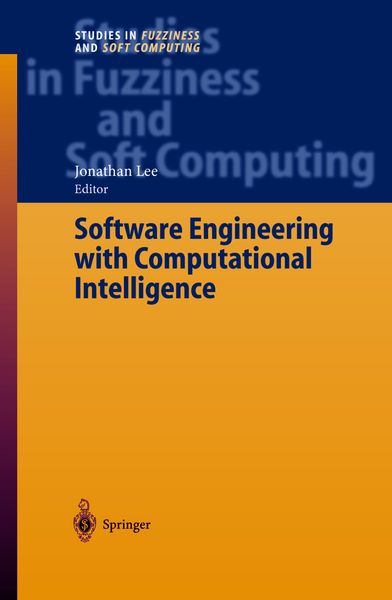
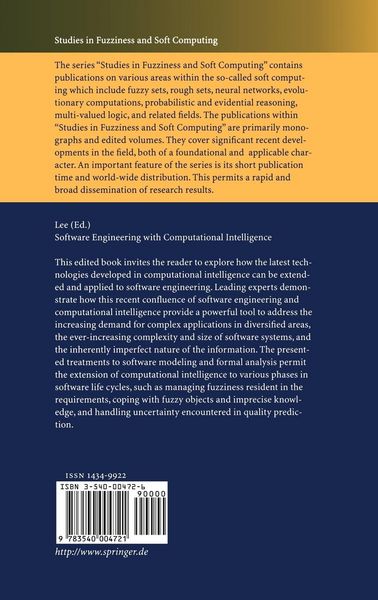
  • Produktbild: Software Engineering with Computational Intelligence
  • Produktbild: Software Engineering with Computational Intelligence
Band 121

Software Engineering with Computational Intelligence

148,99 €

inkl. gesetzl. MwSt., Versandkostenfrei


Beschreibung

It is not an exaggeration to view Professor Lee's book," Software Engineer ing with Computational Intelligence," or SECI for short, as a pioneering contribution to software engineering. Breaking with the tradition of treat ing uncertainty, imprecision, fuzziness and vagueness as issues of peripheral...

Beschreibung

It is not an exaggeration to view Professor Lee's book," Software Engineer ing with Computational Intelligence," or SECI for short, as a pioneering contribution to software engineering. Breaking with the tradition of treat ing uncertainty, imprecision, fuzziness and vagueness as issues of peripheral importance, SECI moves them much closer to the center of the stage. It is ob vious, though still not widely accepted, that this is where these issues should be, since the real world is much too complex and much too ill-defined to lend itself to categorical analysis in the Cartesian spirit. As its title suggests, SECI employs the machineries of computational intel ligence (CI) and, more or less equivalently, soft computing (SC), to deal with the foundations and principal issues in software engineering. Basically, CI and SC are consortia of methodologies which collectively provide a body of con cepts and techniques for conception, design, construction and utilization of intelligent systems. The principal constituents of CI and SC are fuzzy logic, neurocomputing, evolutionary computing, probabilistic computing, chaotic computing and machine learning. The leitmotif of CI and SC is that, in general, better performance can be achieved by employing the constituent methodologies of CI and SC in combination rat her than in a stand-alone mode. In what follows, I will take the liberty of focusing my attention on fuzzy logic and fuzzy set theory, and on their roles in software engineering. But first, a couple of points of semantics which are in need of clarification.

Produktdetails

Einband

Gebundene Ausgabe

Erscheinungsdatum

19.03.2003

Abbildungen

XI, 270 p.

Herausgeber Jonathan Lee

Produktdetails

Einband

Gebundene Ausgabe

Erscheinungsdatum

19.03.2003

Abbildungen

XI, 270 p.

Herausgeber Jonathan Lee
Verlag Springer Berlin
Seitenzahl

270

Maße (L/B/H)

24,1/16/2,1 cm

Gewicht

554 g

Auflage

2003

Sprache

Englisch

ISBN

978-3-540-00472-1

Herstelleradresse

Springer-Verlag GmbH
Europaplatz 3
69115 Heidelberg
DE

Email: ProductSafety@springernature.com

Noch keine Bewertungen vorhanden

Verfassen Sie die erste Bewertung zu diesem Artikel

Helfen Sie anderen Kundinnen und Kunden durch Ihre Meinung.

Kundinnen und Kunden meinen

Bewertungen (0)

  • Produktbild: Software Engineering with Computational Intelligence
  • Produktbild: Software Engineering with Computational Intelligence
  • to Software Engineering with Computational Intelligence.- Fuzzy Concepts and Formal Methods.- Trade-off Requirement Engineering.- A Generalized Object-Oriented Data Model Based on Level-2 Fuzzy Sets.- Modelling Imperfect Spatial Information in a Fuzzy Object Oriented Database.- Using Classical Object-Oriented Features to Build a Fuzzy O-O Database System.- Domain Analysis for the Engineering of Spatiotemporal Software.- Object-Oriented Framework of Fuzzy Knowledge Systems.- Fuzzy Evaluation of Domain Knowledge.- Application of Fuzzy Rule Extraction to Minimize the Costs of Misclassification on Software Quality Modeling.- Processing Software Engineering Data: Granular-based Approach.