Gutscheinbedingungen

**Gültig am 17.06.2026 auf Spielzeug, Schreibwaren, Filme, Geschenke & Trends, Musik, tolino eReader & Zubehör, Hörbücher und Hörbuch-Downloads (außer Abo), nicht preisgebundene Bücher und Kalender online auf thalia.at und in der Thalia App. Einzelne Artikel können ausgeschlossen sein. Aufgrund der Buchpreisbindung sind deutschsprachige Bücher und eBooks ausgenommen. Zusätzlich ausgenommen sind preisgebundene Artikel, Abos & Flatrates, eBooks, Games, Geschenkkarten/-boxen, Shelfies, Software, Zeitschriften sowie einzelne Artikel von tonies®. Pro Einkauf einmal einlösbar. Click & Collect nur bei Onlinevorabzahlung möglich. Keine Barauszahlung. Nicht kombinierbar mit anderen Aktionen und Gutscheinen. Gutschein wird auf max. 500€ Bestellwert angerechnet. Nicht gültig für Versandkosten und Services.

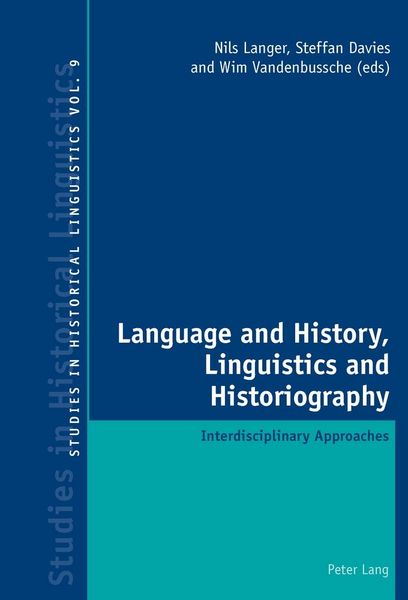
  • Produktbild: Language and History, Linguistics and Historiography
  • Produktbild: Language and History, Linguistics and Historiography
Band 9

Language and History, Linguistics and Historiography Interdisciplinary Approaches

86,85 €

inkl. gesetzl. MwSt., Versandkostenfrei


Beschreibung

Produktdetails

Einband

Taschenbuch

Erscheinungsdatum

08.12.2011

Herausgeber

Nils Langer + weitere

Verlag

Peter Lang Group AG, International Academic Publishers

Seitenzahl

516

Maße (L/B/H)

22,5/15/2,9 cm

Gewicht

750 g

Auflage

1. Auflage

Sprache

Englisch

ISBN

978-3-0343-0761-1

Beschreibung

Portrait

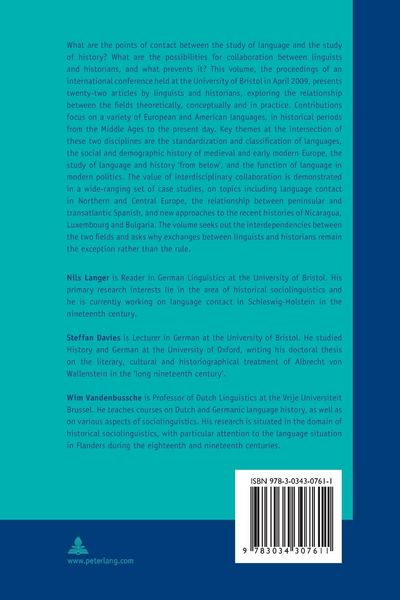
Nils Langer is Reader in German Linguistics at the University of Bristol. His primary research interests lie in the area of historical sociolinguistics and he is currently working on language contact in Schleswig-Holstein in the nineteenth century.
Steffan Davies is Lecturer in German at the University of Bristol. He studied History and German at the University of Oxford, writing his doctoral thesis on the literary, cultural and historiographical treatment of Albrecht von Wallenstein in the ‘long nineteenth century’.
Wim Vandenbussche is Professor of Dutch Linguistics at the Vrije Universiteit Brussel. He teaches courses on Dutch and Germanic language history, as well as on various aspects of sociolinguistics. His research is situated in the domain of historical sociolinguistics, with particular attention to the language situation in Flanders during the eighteenth and nineteenth centuries.

Produktdetails

Einband

Taschenbuch

Erscheinungsdatum

08.12.2011

Herausgeber

Verlag

Peter Lang Group AG, International Academic Publishers

Seitenzahl

516

Maße (L/B/H)

22,5/15/2,9 cm

Gewicht

750 g

Auflage

1. Auflage

Sprache

Englisch

ISBN

978-3-0343-0761-1

EU-Ansprechpartner

Zeitfracht Medien GmbH
Ferdinand-Jühlke-Straße 7|99095|Erfurt|DE
produktsicherheit@zeitfracht.de

Herstelleradresse

Peter Lang
Avenue du Théâtre 7|1005|Lausanne|CH
orders@peterlang.com

Kundinnen und Kunden meinen

0 Bewertungen

Informationen zu Bewertungen

Zur Abgabe einer Bewertung ist eine Anmeldung im Konto notwendig. Die Authentizität der Bewertungen wird von uns nicht überprüft. Wir behalten uns vor, Bewertungstexte, die unseren Richtlinien widersprechen, entsprechend zu kürzen oder zu löschen.

Die Bewertungen sind nach Format, Anzahl Sterne und Datum sortiert.

Verfassen Sie die erste Bewertung zu diesem Artikel

Helfen Sie anderen Kund*innen durch Ihre Meinung

Kundinnen und Kunden meinen

0 Bewertungen filtern

  • Produktbild: Language and History, Linguistics and Historiography
  • Produktbild: Language and History, Linguistics and Historiography
  • Contents: Steffan Davies/Nils Langer/Wim Vandenbussche: Language and History, Linguistics and Historiography: Interdisciplinary Problems and Opportunities – Patrick Honeybone: History and Historical Linguistics: Two Types of Cognitive Reconstruction? – Nicholas M. Wolf: History and Linguistics: The Irish Language as a Case Study in an Interdisciplinary Approach to Culture – Brian D. Joseph: Historical Linguistics and Sociolinguistics: Strange Bedfellows or Natural Friends? – Nicola McLelland: From Humanist History to Linguistic Theory: The Case of the Germanic Rootword – Agnete Nesse: Editorial Practices and Language Choice: ‘Low German Language Monuments’ in Norway – Robert Evans: Official Languages: A Brief Prehistory – Tomasz Kamusella: Classifying the Slavic Languages, or the Politics of Classification – José del Valle: Linguistic History and the Development of Normative Regimes: The Royal Spanish Academy’s Disputed Transatlantic Authority – Juan R. Valdez: Colouring Language: Pedro Henríquez Ureña’s Representations of Spanish and Dominican Identity – Laura Villa: ‘Because When Governments Speak, They Are Not Always Right’: National Construction and Orthographic Conflicts in Mid-Nineteenth-Century Spain – Gijsbert Rutten/Rik Vosters: As Many Norms as There Were Scribes? Language History, Norms and Usage in the Southern Netherlands in the Nineteenth Century – Anneleen Vanden Boer: Language and Nation: The Case of the German-Speaking Minority in Belgium – Richard Ingham: The Decline of Bilingual Competence in French in Medieval England: Evidence from the PROME Database – Rembert Eufe: Merovingian Coins and Their Inscriptions: A Challenge to Linguists and Historians – Remco Knooihuizen: The Use of Historical Demography for Historical Sociolinguistics: The Case of Dunkirk – Judith Nobels/Marijke van der Wal: Linking Words to Writers: Building a Reliable Corpus for Historical Sociolinguistic Research – Helmut Graser/B. Ann Tlusty: Sixteenth-Century Street Songs and Language History ‘From Below’ – Juan Manuel Hernández-Campoy: Mood Distinction in Late Middle English: The End of the Inflectional Subjunctive – Lisa Carroll-Davies: Identifying the Enemy: Using a CDA and Corpus Approach to Analyse Sandinista Strategies of Naming – Krassimir Stoyanov: Ritualized Slogan Lexis in the Bulgarian Press during the Times of Violent Contradiction in Ideologies (1944-1947) – Kristine Horner/Melanie Wagner: Remembering World War II and Legitimating Luxembourgish as the National Language: Consensus or Conflict? – Michela Giordano/Federica Falchi: John Stuart Mill and Salvatore Morelli: Language as a Social Tool in Nineteenth-Century Britain and Italy.