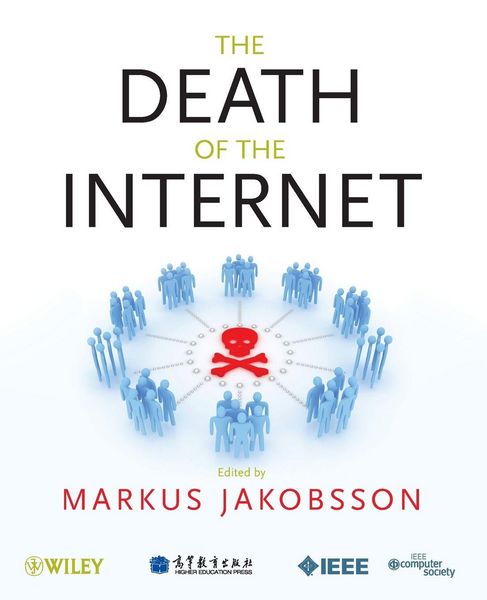
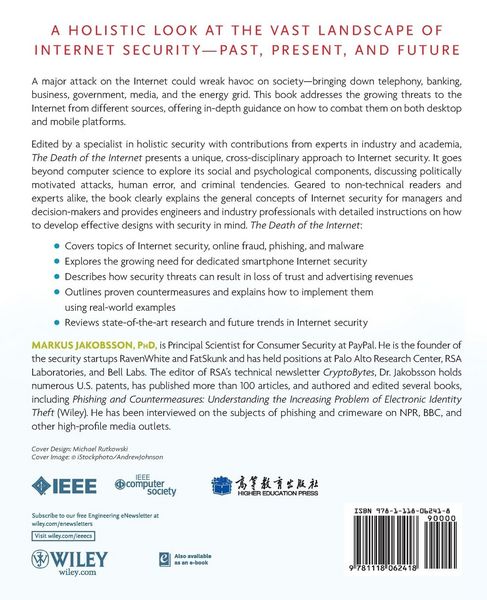
• Produktbild: The Death of the Internet
  • Produktbild: The Death of the Internet

The Death of the Internet

Aus der Reihe Wiley - IEEE

93,99 €

inkl. gesetzl. MwSt., Versandkostenfrei


Beschreibung

Produktdetails

Einband

Taschenbuch

Erscheinungsdatum

06.07.2012

Herausgeber

Markus Jakobsson

Verlag

John Wiley & Sons

Seitenzahl

386

Maße (L/B/H)

23,6/18,9/2,2 cm

Gewicht

683 g

Auflage

1. Auflage

Sprache

Englisch

ISBN

978-1-118-06241-8

Beschreibung

Rezension

"For those looking for a book to gain situation awareness about the dangers of the Internet, one is hard pressed to find a better title than The Death of the Internet." (Word Virus, 17 April 2013)
 
"For those looking for a book to gain situation awareness about the dangers of the Internet, one is hard pressed to find a better title than The Death of the Internet." (Slashdot, 15 April 2013)
 
"The book includes possible solutions to some of the problems, but the overwhelming appeal of this text is the awareness is provides. Summing Up: Highly recommended. Students of all levels, general readers, and professionals/practitioners." (Choice, 1 January 2012)

Produktdetails

Einband

Taschenbuch

Erscheinungsdatum

06.07.2012

Herausgeber

Markus Jakobsson

Verlag

John Wiley & Sons

Seitenzahl

386

Maße (L/B/H)

23,6/18,9/2,2 cm

Gewicht

683 g

Auflage

1. Auflage

Sprache

Englisch

ISBN

978-1-118-06241-8

Herstelleradresse

Libri GmbH
Europaallee 1
36244 Bad Hersfeld
DE

Email: gpsr@libri.de

Noch keine Bewertungen vorhanden

Verfassen Sie die erste Bewertung zu diesem Artikel

Helfen Sie anderen Kundinnen und Kunden durch Ihre Meinung.

Kundinnen und Kunden meinen

Bewertungen (0)

  • Produktbild: The Death of the Internet
  • Produktbild: The Death of the Internet
  • Foreword xv
     
    Preface xvii
     
    Is the Title of this Book a Joke? xix
     
    Acknowledgments xxi
     
    Contributors xxiii
     
    Part I The Problem
     
    1 What Could Kill the Internet? And so What? 3
     
    2 It is About People 7
     
    2.1 Human and Social Issues 7
    Markus Jakobsson
     
    2.1.1 Nigerian Scams 8
     
    2.1.2 Password Reuse 9
     
    2.1.3 Phishing 11
     
    2.2 Who are the Criminals? 13
    Igor Bulavko
     
    2.2.1 Who are they? 13
     
    2.2.2 Where are they? 14
     
    2.2.3 Deep-Dive: Taking a Look at Ex-Soviet Hackers 14
     
    2.2.4 Let's try to Find Parallels in the World we Live in 16
     
    2.2.5 Crime and Punishment? 16
     
    3 How Criminals Profit 19
     
    3.1 Online Advertising Fraud 20
    Nevena Vratonjic, Mohammad Hossein Manshaei, and Jean-Pierre Hubaux
     
    3.1.1 Advertising on the Internet 20
     
    3.1.2 Exploits of Online Advertising Systems 23
     
    3.1.3 Click Fraud 25
     
    3.1.4 Malvertising: Spreading Malware via Ads 31
     
    3.1.5 Inflight Modification of Ad Traffic 32
     
    3.1.6 Adware: Unsolicited Software Ads 34
     
    3.1.7 Conclusion 35
     
    3.2 Toeing the Line: Legal but Deceptive Service Offers 35
    Markus Jakobsson and Ruilin Zhu
     
    3.2.1 How Does it Work? 36
     
    3.2.2 What do they Earn? 36
     
    3.3 Phishing and Some Related Attacks 38
    Markus Jakobsson and William Leddy
     
    3.3.1 The Problem is the User 38
     
    3.3.2 Phishing 38
     
    3.3.3 Man-in-the-Middle 39
     
    3.3.4 Man-in-the-Browser 40
     
    3.3.5 New Attack: Man-in-the-Screen 41
     
    3.4 Malware: Current Outlook 42
     
    Members of the BITS Security Working Group and staff leads Greg Rattray and Andrew Kennedy
     
    3.4.1 Malware Evolution 42
     
    3.4.2 Malware Supply and Demand 48
     
    3.5 Monetization 53
    Markus Jakobsson
     
    3.5.1 There is Money Everywhere 53
     
    4 How ThingsWork and Fail 57
     
    4.1 Online Advertising: With Secret Security 58
    Markus Jakobsson
     
    4.1.1 What is a Click? 58
     
    4.1.2 How Secret Filters are Evaluated 60
     
    4.1.3 What do Fraudsters Know? 62
     
    4.2 Web Security Remediation Efforts 63
    Jeff Hodges and Andy Steingruebl
     
    4.2.1 Introduction 63
     
    4.2.2 The Multitude of Web Browser Security Mechanisms 64
     
    4.2.3 Where do we go from Here? 75
     
    4.3 Content-Sniffing XSS Attacks: XSS with Non-HTML Content 75
    Juan Caballero, Adam Barth, and Dawn Song
     
    4.3.1 Introduction 75
     
    4.3.2 Content-Sniffing XSS Attacks 77
     
    4.3.3 Defenses 84
     
    4.3.4 Conclusion 89
     
    4.4 Our Internet Infrastructure at Risk 89
    Garth Bruen
     
    4.4.1 Introduction 89
     
    4.4.2 The Political Structure 90
     
    4.4.3 The Domain 92
     
    4.4.4 WHOIS: Ownership and Technical Records 94
     
    4.4.5 Registrars: Sponsors of Domain Names 96
     
    4.4.6 Registries: Sponsors of Domain Extensions 97
     
    4.4.7 CCTLDs: The Sovereign Domain Extensions 99
     
    4.4.8 ICANN: The Main Internet Policy Body 100
     
    4.4.9 Conclusion 102
     
    4.5 Social Spam 103
    Dimitar Nikolov and Filippo Menczer
     
    4.5.1 Introduction 103
     
    4.5.2 Motivations for Spammers 105
     
    4.5.3 Case Study: Spam in the GiveALink Bookmarking System 108
     
    4.5.4 Web Pollution 114
     
    4.5.5 The Changing Nature of Social Spam: Content Farms 116
     
    4.5.6 Conclusion 117
     
    4.6 Understanding CAPTCHAs and Their Weaknesses 117
    Elie Bursztein
     
    4.6.1 What is a Captcha? 117
     
    4.6.2 Types of Captchas 118
     
    4.6.3 Evaluating Captcha Attack Effecti