KI-Beratung Beta

  • Produktbild: Quest to Understand Human Affairs
  • Produktbild: Quest to Understand Human Affairs

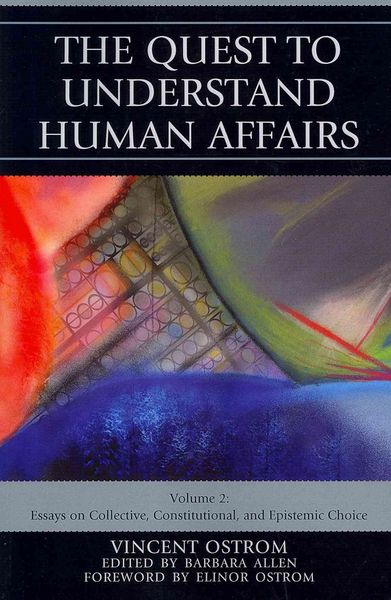
Quest to Understand Human Affairs Essays on Collective, Constitutional, and Epistemic Choice

115,99 €

inkl. gesetzl. MwSt., Versandkostenfrei


Beschreibung

The second volume of The Quest to Understand Human Affairs presents thirty-six previously unpublished manuscripts written by Vincent Ostrom, cofounder of the Workshop in Political Theory and Policy Analysis. The essays are divided among three parts: Constitutional Choice, Epistemic Choice, and The Quest...

Beschreibung

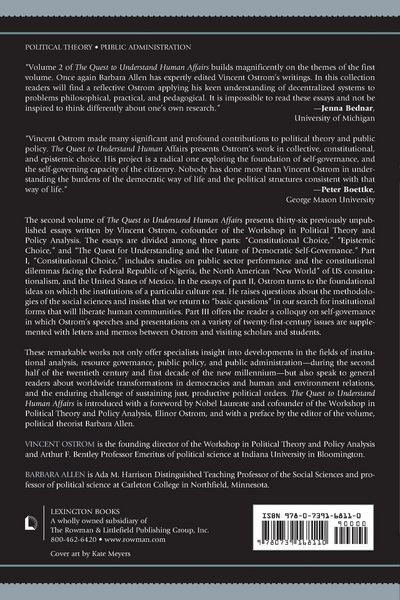
The second volume of The Quest to Understand Human Affairs presents thirty-six previously unpublished manuscripts written by Vincent Ostrom, cofounder of the Workshop in Political Theory and Policy Analysis. The essays are divided among three parts: Constitutional Choice, Epistemic Choice, and The Quest for Understanding and the Future of Democratic Self-Governance. Part I, Constitutional Choice, includes studies on public sector performance and the constitutional dilemmas facing the Federal Republic of Nigeria, the North American "New World" of US constitutionalism, and the United States of Mexico. In the essays of Part II, Ostrom turns to the foundational ideas on which the institutions of a particular culture rest. He raises questions about the methodologies of the social sciences and insists that we return to "basic questions" in our search for institutional forms that will liberate human communities. Part III offers the reader a colloquy on self-governance in which Ostrom’s speeches and presentations on a variety of twenty-first-century issues are supplemented with letters and memos between Ostrom and visiting scholars and students. These remarkable works not only offer specialists insight into developments in the fields of institutional analysis, resource governance, policy and administration—during the second half of the twentieth century and first decade of the new millennium—but also speak to general readers about worldwide transformations in democracies and human and environment relations as well as the enduring challenge of sustaining just, productive political orders. The Quest to Understand Human Affairs is introduced with a foreword by Nobel Laureate and co-founder of the Workshop in Political Theory and Policy Analysis, Elinor Ostrom, with a preface by the editor of the volume, political theorist Barbara Allen.

Produktdetails

Einband

Taschenbuch

Erscheinungsdatum

02.02.2012

Herausgeber Barbara Allen
Verlag Ingram Publishers Services

Produktdetails

Einband

Taschenbuch

Erscheinungsdatum

02.02.2012

Herausgeber Barbara Allen
Verlag Ingram Publishers Services
Seitenzahl

686

Maße (L/B/H)

22,9/15,2/3,7 cm

Gewicht

977 g

Sprache

Englisch

ISBN

978-0-7391-6811-0

Herstelleradresse

Libri GmbH
Europaallee 1
36244 Bad Hersfeld
DE

Email: gpsr@libri.de

Noch keine Bewertungen vorhanden

Verfassen Sie die erste Bewertung zu diesem Artikel

Helfen Sie anderen Kundinnen und Kunden durch Ihre Meinung.

Kundinnen und Kunden meinen

Bewertungen (0)

  • Produktbild: Quest to Understand Human Affairs
  • Produktbild: Quest to Understand Human Affairs
  • Foreword by Elinor Ostrom
    Preface
    PART I: CONSTITUTIONAL CHOICE
    David Hume as a Political Analyst
    The Individual and the Constitutional Order in the American Federal Republic
    Constitutional Choice in Postcolonial Polities: The Federal Republic of Nigeria
    The Challenge of Federalism
    Guidance, Control, and Performance in the Public Sector
    Some Conjectures about the Shape of the Political Science to Come
    Buchanan's Opening to Constitutional Choice and Meta Levels of Analysis
    Constitutional Choice in the Spanish New World
    Federalism in the Affairs of Everyday Life
    The Challenge Facing the Mexican Revolution in Its Third Century
    PART II: EPISTEMIC CHOICE
    Political Characteristics of the Pacific Northwest:
    A Challenge to Research-The Problem of Method
    Freedom and Organization
    Implications of Epistemic Choice for Political Science Methodologies
    Federalism and Consociationalism: Competing or Complementary Approaches?
    Comments
    Conceptualizing the Nature and Magnitude of the Task of Institutional Analysis and Development
    Culture, Liberation Movements, and Human Development
    Some Ontological and Epistemological Puzzles in Policy Analysis
    Interpreting Social Experiments: An Agenda for Critical Reflections and Inquiry about a Research
    Program in Comparative Institutional Analysis and Development
    Great Experiments and the Welfare State: Basic Paradigmatic Challenges
    To the Readers of the Chinese Translation [of The Meaning of American Federalism]
    PART III THE QUEST FOR UNDERSTANDING AND THE FUTURE OF DEMOCRATIC SELF-GOVERNANCE
    A Continuing Colloquy on Self-Governance
    Democracy and Self-Governance
    The Inevitability of Democracy
    Some Requisites for Understanding Viable
    Constitutional Designs
    Memos to Colleagues and Students
    Workshop Analytics and Tocquevillian Analytics
    Experiments in Constitutional Choice
    The Use of Theory to Study Problems of Institutional Analysis and Design
    Studying Democracy in America: Learning to be Self-Governing by Vincent Ostrom and Barbara Allen
    Democratic Transformations: From the Struggle for Democracy to Self-Governance? by Michael McGinnis and Vincent Ostrom
    Federalism and the Exercise of Self-Governing Capabilities
    Rethinking Federalism
    The Spirit of Federalism
    What is Federalism? A Search for Meaning
    Self-Government and Federalism
    Revisiting Public Administration and Democratic Governance
    Political Theory and Public Administration
    Syracuse Notes: How Do We Conceptualize the Meaning of the American Experiment?
    Some Developments in the Study of Market Choice, Public Choice, and Institutional Choice
    The Continuing Challenge of Constitutional Choice
    Why Were There So Many Constitutional Failures in the Twentieth Century?
    An Assessment of Failure and the Challenge Ahead
    Citizen-Sovereigns: The Implications of Hamilton's Query and Tocqueville's Conjecture about the Democratic
    Revolution
    Index