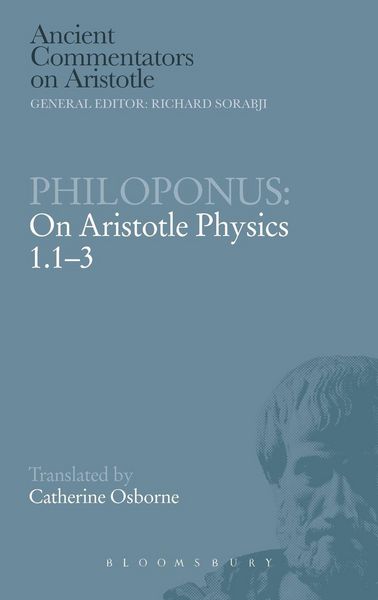
Philoponus On Aristotle Physics 1.1-3
-
- Hardcover ausgewählt
- Taschenbuch
- eBook
-
Sprache:Englisch
-
Verlag:Bloomsbury
188,99 €
inkl. gesetzl. MwSt.,
Beschreibung
Produktdetails
Einband
Gebundene Ausgabe
Erscheinungsdatum
27.01.2006
Herausgeber
Catherine OsborneVerlag
BloomsburySeitenzahl
240
Maße (L/B/H)
24/16,1/1,4 cm
Gewicht
408 g
Sprache
Englisch
ISBN
978-0-7156-3409-7
Until the launch of this series over fifteen years ago, the 15,000 volumes of the ancient Greek commentators on Aristotle, written mainly between 200 and 600 AD, constituted the largest corpus of extant Greek philosophical writings not translated into English or other European languages. In this, the first half of Philoponus' analysis of book one of Aristotle's Physics, the principal themes are metaphysical. Aristotle's opening chapter in the Physics is an abstract reflection on methodology for the investigation of nature, or 'physics'. Aristotle suggests that one must proceed from things that are familiar but vague, and derive more precise but less obvious principles to constitute genuine knowledge. His controversial claim that this is to progress from the universal to the more particular occasions extensive apologetic exegesis, typical of Philoponus' meticulous and somewhat pedantic method. Philoponus explains away the apparent conflict between the 'didactic method' (unavoidable in physics) and the strict demonstrative method described in the Analytics. After 20 pages on Chapter 1, Philoponus devotes the remaining 66 pages to Aristotle's objections to two major Presocratic thinkers, Parmenides and Melissus. Aristotle included these thinkers as an aside, because they were not engaged in physics, but in questioning the very basis of physics. Philoponus investigates Aristotle's claims about the relation between a science and its axioms, explores alternative ways of formalising Aristotle's refutation of Eleatic monism and provides a sustained critique of Aristotle's analysis of the Eleatics' purported mistakes about unity and being.
Noch keine Bewertungen vorhanden
Verfassen Sie die erste Bewertung zu diesem Artikel
Helfen Sie anderen Kundinnen und Kunden durch Ihre Meinung.
Kurze Frage zu unserer Seite
Vielen Dank für Ihr Feedback
Wir nutzen Ihr Feedback, um unsere Produktseiten zu verbessern. Bitte haben Sie Verständnis, dass wir Ihnen keine Rückmeldung geben können. Falls Sie Kontakt mit uns aufnehmen möchten, können Sie sich aber gerne an unseren Kund*innenservice wenden.
zum Kundenservice