KI-Beratung Beta

Gutscheinbedingungen

**Gültig am 27.11.2026 auf Spielzeug, Schreibwaren, Filme, Geschenke & Trends, Musik, tolino eReader & Zubehör, Hörbücher und Hörbuch-Downloads, nicht preisgebundene Bücher und Kalender online auf thalia.at und in der Thalia App. Einzelne Artikel können ausgeschlossen sein. Aufgrund der Buchpreisbindung sind deutschsprachige Bücher und eBooks ausgenommen. Zusätzlich ausgenommen sind Abos & Flatrates, Games, Geschenkkarten/-boxen, Shelfies, Software, Zeitschriften sowie einzelne Artikel von tonies®. Pro Einkauf einmal einlösbar. Click & Collect nur bei Onlinevorabzahlung möglich. Keine Barauszahlung. Nicht kombinierbar mit anderen Aktionen und Gutscheinen. Gutschein wird auf max. 500€ Bestellwert angerechnet. Nicht gültig für Versandkosten und Services.

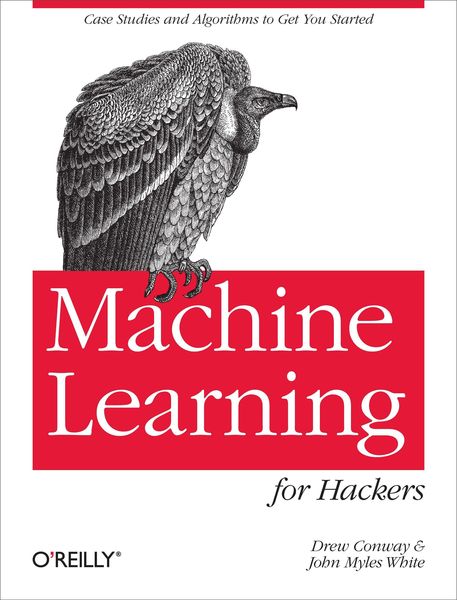
Produktbild: Machine Learning for Hackers

Machine Learning for Hackers Case Studies and Algorithms to Get You Started

48,99 €

inkl. gesetzl. MwSt., Versandkostenfrei


Beschreibung

If you're an experienced programmer interested in crunching data, this book will get you started with machine learning—a toolkit of algorithms that enables computers to train themselves to automate useful tasks. Authors Drew Conway and John Myles White help you understand machine learning and statistics...

Beschreibung

If you're an experienced programmer interested in crunching data, this book will get you started with machine learning—a toolkit of algorithms that enables computers to train themselves to automate useful tasks. Authors Drew Conway and John Myles White help you understand machine learning and statistics tools through a series of hands-on case studies, instead of a traditional math-heavy presentation.

Each chapter focuses on a specific problem in machine learning, such as classification, prediction, optimization, and recommendation. Using the R programming language, you'll learn how to analyze sample datasets and write simple machine learning algorithms. Machine Learning for Hackers is ideal for programmers from any background, including business, government, and academic research.

  • Develop a naïve Bayesian classifier to determine if an email is spam, based only on its text
  • Use linear regression to predict the number of page views for the top 1,000 websites
  • Learn optimization techniques by attempting to break a simple letter cipher
  • Compare and contrast U.S. Senators statistically, based on their voting records
  • Build a "whom to follow” recommendation system from Twitter data

Produktdetails

Einband

Taschenbuch

Erscheinungsdatum

20.03.2012

Abbildungen

w. ill.

Verlag O'Reilly Media

Produktdetails

Einband

Taschenbuch

Erscheinungsdatum

20.03.2012

Abbildungen

w. ill.

Verlag O'Reilly Media
Seitenzahl

320

Maße (L/B/H)

23,7/18,2/2,2 cm

Gewicht

529 g

Sprache

Englisch

ISBN

978-1-4493-0371-6

Herstelleradresse

Libri GmbH
Europaallee 1
36244 Bad Hersfeld
DE

Email: gpsr@libri.de

Noch keine Bewertungen vorhanden

Verfassen Sie die erste Bewertung zu diesem Artikel

Helfen Sie anderen Kundinnen und Kunden durch Ihre Meinung.

Kundinnen und Kunden meinen

Bewertungen (0)

Die Leseprobe wird geladen.
  • Produktbild: Machine Learning for Hackers
  • Preface; Machine Learning for Hackers; How This Book Is Organized; Conventions Used in This Book; Using Code Examples; Safari® Books Online; How to Contact Us; Acknowledgements; Chapter 1: Using R; 1.1 R for Machine Learning; Chapter 2: Data Exploration; 2.1 Exploration versus Confirmation; 2.2 What Is Data?; 2.3 Inferring the Types of Columns in Your Data; 2.4 Inferring Meaning; 2.5 Numeric Summaries; 2.6 Means, Medians, and Modes; 2.7 Quantiles; 2.8 Standard Deviations and Variances; 2.9 Exploratory Data Visualization; 2.10 Visualizing the Relationships Between Columns; Chapter 3: Classification: Spam Filtering; 3.1 This or That: Binary Classification; 3.2 Moving Gently into Conditional Probability; 3.3 Writing Our First Bayesian Spam Classifier; Chapter 4: Ranking: Priority Inbox; 4.1 How Do You Sort Something When You Don't Know the Order?; 4.2 Ordering Email Messages by Priority; 4.3 Writing a Priority Inbox; Chapter 5: Regression: Predicting Page Views; 5.1 Introducing Regression; 5.2 Predicting Web Traffic; 5.3 Defining Correlation; Chapter 6: Regularization: Text Regression; 6.1 Nonlinear Relationships Between Columns: Beyond Straight Lines; 6.2 Methods for Preventing Overfitting; 6.3 Text Regression; Chapter 7: Optimization: Breaking Codes; 7.1 Introduction to Optimization; 7.2 Ridge Regression; 7.3 Code Breaking as Optimization; Chapter 8: PCA: Building a Market Index; 8.1 Unsupervised Learning; Chapter 9: MDS: Visually Exploring US Senator Similarity; 9.1 Clustering Based on Similarity; 9.2 How Do US Senators Cluster?; Chapter 10: kNN: Recommendation Systems; 10.1 The k-Nearest Neighbors Algorithm; 10.2 R Package Installation Data; Chapter 11: Analyzing Social Graphs; 11.1 Social Network Analysis; 11.2 Hacking Twitter Social Graph Data; 11.3 Analyzing Twitter Networks; Chapter 12: Model Comparison; 12.1 SVMs: The Support Vector Machine; 12.2 Comparing Algorithms; Works Citedbooks and publicationsbibliography ofresourcesbooks and publications; website resourcesstatisticsresources formachine learningresources forR programming languageresources for; Colophon;