Gutscheinbedingungen

**Gültig bis 25.06.2026 auf fremdsprachige Bücher online auf thalia.at und in der Thalia App. Einzelne Artikel können ausgeschlossen sein. Ausgenommen sind preisgebundene Artikel & eBooks. Pro Einkauf einmal einlösbar. Click & Collect nur bei Onlinevorabzahlung möglich. Keine Barauszahlung. Nicht kombinierbar mit anderen Aktionen und Gutscheinen. Gutschein wird auf max. 500€ Bestellwert angerechnet. Nicht gültig für Geschenkkarten, Versandkosten und Services.

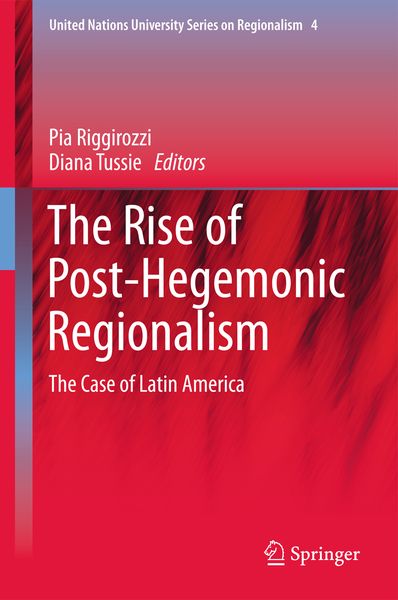
  • Produktbild: The Rise of Post-Hegemonic Regionalism
  • Produktbild: The Rise of Post-Hegemonic Regionalism
Band 4

The Rise of Post-Hegemonic Regionalism The Case of Latin America

99,99 €

inkl. gesetzl. MwSt., Versandkostenfrei


Beschreibung

Produktdetails

Einband

Gebundene Ausgabe

Erscheinungsdatum

07.01.2012

Herausgeber

Pía Riggirozzi + weitere

Verlag

Springer Netherland

Seitenzahl

194

Maße (L/B/H)

24,1/16/1,8 cm

Gewicht

489 g

Auflage

1. Auflage

Sprache

Englisch

ISBN

978-94-007-2693-2

Beschreibung

Rezension

From the reviews:

“Examine how regional projects in the Americas are adapting, emerging and evolving independent of the hegemonic influence of the United States. … For scholars of inter-American affairs and regionalism this book serves as an important touchstone summarizing the current state of affairs in Latin America. … For the non-specialist and busy policy-maker … it provides a clear, concise and sophisticated survey of the major regional processes and challenges that matter. … should be read by generalists turning their attention to the Americas.” (Sean Burges, International Affairs, Vol. 89 (2), March, 2013)

Zitat

From the reviews:"Examine how regional projects in the Americas are adapting, emerging and evolving independent of the hegemonic influence of the United States. ... For scholars of inter-American affairs and regionalism this book serves as an important touchstone summarizing the current state of affairs in Latin America. ... For the non-specialist and busy policy-maker ... it provides a clear, concise and sophisticated survey of the major regional processes and challenges that matter. ... should be read by generalists turning their attention to the Americas." (Sean Burges, International Affairs, Vol. 89 (2), March, 2013)

Produktdetails

Einband

Gebundene Ausgabe

Erscheinungsdatum

07.01.2012

Herausgeber

Verlag

Springer Netherland

Seitenzahl

194

Maße (L/B/H)

24,1/16/1,8 cm

Gewicht

489 g

Auflage

1. Auflage

Sprache

Englisch

ISBN

978-94-007-2693-2

Herstelleradresse

Springer-Verlag KG
Sachsenplatz 4-6
1201 Wien
AT

Email: ProductSafety@springernature.com

Kundinnen und Kunden meinen

0 Bewertungen

Informationen zu Bewertungen

Zur Abgabe einer Bewertung ist eine Anmeldung im Konto notwendig. Die Authentizität der Bewertungen wird von uns nicht überprüft. Wir behalten uns vor, Bewertungstexte, die unseren Richtlinien widersprechen, entsprechend zu kürzen oder zu löschen.

Die Bewertungen sind nach Format, Anzahl Sterne und Datum sortiert.

Verfassen Sie die erste Bewertung zu diesem Artikel

Helfen Sie anderen Kund*innen durch Ihre Meinung

Kundinnen und Kunden meinen

0 Bewertungen filtern

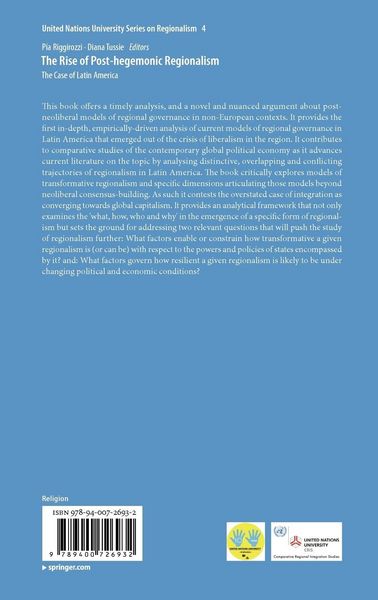
  • Produktbild: The Rise of Post-Hegemonic Regionalism
  • Produktbild: The Rise of Post-Hegemonic Regionalism
  • 1. The Rise of Post-Hegemonic Regionalism in Latin America; Pía Riggirozzi and Diana Tussie.- 2. Reconstructing Regionalism in Latin America: What Does Development Have To Do With It?; Pía Riggirozzi.- 3. Consistency and Resilience through Cycles of Repolitization;  Olivier Dabène.- 4. Infrastructure: Learning and Cooperation for the Provision of Regional Public Goods ; Ricardo Carciofi.- 5. Defence in a Post Hegemonic Regional Agenda: The Case of the South American Defence Council ; Jorge Battaglino.- 6. The Rise of Monetary Agreements in South America ; Pablo Trucco.- 7. Socio-Environmental Regionalism in South America: Tensions in New Development Models; Marcelo Saguier.- 8. Regionalism and Civil Society: Bridging the Democratic Gap?; Andres Serbín).- 9. Moving Regions: Brazil's Global Emergence and the Redefinition of Latin American Borders; Andres Malamud.- 10. Postlude; Pía Riggirozzi and Diana Tussie.-