Gutscheinbedingungen

**Gültig von 22.06.2026 ab 19 Uhr bis 23.06.2026 24 Uhr auf Spielzeug, Schreibwaren, Filme, Geschenke & Trends, Musik, tolino eReader & Zubehör, Hörbücher und Hörbuch-Downloads (außer Abo), nicht preisgebundene Bücher und Kalender online auf thalia.at und in der Thalia App. Einzelne Artikel können ausgeschlossen sein. Aufgrund der Buchpreisbindung sind deutschsprachige Bücher und eBooks ausgenommen. Zusätzlich ausgenommen sind preisgebundene Artikel, Abos & Flatrates, eBooks, Games, Geschenkkarten/-boxen, Shelfies, Software, Zeitschriften sowie einzelne Artikel von tonies®. Pro Einkauf einmal einlösbar. Click & Collect nur bei Onlinevorabzahlung möglich. Keine Barauszahlung. Nicht kombinierbar mit anderen Aktionen und Gutscheinen. Gutschein wird auf max. 500€ Bestellwert angerechnet. Nicht gültig für Versandkosten und Services.

  • Produktbild: Social Self-Organization
  • Produktbild: Social Self-Organization
- 13%

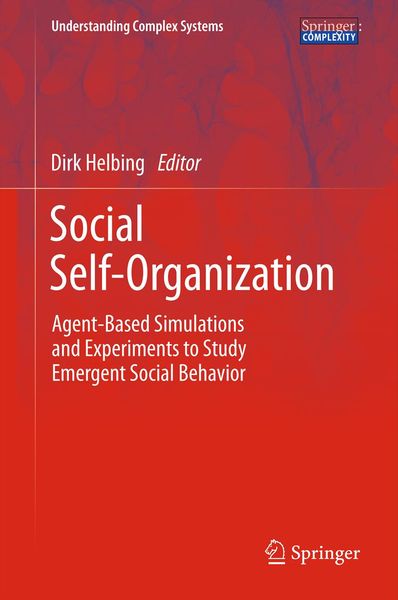
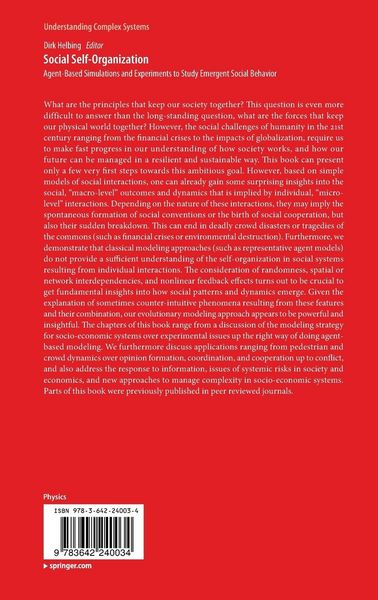
Social Self-Organization Agent-Based Simulations and Experiments to Study Emergent Social Behavior

13% sparen

142,99 € UVP 164,99 €

inkl. gesetzl. MwSt., Versandkostenfrei


Beschreibung

Produktdetails

Einband

Gebundene Ausgabe

Erscheinungsdatum

06.05.2012

Herausgeber

Dirk Helbing

Verlag

Springer Berlin

Seitenzahl

341

Maße (L/B/H)

24,1/16/2,4 cm

Gewicht

694 g

Auflage

2012

Sprache

Englisch

ISBN

978-3-642-24003-4

Beschreibung

Rezension

From the reviews:

“This volume is a collection of models whose aim is not only to better explain a variety of phenomena in the social, cultural and economic realms using agent-based models, but also to manage these complex phenomena. … I recommend this as an important addition to the growing work on both the theoretical and practical world of agent-based simulation modelling in the social sciences.” (John Bragin, Journal of Artificial Societies and Social Simulation, April, 2013)

Portrait

Dirk Helbing,

ETH Zürich

Chair of Sociology Dept., Theoretical physicist, Worldwide leading scientist in computational social sciences and econophysics/complexity research.

Zitat

From the reviews:"This volume is a collection of models whose aim is not only to better explain a variety of phenomena in the social, cultural and economic realms using agent-based models, but also to manage these complex phenomena. ... I recommend this as an important addition to the growing work on both the theoretical and practical world of agent-based simulation modelling in the social sciences." (John Bragin, Journal of Artificial Societies and Social Simulation, April, 2013)

Produktdetails

Einband

Gebundene Ausgabe

Erscheinungsdatum

06.05.2012

Herausgeber

Dirk Helbing

Verlag

Springer Berlin

Seitenzahl

341

Maße (L/B/H)

24,1/16/2,4 cm

Gewicht

694 g

Auflage

2012

Sprache

Englisch

ISBN

978-3-642-24003-4

Herstelleradresse

Springer-Verlag GmbH
Tiergartenstr. 17
69121 Heidelberg
DE

Email: ProductSafety@springernature.com

Kundinnen und Kunden meinen

0 Bewertungen

Informationen zu Bewertungen

Zur Abgabe einer Bewertung ist eine Anmeldung im Konto notwendig. Die Authentizität der Bewertungen wird von uns nicht überprüft. Wir behalten uns vor, Bewertungstexte, die unseren Richtlinien widersprechen, entsprechend zu kürzen oder zu löschen.

Die Bewertungen sind nach Format, Anzahl Sterne und Datum sortiert.

Verfassen Sie die erste Bewertung zu diesem Artikel

Helfen Sie anderen Kund*innen durch Ihre Meinung

Kundinnen und Kunden meinen

0 Bewertungen filtern

  • Produktbild: Social Self-Organization
  • Produktbild: Social Self-Organization
  • Modeling of Socio-Economic Systems.- Agent-based modeling.- Self-Organization in Pedestrian Crowds.- Opinion Formation.- Spatial Self-Organization through Success-Driven Mobility.- Cooperation in Social Dilemmas.- Co-Evolution of Social Behavior and Spatial Organization.- Evolution of Moral Behavior.- Coordination and Competitive Innovation Spreading in Social Networks.- Heterogeneous Populations: Coexistence, Integration, or Conflict.- Social Experiments and Computers.- Learning of Coordinated Behavior.- Response to Information.- Systemic Risks in Society and Economics.- Managing Complexity.- Challenges in Economics.