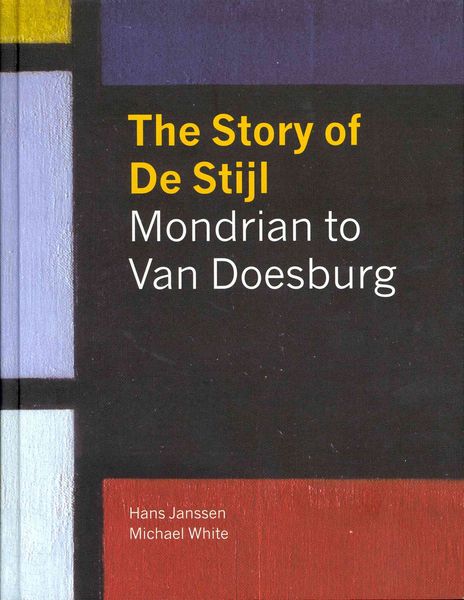
Produktbild: The Story of de Stijl

The Story of de Stijl Mondrian to van Doesburg

58,99 €

inkl. gesetzl. MwSt., Versandkostenfrei


Beschreibung

Produktdetails

Einband

Gebundene Ausgabe

Erscheinungsdatum

28.10.2011

Verlag

Lund Humphries Publishers Ltd

Seitenzahl

272

Maße (L/B/H)

29/24,4/1,4 cm

Gewicht

1302 g

Sprache

Englisch

ISBN

978-1-84822-094-2

Beschreibung

Produktdetails

Einband

Gebundene Ausgabe

Erscheinungsdatum

28.10.2011

Verlag

Lund Humphries Publishers Ltd

Seitenzahl

272

Maße (L/B/H)

29/24,4/1,4 cm

Gewicht

1302 g

Sprache

Englisch

ISBN

978-1-84822-094-2

Noch keine Bewertungen vorhanden

Verfassen Sie die erste Bewertung zu diesem Artikel

Helfen Sie anderen Kundinnen und Kunden durch Ihre Meinung.

Kundinnen und Kunden meinen

Bewertungen (0)

  • Produktbild: The Story of de Stijl
  • Contents: Introduction - What is De Stijl?; H.P. Berlage (1856 Amsterdam - The Hague 1934); Bart van der Leck (1876 Utrecht - Blaricum, the Netherlands 1958); I - How most of the original protagonists meet and form De Stijl; 01 (1916) - The famous architect and the headstrong artist - The design of the 'art room' at Groot Haesebroeck estate, Piet Mondrian (1872 Amersfoort, the Netherlands - New York 1944); 02 (1916) The downfall of the village - Mondrian, Laren and the search for an abstract life, Theo van Doesburg (1883 Utrecht - Davos 1931); 03 (1916) - A new monumentality - Van Doesburg and Huszar at the Kroller-Muller collection in The Hague, Vilmos Huszar (1884 Budapest - Hierden, the Netherlands 1960); 04 (1917) - "Das colorierte Haus" - The house for solicitor J. de Lange of Alkmaar, Antony Kok (1882 Rotterdam - Tilburg, the Netherlands 1969); 05 (1917) - Of different minds - The Hollandsche Kunstenaarskring exhibition of 1917, Georges Vantongerloo (1886 Antwerp - Paris 1965); 06 (1918) - By bike and by train - An art movement in the new urban environment called the Randstad, Robert van 't Hoff (1887 Rotterdam - New Milton (UK) 1979); 07 (1918) - Troubled waters - Houseboat De Stijl; Entr'acte Fashion 1 - Modernity in fashion; II - Significant collaborations (and their problems 08 (1919) - Radical art and radical politics - The colour design for the house of Bart de Ligt in Katwijk aan Zee, Piet Zwart (1885 Zaandijk, the Netherlands - Leidschendam, the Netherlands 1977); 09 (1919) - The ethics of straight lines - the Huszar - Zwart debate at the Haagsche Kunstkring, Jan Wils (1891 Alkmaar, the Netherlands - Voorburg, the Netherlands 1972); 10 (1920) - A promising scheme - The enthusiastic response to the Papaverhof houses in The Hague and the marriage of Theo van Doesburg and Lena Milius, J. J. P. Oud (1890 Purmerend, the Netherlands - The Hague 1963); 11 (1920) - Housing and collectivity - Oud and Van Doesburg and their almost invisible solutions for the Spangen apartment blocks in Rotterdam; 12 (1920) - The dynamics of progress - The Section d'Or, Theo van Doesburg and Jan Toorop exhibition, I.K. Bonset (1920 unknown - Davos 1931); 13 (1920) - Dada and De Stijl - An artist writes about modern life, Lena Milius (1889 Tilburg, the Netherlands - The Hague 1968); 14 (1920) - 'I am no house painter. I take these things very seriously - ' The collaboration between Oud and Van Doesburg on the housing blocks for Spangen II Aldo Camini (1921 unknown - Milan, prior to 1921); 15 (1921) - For readers on the move - A new format for a modern magazine, Gerrit Rietveld (1888 Utrecht - Utrecht 1964); 16 (1922) - The birth of modern city planning - Van Eesteren meets Van Doesburg in Weimar; 17 (1923) - The Dada Tour of Holland - Everything was dada, except the prices; 18 (1923) - A Far Flung Corner of a World City - The businesslike but very Dutch solutions to the architecture in the Tusschendijken district, Cornelis van Eesteren (1897 Kinderdijk, the Netherlands - 1988 Amsterdam); 19 (1923) - 'The practical execution of the Stijl idea' - the Rosenberg exhibition Truus Schroder (1889 Deventer - Utrecht 1974); 20 (1924) - How do you want to live? - An emancipated woman's views on child rearing, and the new architecture of the Rietveld- Schroder House; Entr'acte Fashion 2 - Stylishly dressed; III - The problems of 1925 and the disintegration of the De Stijl group; 21 (1925) - Counter-compositions - The role of dance and women in modern life; 22 (1925) - The applied arts swindle - The Exposition Internationale des Arts Decoratifs et Industriels Modernes, Paris, 1925; 23 (1925) - 'The cold kills the microbes' - The City of Circulation; 24 (1926) - A painting in three dimensions - The 'Salle des fleurs' for a lavish villa in the south of France, Cesar Domela (1900 Amsterdam - 1992 Paris) 25 (1927) - 'Not as sectarian as (the late!) "De Stijl".' - Cesar Domela, Arthur Lehning, Piet Mondrian and i10; 26 (1927) - Advertising as Fine Art - Vilmos Huszar and the 'Miss Blanche' cigarette advertising campaign; 27 (1927) - An Hour of Town Planning with Van Eesteren - New approaches to the rationalization of town planning, Nelly van Doesburg (1899 The Hague - Meudon 1975); 28 (1928) - A building of movement - The design for the Aubette centre in Strasbourg; 29 (1928) - 'Down with conservatism' - The CIAM meeting at La Sarraz with Rietveld and Berlage, Mart Stam (1899 Purmerend, the Netherlands - Goldbach (Zurich canton, Switzerland, 1986); 30 (1929) - The tubular chair - An exhibition and a copyright issue; 31 (1930) - 'Dwelling Fords'? - A solution to the re-housing problem for rock-bottom incomes; 32 (1931) - Mondrian in his studio - 'A pure world [your work] has shown us and thus have we become aware of it'; Entr'acte Fashion 3 - Right down to the glass cloths -; 33 (1935) - 'A daily joy' - The Bruynzeel kitchen and the 'standardisation' of women's work; 34 (1939) - Back to the Future - The Dutch contribution at the New York World's Fair of 1939.