Gutscheinbedingungen

**Gültig bis 06.07.2026 auf fremdsprachige Bücher online auf thalia.at, in der Thalia App ab einem Mindestbestellwert von 30€ und in allen Thalia Buchhandlungen in Österreich. In den Buchhandlungen nur gültig auf lagernde Ware. Einzelne Artikel können ausgeschlossen sein. Ausgenommen sind preisgebundene Artikel & eBooks. Pro Einkauf einmal einlösbar. Nur gültig gegen Vorlage oder im Onlineshop hinterlegter Bonuscard. Infos zur Einlösung in der Buchhandlung sind auf der Bonuscard-Vorteilspreisseite zu finden. Click & Collect nur bei Onlinevorabzahlung möglich. Keine Einlösung bei Scan & Go-Bezahlung. Keine Barauszahlung. Nicht kombinierbar mit anderen Aktionen und Gutscheinen. Gutschein wird auf max. 500€ Bestellwert angerechnet. Nicht gültig für Versandkosten und Services.

  • Produktbild: Solving Numerical PDEs: Problems, Applications, Exercises
  • Produktbild: Solving Numerical PDEs: Problems, Applications, Exercises

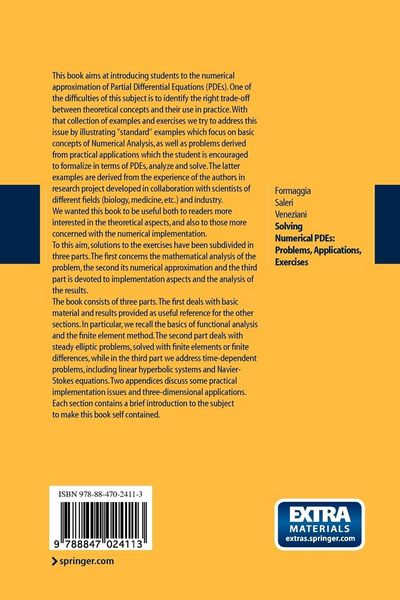
Solving Numerical PDEs: Problems, Applications, Exercises

Aus der Reihe La Matematica per il 3+2

49,99 €

inkl. gesetzl. MwSt., Versandkostenfrei


Beschreibung

Produktdetails

Einband

Taschenbuch

Erscheinungsdatum

13.12.2011

Verlag

Springer Italia

Seitenzahl

434

Maße (L/B/H)

23,5/15,5/2,5 cm

Gewicht

696 g

Auflage

1. Auflage

Sprache

Englisch

ISBN

978-88-470-2411-3

Beschreibung

Produktdetails

Einband

Taschenbuch

Erscheinungsdatum

13.12.2011

Verlag

Springer Italia

Seitenzahl

434

Maße (L/B/H)

23,5/15,5/2,5 cm

Gewicht

696 g

Auflage

1. Auflage

Sprache

Englisch

ISBN

978-88-470-2411-3

Herstelleradresse

Springer-Verlag KG
Sachsenplatz 4-6
1201 Wien
AT

Email: GPSR Kontakt

Noch keine Bewertungen vorhanden

Verfassen Sie die erste Bewertung zu diesem Artikel

Helfen Sie anderen Kundinnen und Kunden durch Ihre Meinung.

Kundinnen und Kunden meinen

Bewertungen (0)

  • Produktbild: Solving Numerical PDEs: Problems, Applications, Exercises
  • Produktbild: Solving Numerical PDEs: Problems, Applications, Exercises
  • Part I Basic Material. 1 Some fundamental tools. 1.1 Hilbert spaces. 1.2 Distributions. 1.3 The spaces Lp and Hs. 1.4 Sequences in lp. 1.5 Important inequalities. 1.6 Brief overview of matrix algebra. 2 Fundamentals of finite elements and finite differences. 2.1 The one dimensional case: approximation by piecewise polynomials. 2.2 Interpolation in higher dimension using finite elements. 2.2.1 Geometric preliminary definitions. 2.2.2 The finite element. 2.2.3 Parametric Finite Elements. 2.2.4 Function approximation by finite elements. 2.3 The method of finite differences. 2.3.1 Difference quotients in dimension one. Part II Stationary Problems. 3 Galerkin-finite element method for elliptic problems. 3.1 Approximation of 1D elliptic problems. 3.1.1 Finite differences in 1D. 3.2 Elliptic problems in 2D. 3.3 Domain decomposition methods for 1D elliptic problems. 3.3.1 Overlapping methods. 3.3.2 Non-overlapping methods. 4 Advection-diffusion-reaction (ADR) problems . 4.1 Preliminary problems. 4.2 Advection dominated problems. 4.3 Reaction dominated problems. Part III Time dependent problems. 5 Equations of parabolic type. 5.1 Finite difference time discretization. 5.2 Finite element time discretization. 6 Equations of hyperbolic type. 6.1 Scalar advection-reaction problems. 6.2 Systems of linear hyperbolic equations of order one. 7 Navier-Stokes equations for incompressible fluids. 7.1 Steady problems. 7.2 Unsteady problems. Part IV Appendices. A The treatment of sparse matrices. A.1 Storing techniques for sparse matrices. A.1.1 The COO format. A.1.2 The skyline format. A.1.3 The CSR format. A.1.4 The CSC format. A.1.5 The MSR format. A.2 Imposing essential boundary conditions. A.2.1 Elimination of essential degrees of freedom. A.2.2 Penalization technique. A.2.3 “Diagonalization” technique. A.2.4 Essential conditions in a vectorial problem. B Who’swho.