Gutscheinbedingungen

**Gültig bis 22.07.2026 ab einem Mindestbestellwert von 40€ auf Spielzeug, Schreibwaren, Filme, Geschenke & Trends, Musik, tolino eReader & Zubehör, Hörbücher und Hörbuch-Downloads (außer Abo), nicht preisgebundene Bücher und Kalender online auf thalia.at und in der Thalia App. Einzelne Artikel können ausgeschlossen sein. Aufgrund der Buchpreisbindung sind deutschsprachige Bücher und eBooks ausgenommen. Zusätzlich ausgenommen sind preisgebundene Artikel, Abos & Flatrates, eBooks, Games, Geschenkkarten/-boxen, Shelfies, Software, Zeitschriften sowie einzelne Artikel von tonies®. Pro Einkauf einmal einlösbar. Click & Collect nur bei Onlinevorabzahlung möglich. Keine Barauszahlung. Nicht kombinierbar mit anderen Aktionen und Gutscheinen. Gutschein wird auf max. 500€ Bestellwert angerechnet. Nicht gültig für Versandkosten und Services. Preisgebundene Artikel sind vom Mindestbestellwert ausgeschlossen.

  • Produktbild: Restoring Lands - Coordinating Science, Politics and Action
  • Produktbild: Restoring Lands - Coordinating Science, Politics and Action

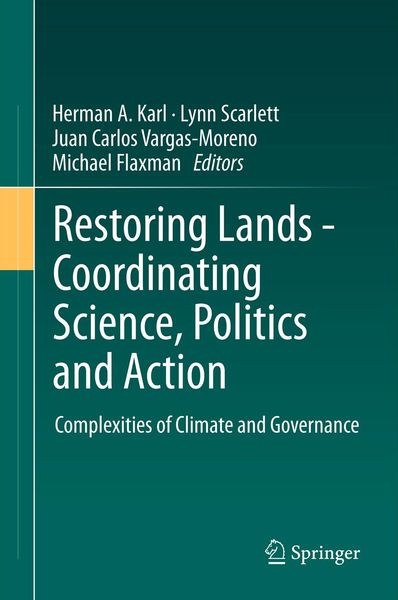
Restoring Lands - Coordinating Science, Politics and Action Complexities of Climate and Governance

148,99 €

inkl. gesetzl. MwSt., Versandkostenfrei


Beschreibung

Produktdetails

Einband

Gebundene Ausgabe

Erscheinungsdatum

05.02.2012

Herausgeber

Herman Karl + weitere

Verlag

Springer Netherland

Seitenzahl

540

Maße (L/B/H)

24,1/16/3,5 cm

Gewicht

886 g

Auflage

1. Auflage

Sprache

Englisch

ISBN

978-94-007-2548-5

Beschreibung

Portrait

Herman Karl is a U.S. Geological Survey Research Scientist and Visiting Lecturer in the Department of Urban Studies and Planning; he co-directs the MIT-USGS Science Impact Collaborative (MUSIC). During his thirty-year career at USGS, Dr. Karl has developed and led many projects to collect scientific information to inform policy decisions. He was a chief scientist of the EEZ-Scan project. EEZ-Scan project teams mapped the entire U.S. Exclusive Economic Zone and provided data in planning for environmental and resource management of this zone. He received the U.S. Department of the Interior Superior Service Award for his leadership of the EEZ-Scan project. He initiated and led the Gulf of the Farallones project, which conducted research on the effects of radioactive waste dumped off the San Francisco Bay area. The book summarizing this research won the Association of Earth Science Editors Award for Outstanding Publication of 2003 and two other national awards. His work was used in testimony to Congress. Dr. Karl was one of several chief scientists directing research gathering information on DDT-contaminated sediment offshore the southern California coast. This research was in support of the Montrose Case, the single largest environmental lawsuit at the time. Dr. Karl was one of the government expert witnesses in this case; the government won the lawsuit. For several years, he was part of the instructor core in the U.S. Bureau of Land Management Community Based Ecosystem Steward course. The course was given at the request of land managers at sites of some of the most contentious environmental issues in the Nation, such as the spotted owl/timber harvest controversy. USGS located Dr. Karl at MIT to continue to develop ways to more effectively utilize science to inform policy. Before coming to MIT, he was Chief Scientist of the USGS Western Geographic Science Center.

Produktdetails

Einband

Gebundene Ausgabe

Erscheinungsdatum

05.02.2012

Herausgeber

Verlag

Springer Netherland

Seitenzahl

540

Maße (L/B/H)

24,1/16/3,5 cm

Gewicht

886 g

Auflage

1. Auflage

Sprache

Englisch

ISBN

978-94-007-2548-5

Herstelleradresse

Springer-Verlag GmbH
Tiergartenstr. 17
69121 Heidelberg
DE

Email: ProductSafety@springernature.com

Noch keine Bewertungen vorhanden

Verfassen Sie die erste Bewertung zu diesem Artikel

Helfen Sie anderen Kundinnen und Kunden durch Ihre Meinung.

Kundinnen und Kunden meinen

Bewertungen (0)

  • Produktbild: Restoring Lands - Coordinating Science, Politics and Action
  • Produktbild: Restoring Lands - Coordinating Science, Politics and Action
  • Acknowledgements.- Preface.- Introduction: Chapter 1 Restoring and Sustaining Lands—Coordinating Science, Politics, and Communities for Action, by  Karl, Scarlett, Vargas-Moreno, and Flaxman.- Section One—Science, Technology, and Engineering (Tools and Methods):  Chapter 2 Section Introduction, by  Flaxman and Vargas-Moreno.- Chapter 3: Participatory Climate Change Scenario and Simulation Modeling: Exploring Future Conservation Challenges in the Greater Everglades Landscape, by Vargas-Moreno and Flaxman.- Chapter 4 Using "Spatial Resilience Planning" to Test Climate-Adaptive Conservation Strategies, by  Flaxman and Vargas-Moreno.- Chapter 5: Cities and Integrated Water Planning: Complexities of Climate Change, by Kirshen and others.-

    Chapter 6 Collaborative Modeling: Institutional Complexities, by Barreteau and others; Chapter 7 Challenge of Integrating Natural and Social Sciences to Better Inform Decisions: A Novel Proposal Review Process, by Matso.- Section Two—Politics and Policy (Governance and Frameworks): Chapter 8 Section Introduction, by Scarlett; Chapter 9 Transcending Boundaries: The Emergence of Conservation Networks, by  Scarlett.- Chapter 10 Managing the Science-Policy Interface in a Complex and Contentious World, by Beratan and Karl.- Chapter 11 Deliberative Democratic Governance to Foster Sustainability, by Merad.- Chapter 12 Values in Natural Resource Management and Policy, by Mattson and others.- Chapter 13 Flow in the Everglades: The Game Inside the Game, by Light.- Chapter 14 Framing an Uncertain Climate: Adaptation and Water Management Practice in the Netherlands, by Hogendorn, Laws, and Petersen.- Chapter 15 Adapting to Changing Climate: Exploring the Role of the Neighborhood, by Karl and others.- Section Three—People and Action (Implementation and Stewardship): Chapter 16 Section Introduction, by Karl.- Chapter 17 Community-based Ecological Stewardship—A Concept for Productive Harmony on the Public Lands of the Western United States, by McVicker.- Chapter 18 Thoughts on How to Implement Citizen Based Ecosystem Stewardship from 32 Years in Governance, by Whitley.- Chapter 19 Climate Change and the Language of Geographic Place, by Kent and Preister.- Chapter 20 Tomales Bay Watershed Council: Model of Collective Action, by Pileggi and others.- Chapter 21 Outcomes of social-ecological experiments in near-shore marine environments: cognitive interpretation of the impact of changes in fishing gear type on ecosystem form and function, by Curtin and Hammitt.- Synthesis: Chapter 22 Synthesis: Developing the institutions to coordinate science, politics, and communities for action to restore and sustain lands, by Karl, Scarlett, Vargas-Moreno, Flaxman.