Gutscheinbedingungen

**Gültig am 28.06.2026 auf Spielzeug, Schreibwaren, Filme, Geschenke & Trends, Musik, tolino eReader & Zubehör, Hörbücher und Hörbuch-Downloads (außer Abo), nicht preisgebundene Bücher und Kalender online auf thalia.at und in der Thalia App. Einzelne Artikel können ausgeschlossen sein. Aufgrund der Buchpreisbindung sind deutschsprachige Bücher und eBooks ausgenommen. Zusätzlich ausgenommen sind preisgebundene Artikel, Abos & Flatrates, eBooks, Games, Geschenkkarten/-boxen, Shelfies, Software, Zeitschriften sowie einzelne Artikel von tonies®. Pro Einkauf einmal einlösbar. Click & Collect nur bei Onlinevorabzahlung möglich. Keine Barauszahlung. Nicht kombinierbar mit anderen Aktionen und Gutscheinen. Gutschein wird auf max. 500€ Bestellwert angerechnet. Nicht gültig für Versandkosten und Services.

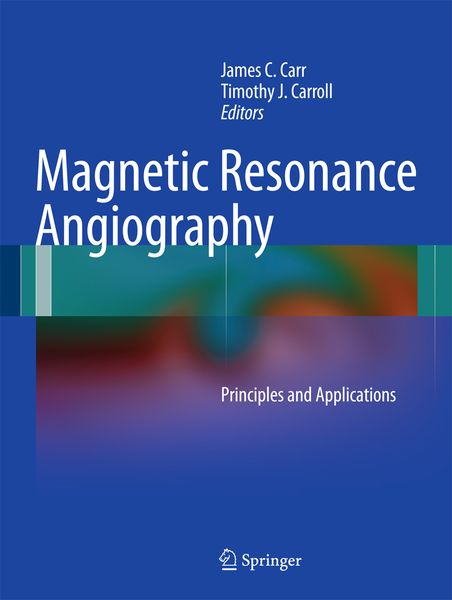
Produktbild: Magnetic Resonance Angiography
- 12%

Magnetic Resonance Angiography Principles and Applications

12% sparen

95,99 € UVP 109,99 €

inkl. gesetzl. MwSt., Versandkostenfrei


Beschreibung

Produktdetails

Einband

Gebundene Ausgabe

Erscheinungsdatum

22.12.2011

Herausgeber

James C. Carr + weitere

Verlag

Springer Us

Seitenzahl

412

Maße (L/B/H)

28,5/21,5/2,8 cm

Gewicht

1427 g

Auflage

2012

Sprache

Englisch

ISBN

978-1-4419-1685-3

Beschreibung

Rezension

From the reviews:

“This book outlines the history and evolution of magnetic resonance angiography (MRA), as well as clinical applications. … I would recommend it for both medical physicists and radiology residents and physicians. … Literature references at the end of each chapter enable readers to obtain more information. This book will be a good resource for those currently in the field as well as those who are just starting out. I would recommend it for readers who need to learn more about MRA.” (Lara Dyke, Doody's Book Reviews, April, 2013)

“This book consists of two sections, each containing a number of independent chapters by different authors. The first section covers MRI and magnetic resonance angiography (MRA) techniques and the second section focuses more on application of MRA to imaging specific parts of the body. … the book seems to thoroughly cover the field of MRA and would be a useful reference to any person who is interested or working in MRA.” (Daniel Badger, Australasian Physical & Engineering Sciences in Medicine, Vol. 36, 2013)

Zitat

From the reviews:"This book outlines the history and evolution of magnetic resonance angiography (MRA), as well as clinical applications. ... I would recommend it for both medical physicists and radiology residents and physicians. ... Literature references at the end of each chapter enable readers to obtain more information. This book will be a good resource for those currently in the field as well as those who are just starting out. I would recommend it for readers who need to learn more about MRA." (Lara Dyke, Doody's Book Reviews, April, 2013)

Produktdetails

Einband

Gebundene Ausgabe

Erscheinungsdatum

22.12.2011

Herausgeber

Verlag

Springer Us

Seitenzahl

412

Maße (L/B/H)

28,5/21,5/2,8 cm

Gewicht

1427 g

Auflage

2012

Sprache

Englisch

ISBN

978-1-4419-1685-3

Herstelleradresse

Springer-Verlag KG
Sachsenplatz 4-6
1201 Wien
AT

Email: GPSR Kontakt

Kundinnen und Kunden meinen

0 Bewertungen

Informationen zu Bewertungen

Zur Abgabe einer Bewertung ist eine Anmeldung im Konto notwendig. Die Authentizität der Bewertungen wird von uns nicht überprüft. Wir behalten uns vor, Bewertungstexte, die unseren Richtlinien widersprechen, entsprechend zu kürzen oder zu löschen.

Die Bewertungen sind nach Format, Anzahl Sterne und Datum sortiert.

Verfassen Sie die erste Bewertung zu diesem Artikel

Helfen Sie anderen Kund*innen durch Ihre Meinung

Kundinnen und Kunden meinen

0 Bewertungen filtern

  • Produktbild: Magnetic Resonance Angiography
  • I.  MRA Techniques
     
    Chapter 1     
    Basic Principles of MRI and MR Angiography
    Frank R. Korosec, PhD
     
    Chapter 2
    Time-of-Flight Angiography
    Seong-Eun Kim, PhD, and Dennis L. Parker, PhD
     
    Chapter 3
    Phase Contrast MRI and Flow Quantification
    Bernd Jung, PhD, and Michael Markl, PhD
     
    Chapter 4
    Technical Aspect of Contrast-Enhanced MRA
    Honglei Zhang, MD, Wei Zhang, MD, and Martin R. Prince, MD, PhD
     
    Chapter 5
    Time-Resolved Contrast-Enhanced MR Angiography Using Cartesian Methods
    Stephen J. Riederer, PhD, Clifton R. Haider, PhD, Casey P. Johnson, and Petrice M. Mostardi
     
    Chapter 6
    Flow-Dependent Noncontrast MR Angiography
    Mitsue Miyakazi, PhD, Satosha Sugiura, Yoshimori Kassai, MS, Nobuyasu Ichinose, MS, and Hitoshi Kanazawa, MS
     
    Chapter 7
    Low-Dose Contrast-Enhanced MR Angiography
    Kambiz Nael, MD, Roya Saleh, MD, Gerhard Laub, PhD, and J. Paul Finn, MD
     
    Chapter 8
    Vessel Wall Imaging Techniques
    Rui Li, PhD, Niranjan Balu, PhD, and Chun Yuan PhD
     
    Chapter 9
    Noncontrast Coronary Artery Imaging
    Allison G. Hays, MD, Robert G. Weiss, MD, and Matthias Stuber, PhD
     
    Chapter 10
    Contrast-Enhanced MR Angiography of the Coronary Arteries
    Qi Yang, MD, PhD, and Debaio Li, PhD
     
    Chapter 11
    MR Angiography and High Field Strength: 3.0 Tesla and Higher
    Harald H. Quick, PhD, and Mark E. Ladd, PhD
     
    Chapter 12
    Susceptibility Weighted Imaging and MR Angiography
    Samuel Barnes, MS, and E. Mark Haacke, PhD
     
    Chapter 13
    Non-Cartesian MR Angiography
    Walter F. Block, PhD, and Oliver Wieben, PhD
     
    Chapter 14
    Parallel Imaging in Angiography
    Nicole Seiberlich, PhD, and Mark Griswold, PhD
     
    Chapter 15
    Targeted Agents for Wall Imaging
    Emily A. Waters, PhD, and Thomas J. Meade, PhD
     
    Chapter 16
    Intracranial Arterial and Venous Disease
    Dariusch Reza Hadizadeh, MD, Horst Urbach, MD, and Winfried A. Willinek, MD
     
    II. Clinical Applications
     
    Chapter 17
    Carotid and Vertebral Circulation: Clinical Applications
    Max Winterman, MD, MAS, and Sugoto Mukherjee, MD
     
    Chapter 18
    Thoracic Aorta
    Emily Ward, MB, BCh, BAO, and James C. Carr, MD
     
    Chapter 19
    Pulmonary MR Angiography
    James F.M. Meaney, MD, and Peter Beddy, MD
     
    Chapter 20
    Abdominal Aorta and Mesenteric Vessels
    Klaus D. Hagspiel, MD, and Patrick T. Norton, MD
     
    Chapter 21
    Renal Vascular Diseases
    Tim Leiner, MD, PhD, Henrik Michaely, MD, PhD
     
    Chapter 22
    Upper Extremity and Hand Vessels
    Ruth P. Lim, MBBS, MMed, FRANZCR, and Vivian L. Lee, MD, PhD, MBA
     
    Chapter 23
    Lower Extremity Peripheral Arterial Disease
    Jeremy D. Collins, MD, and Timothy Scanlon, MD
     
    Chapter 24
    Noninvasive Imaging for Coronary Artery Disease
    Reza Nezafat, PhD, Susie N. Hong, MD, Peng Hu, PhD, Mehdi H. Moghari, PhD, and Warren J. Manning MD
     
    Chapter 25
    Venous Imaging: Techniques, Protocols and Clinical Applications
    Amir H. Davarpanah, MD, Philip Hodnett, MD, Jeremy D. Collins, MD, James C. Carr, MD, and Timothy Scanlon, MD
     
    Chapter 26
    Pediatric MR Angiography: Principles and Applications
    Bharathi D. Jagadeesan, MD, and David N. Loy, MD, PhD
     
    Chapter 27
    Contrast Agents for MR Angiography
    Christoph U. Herborn, MD, MBA
     
    Chapter 28
    CE-MRA in the Age of Nephrogenic Systemic Fibrosis
    Aditya Bharatha MD, FRCPC, Sean P. Symons MPH, MD, FRCPC, and Walter Kucharczyk MD, FRCPC
     
    Chapter 29
    Emerging Interventional MR Applications
    Clifford R. Weiss, MD, Aravindan Kolandaivelu, MD, Jeff Bulte, PhD, and Aravind Arepally, MD