KI-Beratung Beta

Gutscheinbedingungen

**Gültig bis 30.11.2026 auf Spielzeug, Schreibwaren, Filme, Geschenke & Trends, Musik, tolino eReader & Zubehör, Hörbücher und Hörbuch-Downloads, nicht preisgebundene Bücher und Kalender online auf thalia.at und in der Thalia App. Einzelne Artikel können ausgeschlossen sein. Aufgrund der Buchpreisbindung sind deutschsprachige Bücher und eBooks ausgenommen. Zusätzlich ausgenommen sind Abos & Flatrates, Games, Geschenkkarten/-boxen, Shelfies, Software, Zeitschriften sowie einzelne Artikel von tonies®. Pro Einkauf einmal einlösbar. Nur gültig mit im Onlineshop hinterlegter Bonuscard. Click & Collect nur bei Onlinevorabzahlung möglich. Keine Barauszahlung. Nicht kombinierbar mit anderen Aktionen und Gutscheinen. Gutschein wird auf max. 500€ Bestellwert angerechnet. Nicht gültig für Versandkosten und Services.

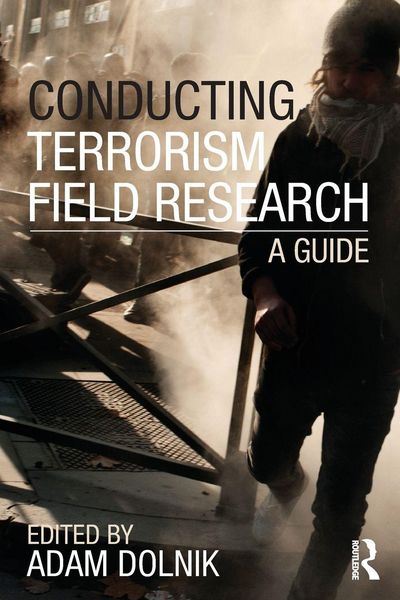
  • Produktbild: Conducting Terrorism Field Research
  • Produktbild: Conducting Terrorism Field Research

Conducting Terrorism Field Research A Guide

74,99 €

inkl. gesetzl. MwSt., Versandkostenfrei


Beschreibung

This book offers a detailed and practically oriented guide to the challenges of conducting terrorist fieldwork.

The past decade has seen an explosion of research into terrorism. However, field research on terrorism has traditionally been surrounded by many myths, and has been called anything from "necessary"...

Beschreibung

This book offers a detailed and practically oriented guide to the challenges of conducting terrorist fieldwork.

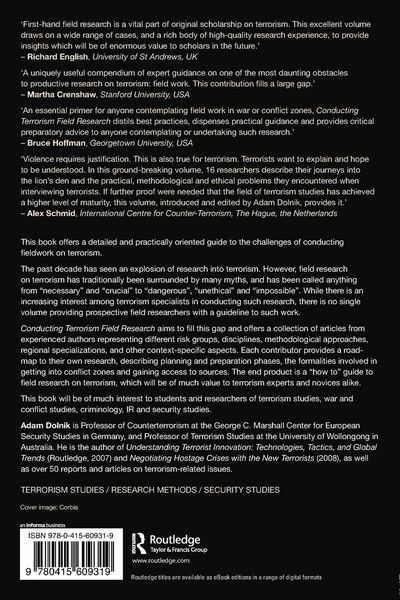
The past decade has seen an explosion of research into terrorism. However, field research on terrorism has traditionally been surrounded by many myths, and has been called anything from "necessary" and "crucial" to "dangerous", "unethical" and "impossible". While there is an increasing interest among terrorism specialists in conducting such research, there is no single volume providing prospective field researchers with a guideline to such work.

Conducting Terrorism Field Research aims to fill this gap and offers a collection of articles from experienced authors representing different risk groups, disciplines, methodological approaches, regional specializations, and other context-specific aspects. Each contributor provides a road-map to their own research, describing planning and preparation phases, the formalities involved in getting into conflict zones and gaining access to sources. The end product is a 'how to' guide to field research on terrorism, which will be of much value to terrorism experts and novices alike.

This book will be of much interest to students and researchers of terrorism studies, war and conflict studies, criminology, IR and security studies.

Rezension

'First-hand field research is a vital part of original scholarship on
terrorism. This excellent volume draws on a wide range of cases, and a rich
body of high-quality research experience, to provide insights which will be
of enormous value to scholars in the future.'
-- Richard English, University of St Andrews

'A uniquely useful compendium of expert guidance on one of the most daunting obstacles to productive research on terrorism:  field work.  This contribution fills a large gap.' -- Martha Crenshaw, Stanford University 


'An essential primer for anyone contemplating field work in war or conflict zones, Conducting Terrorism Field Research distills best practices, dispenses practical guidance and provides critical preparatory advice to anyone contemplating or undertaking such research.' -- Bruce Hoffman, Georgetown University

'Violence requires justification. This is also true for terrorism. Terrorists want to explain and hope to be understood. In this ground-breaking volume, 16 researchers describe their journeys into the lion's den and the practical, methodological and ethical problems they encountered when interviewing terrorists. If further proof were needed that the field of terrorism studies has achieved a higher level of maturity, this volume, introduced and edited by Adam Dolnik, provides it.' -- Alex Schmid, International Centre for Counter-Terrorism, The Hague

Produktdetails

Einband

Taschenbuch

Erscheinungsdatum

27.02.2013

Herausgeber Adam Dolnik
Verlag Taylor & Francis

Produktdetails

Einband

Taschenbuch

Erscheinungsdatum

27.02.2013

Herausgeber Adam Dolnik
Verlag Taylor & Francis
Seitenzahl

280

Maße (L/B/H)

23,4/15,6/1,5 cm

Gewicht

430 g

Sprache

Englisch

ISBN

978-0-415-60931-9

EU-Ansprechpartner

Taylor & Francis Verlag GmbH
Kaufingerstraße 24
80331 München
DE
GPSR@taylorandfrancis.com

Herstelleradresse

Taylor & Francis Group
5 Howick Place
SW1P 1WG London
UK
GPSR@taylorandfrancis.com

Noch keine Bewertungen vorhanden

Verfassen Sie die erste Bewertung zu diesem Artikel

Helfen Sie anderen Kundinnen und Kunden durch Ihre Meinung.

Kundinnen und Kunden meinen

Bewertungen (0)

Die Leseprobe wird geladen.
  • Produktbild: Conducting Terrorism Field Research
  • Produktbild: Conducting Terrorism Field Research
  • 1. Introduction: the Need for Field Research, Adam Dolnik  2. Interviewing Government and Official Sources: An Introductory Guide, Lindsay Clutterbuck and Richard Warnes  3. Learning From the "Dark Side": Identifying, Accessing and Interviewing Illicit Non-State Actors, Michael Kenney  4. Research Challenges Involved in Field Study on Terrorism in the Middle East, Magnus Ranstorp  5. Field Research: Argentina in Comparative Perspective, Maria Rasmussen  6. Conversing with the Adversary: Interviewing Palestinian Suicide Bombers and Their Dispatchers in Israeli Prisons, Yoram Schweitzer  7. Face to Face with my Case Study, Laila Bokhari  8. Conducting Field Research on Terrorism in Iraq, Michael Knights  9. A Practical Guide to Research on Terrorism in the North Caucasus, Cerwyn Moore  10. Conducting Terrorism Fieldwork on a Shoestring Budget: Researching Suicide Terrorism in the Israeli-Palestinian Conflict, Rashmi Singh  11. Researching Militant Groups in Southeast Asia, Zachary Abuza  12. Conducting Field Research on Terrorism in Northern Ireland, Kacper Rekawek  13. Interviewing the Terrorists: Reflections on Fieldwork and Implications for Psychological Research, John Horgan  14. Professionalizing High-Risk Field Research in Academia, Michael Taarnby  15. Up Close and Personal: Conducting Field Research on Terrorism in Conflict Zones, Adam Dolnik