Gutscheinbedingungen

**Gültig bis 06.07.2026 auf fremdsprachige Bücher online auf thalia.at, in der Thalia App ab einem Mindestbestellwert von 30€ und in allen Thalia Buchhandlungen in Österreich. In den Buchhandlungen nur gültig auf lagernde Ware. Einzelne Artikel können ausgeschlossen sein. Ausgenommen sind preisgebundene Artikel & eBooks. Pro Einkauf einmal einlösbar. Nur gültig gegen Vorlage oder im Onlineshop hinterlegter Bonuscard. Infos zur Einlösung in der Buchhandlung sind auf der Bonuscard-Vorteilspreisseite zu finden. Click & Collect nur bei Onlinevorabzahlung möglich. Keine Einlösung bei Scan & Go-Bezahlung. Keine Barauszahlung. Nicht kombinierbar mit anderen Aktionen und Gutscheinen. Gutschein wird auf max. 500€ Bestellwert angerechnet. Nicht gültig für Versandkosten und Services.

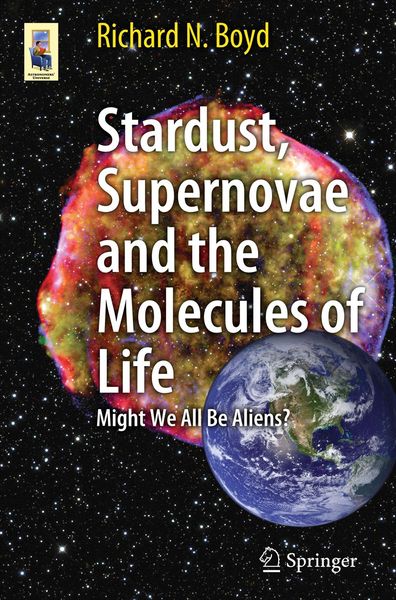
  • Produktbild: Stardust, Supernovae and the Molecules of Life
  • Produktbild: Stardust, Supernovae and the Molecules of Life
- 11%

Stardust, Supernovae and the Molecules of Life Might We All Be Aliens?

Aus der Reihe Astronomers' Universe
11% sparen

31,99 € UVP 36,29 €

inkl. gesetzl. MwSt., Versandkostenfrei


Beschreibung

Produktdetails

Einband

Taschenbuch

Erscheinungsdatum

14.12.2011

Verlag

Springer Us

Seitenzahl

215

Maße (L/B/H)

23,5/15,5/1,3 cm

Gewicht

352 g

Auflage

2012

Sprache

Englisch

ISBN

978-1-4614-1331-8

Beschreibung

Rezension

From the reviews:

“Book shows the reader first the beginning of atoms and molecules, and how they formed, and then continues with the intriguing question of chirality in molecules, and in amino acids in particular. … presented in an easily understandable way with several schematics and images to explain some of the concepts. … presents an interesting topic, that is certainly exciting and informative for the general reader, showing connections between various fields of research, and different astronomical objects and life on Earth.” (Kadri Tinn, AstroMadness.com, April, 2014)

“Boyd … presents a summary of his work and that of his colleagues in which the left-handed symmetry is postulated to result from exposure of the amino acids to circularly polarized starlight during their formation in space. … the book serves as an in-depth introduction to the topic of the extraterrestrial origin of amino acids. … The text is very lucid and accessible to general readers … . Summing Up: Recommended. Lower-division undergraduates through graduate students; informed general readers.” (A. Spero, Choice, Vol. 49 (11), August, 2012)

Zitat

From the reviews:"Boyd ... presents a summary of his work and that of his colleagues in which the left-handed symmetry is postulated to result from exposure of the amino acids to circularly polarized starlight during their formation in space. ... the book serves as an in-depth introduction to the topic of the extraterrestrial origin of amino acids. ... The text is very lucid and accessible to general readers ... . Summing Up: Recommended. Lower-division undergraduates through graduate students; informed general readers." (A. Spero, Choice, Vol. 49 (11), August, 2012)

Produktdetails

Einband

Taschenbuch

Erscheinungsdatum

14.12.2011

Verlag

Springer Us

Seitenzahl

215

Maße (L/B/H)

23,5/15,5/1,3 cm

Gewicht

352 g

Auflage

2012

Sprache

Englisch

ISBN

978-1-4614-1331-8

Herstelleradresse

Springer-Verlag KG
Sachsenplatz 4-6
1201 Wien
AT

Email: GPSR Kontakt

Noch keine Bewertungen vorhanden

Verfassen Sie die erste Bewertung zu diesem Artikel

Helfen Sie anderen Kundinnen und Kunden durch Ihre Meinung.

Kundinnen und Kunden meinen

Bewertungen (0)

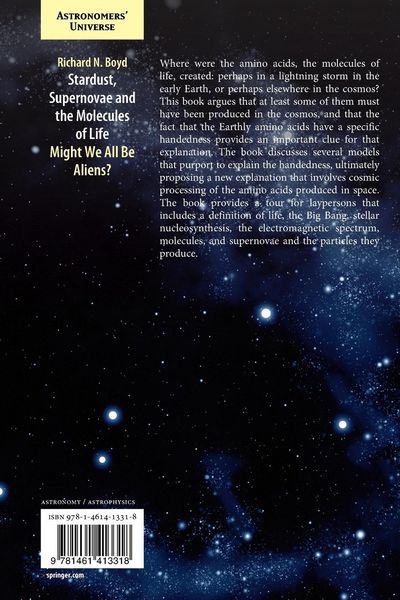
  • Produktbild: Stardust, Supernovae and the Molecules of Life
  • Produktbild: Stardust, Supernovae and the Molecules of Life
  • Table of Contents.- Preface.- Chapter 1: Introduction.- 1.1: In the Beginning.- 1.2: What is "Life?".- 1.3: The Miller Urey Experiment.- 1.4: General Background and Definitions.- Chapter 2: What is the Origin of the Lightest Elements.- 2.1: The Big Bang.- 2.2: The Supernova Cosmology Project.- 2.3: The Wilkinson Microwave Anisotropy Probe.- 2.4: Olber's Paradox.- 2.5: Big Bang Nucleosynthesis - BBN.- Chapter 3: What is the Origin of the Rest of the Elements?.- 3.1: Introduction to Stellar Nucleosynthesis.- 3.2.1: Hydrogen Burning.- 3.2.2: Helium Burning.- 3.2.3: Subsequent Burning Stages.- 3.3: After Stellar Burning.- 3.3.1: Creating a Core-Collapse Supernova Explosion.- 3.3.2: Synthesizing the Heavy Elements.- 3.3.3: White Dwarfs.- 3.3.4: Type Ia Supernovae.- Chapter 4: Creation of Molecules in the Interstellar Medium.- 4.1: The Electromagnetic Spectrum.- 4.2: Detecting Photons of Different Energies.- 4.3: Secrets from Meteorites.- 4.4: Mining the Comets.- 4.5: The Next Huge Step - Forming Life from the Molecules Delivered to Earth.- Chapter 5: Amino Acids and Chirality.- 5.1: A Primer on Amino Acids.- 5.2: Chirality and Polarization.- 5.3: Relating Optical and Molecular Chirality.- 5.3.1: Chiral Selection.- 5.3.2: A Little Atomic Physics and Some Very Basic Quantum Mechanics.- 5.4: The Other Molecules of Life.- Chapter 6: How Have Scientists Explained the Amino Acid Chirality?.- 6.1: Models that Produce Chirality.- 6.1.1: Chiral Selection via Circularly Polarized Sunlight.- 6.1.2: Chiral Selection via Circularly Polarized Sunlight.- 6.1.3: Chiral Selection via the Weak Interaction.- 6.1.4: Chiral Selection via Chemical Selection in Clay.- 6.2: Amplification via Chemical Catalysis.- 6.3: Laboratory Experiments and Theoretical Developments.- 6.4: Terrestrial  Amplification.- 6.5: Concluding Remarks on Amplification.- Chapter 7: What Happens to the Amino Acids When the Supernova Explodes?.- 7.1: The Supernova.- 7.2: The Neutrino Story.- 7.3: Interactionsof Neutrinos with 14N.- 7.4: Relating the 14 N Spin to the Molecular Chirality.- 7.5: The Supernova Progenitor Star.- Chapter 8: Spreading Chirality Throughout the Galaxy and Throughout the Earth.- 8.1: Might Supernovae Process All the Amino Acids in the Galaxy?.- 8.2: Spreading Molecules and Enantiomerism Throughout the Galaxy.- 8.2.1: Cosmic Amplification.- 8.2.2: Cosmic Amplification.- 8.2.2: Galactic Mixing.- 8.2.3: Planetary Amplification.- 8.3: Testing the Models of Amino Acid Chirality.- 8.4: The Impact of Amino Acid Chirality on Questions of the Origin of Life in the Universe.- Chapter 9: What About the Rest of the Universe?.- 9.1: Are We Alone?.- 9.2: Extremophiles on Earth.- 9.3: And From Outer Space?.- Glossary.- Index.