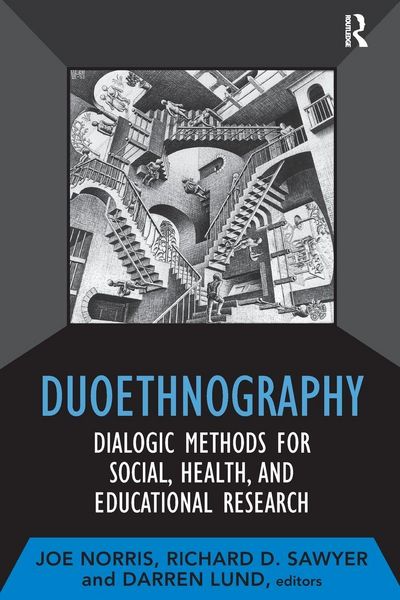
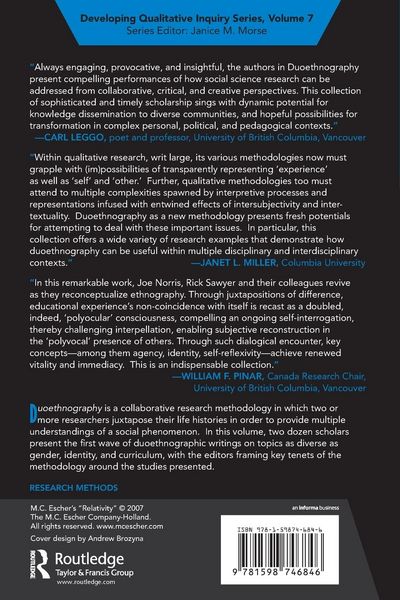
• Produktbild: Duoethnography
  • Produktbild: Duoethnography

Duoethnography Dialogic Methods for Social, Health, and Educational Research

75,99 €

inkl. gesetzl. MwSt., Versandkostenfrei


Beschreibung

Produktdetails

Einband

Taschenbuch

Erscheinungsdatum

29.02.2012

Herausgeber

Joe Norris + weitere

Verlag

Routledge

Seitenzahl

328

Maße (L/B/H)

22,9/15,2/1,8 cm

Gewicht

477 g

Sprache

Englisch

ISBN

978-1-59874-684-6

Beschreibung

Portrait

Joe Norris was a co-founder and the artistic director of the Mirror Theatre, a social issues focused touring theatre troupe, and he co-edited the book Learning to Teach Drama: A Case Narrative Approach. He has served as the Theatre-in-Education Network Chair and Research Network Chair for the American Alliance for Theatre and Education. He presently teaches courses on integrating the arts in the curriculum, learning through drama, curriculum theory, qualitative research, drama as a way of knowing, and the principles of learning at St. Francis Xavier University.

Produktdetails

Einband

Taschenbuch

Erscheinungsdatum

29.02.2012

Herausgeber

Verlag

Routledge

Seitenzahl

328

Maße (L/B/H)

22,9/15,2/1,8 cm

Gewicht

477 g

Sprache

Englisch

ISBN

978-1-59874-684-6

Herstelleradresse

Libri GmbH
Europaallee 1
36244 Bad Hersfeld
DE

Email: gpsr@libri.de

Noch keine Bewertungen vorhanden

Verfassen Sie die erste Bewertung zu diesem Artikel

Helfen Sie anderen Kundinnen und Kunden durch Ihre Meinung.

Kundinnen und Kunden meinen

Bewertungen (0)

Die Leseprobe wird geladen.
  • Produktbild: Duoethnography
  • Produktbild: Duoethnography
  • 1: Toward a Dialogic Methodology; 2: The Hidden Curriculum of Schooling; 3: Postcolonial Education; 4: Responding to Our Muses; 5: Seeking Rigor in the Search for Identity; 6: Power and Privilege; 7: Alleyways and Pathways; 8: Tensions and Contradictions of Living in a Multicultural Nation in an Era of Bounded Identities; 9: Mirror Imaging Diversity Experiences; 10: A Curriculum of Beauty; 11: Professional Boundaries; 12: Dangerous Conversations; 13: Why Duoethnography