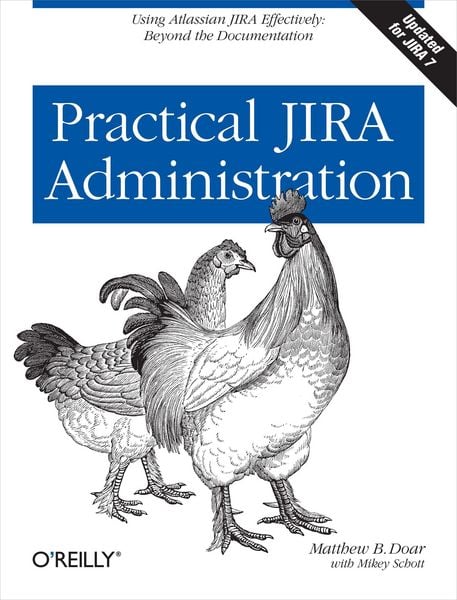
Practical Jira Administration Using Jira Effectively: Beyond the Documentation
-
- Taschenbuch ausgewählt
- eBook
-
Sprache:Englisch
18,79 €
inkl. gesetzl. MwSt.,
- Kostenlose Lieferung ab 30 € Einkaufswert
- Versandkostenfrei für Bonuscard-Kund*innen
Beschreibung
Produktdetails
Einband
Taschenbuch
Erscheinungsdatum
12.07.2011
Verlag
O'Reilly and AssociatesSeitenzahl
107
Maße (L/B/H)
23,5/17,9/1,2 cm
Gewicht
230 g
Sprache
Englisch
ISBN
978-1-4493-0541-3
If you're familiar with JIRA for issue tracking, bug tracking, and other uses, you know it can sometimes be tricky to set up and manage. In this concise book, software toolsmith Matt Doar clarifies some of the more confusing aspects by answering difficult and frequently asked questions about JIRA administration.
Practical JIRA Administration shows you how JIRA is intended to be used, making it an ideal supplement to the extensive documentation already available. The book’s chapters are loosely connected, so you can go straight to the information that best serves your needs.
* Understand the difference between JIRA groups and JIRA project roles
* Discover what JIRA schemes do, and learn how to maintain them
* Use a consistent configuration approach to help you use JIRA as a platform
* Create a workflow from scratch
* Add, modify, and deactivate users
* Prepare for a JIRA upgrade, and troubleshoot if necessary
* Get remote access to JIRA via email, SQL, REST, and other methods
Practical JIRA Administration shows you how JIRA is intended to be used, making it an ideal supplement to the extensive documentation already available. The book’s chapters are loosely connected, so you can go straight to the information that best serves your needs.
* Understand the difference between JIRA groups and JIRA project roles
* Discover what JIRA schemes do, and learn how to maintain them
* Use a consistent configuration approach to help you use JIRA as a platform
* Create a workflow from scratch
* Add, modify, and deactivate users
* Prepare for a JIRA upgrade, and troubleshoot if necessary
* Get remote access to JIRA via email, SQL, REST, and other methods
Kundinnen und Kunden meinen
Verfassen Sie die erste Bewertung zu diesem Artikel
Helfen Sie anderen Kund*innen durch Ihre Meinung
Kurze Frage zu unserer Seite
Vielen Dank für Ihr Feedback
Wir nutzen Ihr Feedback, um unsere Produktseiten zu verbessern. Bitte haben Sie Verständnis, dass wir Ihnen keine Rückmeldung geben können. Falls Sie Kontakt mit uns aufnehmen möchten, können Sie sich aber gerne an unseren Kund*innenservice wenden.
zum Kundenservice