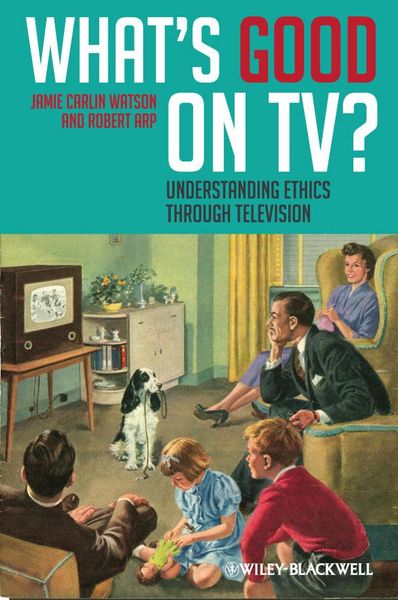
Produktbild: What's Good on TV?

What's Good on TV? Understanding Ethics Through Television

109,99 €

inkl. gesetzl. MwSt., Versandkostenfrei


Beschreibung

Produktdetails

Einband

Gebundene Ausgabe

Erscheinungsdatum

03.10.2011

Verlag

John Wiley & Sons

Seitenzahl

320

Maße (L/B/H)

23,6/16,1/2,5 cm

Gewicht

599 g

Auflage

1. Auflage

Sprache

Englisch

ISBN

978-1-4051-9476-1

Beschreibung

Rezension

"In short, this is an excellent book: pleasant and easy to read while imparting essential philosophical Knowledge." ( Times Higher Education Supplement , 24 May 2012)

Produktdetails

Einband

Gebundene Ausgabe

Erscheinungsdatum

03.10.2011

Verlag

John Wiley & Sons

Seitenzahl

320

Maße (L/B/H)

23,6/16,1/2,5 cm

Gewicht

599 g

Auflage

1. Auflage

Sprache

Englisch

ISBN

978-1-4051-9476-1

Kundinnen und Kunden meinen

0 Bewertungen

Informationen zu Bewertungen

Zur Abgabe einer Bewertung ist eine Anmeldung im Konto notwendig. Die Authentizität der Bewertungen wird von uns nicht überprüft. Wir behalten uns vor, Bewertungstexte, die unseren Richtlinien widersprechen, entsprechend zu kürzen oder zu löschen.

Die Bewertungen sind nach Format, Anzahl Sterne und Datum sortiert.

Verfassen Sie die erste Bewertung zu diesem Artikel

Helfen Sie anderen Kund*innen durch Ihre Meinung

Kundinnen und Kunden meinen

0 Bewertungen filtern

Die Leseprobe wird geladen.
  • Produktbild: What's Good on TV?
  • Preface xi

    The Pilot Episode: Ethics and Popular Culture 1

    What is Ethics? 1

    How Do We Make Progress in Ethics ? 9

    What Does Pop Culture Have to Do with Ethics? 29

    Series I. Is Anything "Good" on Television?

    The Nature of Moral Value

    Episode 1: Truth and Nihilism in Ethics 33

    Introduction 33

    The case for nihilism 39

    J. L. Mackie, "The Argument from Queerness," from Ethics: Inventing Right and Wrong 39

    The case for realism 41

    C. S. Lewis, from Mere Christianity 41

    Case study: The Office (UK), "Work Experience," series 1 43

    Study questions 45

    Alternative case studies 46

    Episode 2: Normativity - Social, Legal, and Moral 47

    Introduction 47

    You promised to play by the rules! 50

    John Rawls, "Legal Obligation and the Duty of Fair Play" 50

    What does my neighbor have to do with my goodness? 55

    John Stuart Mill, "Of the Limits to the Authority of Society over the Individual" from On Liberty 55

    Case study: The Sopranos, "College," season 1 57

    Study questions 60

    Alternative case studies 60

    Episode 3: God and Ethics 61

    Introduction 61

    What has Athens to do with Jerusalem? 65

    Plato, Euthyphro 65

    Does God make the law or does he just let us in on it? 69

    C. S. Lewis, from The Problem of Pain 69

    Case study: Law & Order, "God Bless the Child," season 2 73

    Study questions 75

    Alternative case studies 76

    Series II. What's Right and Wrong? Ethical Theory

    Episode 4: Moral Relativism 79

    Introduction 79

    Are we merely products of our culture? 83

    Ruth Benedict, "A Defense of Ethical Relativism" 83

    Relativism is unjustified 86

    James Rachels, "The Challenge of Cultural Relativism" 86

    Case study 1: Deadwood, "Childish Things," season 2 91

    Case study 2: South Park, "Death Camp of Tolerance," season 6 93

    Study questions 95

    Alternative case studies 95

    Episode 5: Deontology 97

    Introduction 97

    Kant's theory of moral duty 98

    Immanuel Kant, from Groundwork of the Metaphysic of Morals 98

    Case study 1: Arrested Development, "Not without My Daughter," season 1 105

    Contemporary Deontology 109

    Case study 2: Friends, "The One Where Phoebe Hates PBS," season 5 109

    Study questions 112

    Alternative case studies 113

    Episode 6: Consequentialism 114

    Introduction 114

    Mill's theory of utility 115

    John Stuart Mill, from Utilitarianism 115

    Case study 1: Battlestar Galactica, "You Can't Go Home Again," season 1 127

    Case study 2: The Twilight Zone (Newer), "Cradle of Darkness," season 1 129

    Study questions 131

    Alternative case studies 132

    Episode 7: Virtue Ethics 133

    Introduction 133

    Aristotle's theory of virtue 134

    Aristotle, from Nicomachean Ethics 134

    Case study 1: Foyle's War, "Enemy Fire," set 3 143

    Case study 2: Star Trek: The Next Generation, "Hide and Q," season 1 147

    Study questions 151

    Alternative case studies 152

    Series III. But What's Right When . . . ? Practical Ethics

    Episode 8: Environmental Ethics 155

    Introduction 155

    Two Approaches to Environmental Ethics 157

    Silly environmentalists, nature is for people 160

    William Baxter, "People or Penguins" 160

    Case study 1: Northern Exposure, "Zarya," season 6 162

    Case study 2: Family Guy, "It Takes a Village Idiot, and I Married One," season 5 165

    Study questions 168

    Alternative case studies 169

    Episode 9: Animal Welfare 170

    Introduction 170

    Two Dead Ends 171

    Three Approaches to Animal Welfare 173

    Animals are morally valuable, but not as valuable as adult humans 179

    Mary Anne Warren, "Difficulties with the Strong Rights Position" 179

    Case study 1: Bones, "Finger in the Nest," season 4 182

    Case study 2: House, M.D., "Babies and Bathwater," season 1 184

    Study questions 187

    Alternative case studies 188

    Episode 10: Abortion 189

    Introduction 189

    One Common Assumption 190

    Six Fallacies to Avoid 191

    Judith Jarvis Thomson and the Violinist Argument 197

    Mary Anne Warren and the Space Explorer 200

    Abortion is wrong for the same reason that killing adults is wrong 202

    Don Marquis, "Why Abortion is Immoral" 202

    Case study 1: Law & Order, "Dignity," season 20 203

    Case study 2: Maude, "Maude's Dilemma - Parts 1 and 2," season 1 206

    Study questions 208

    Alternative case studies 209

    Episode 11: Homosexuality 210

    Introduction 210

    Arguments Against the Permissibility of Homosexuality 213

    Arguments for the Permissibility of Homosexuality 216

    Additional Concerns 220

    New natural law theory and the morality of homosexuality 220

    Stephen Macedo, "Homosexuality and the Conservative Mind"; Robert George and Bradley Gerard, "Marriage and the Liberal Imagination" 220

    Case study 1: Law & Order, "Manhood," season 3 225

    Case study 2: Family Guy, "You May Now Kiss the . . . Uh . . . Guy Who Receives," season 4 227

    Study questions 230

    Alternative case studies 231

    Episode 12: Punishment and Capital Punishment 232

    Introduction 232

    Theories of Punishment 234

    Arguments For and Against Capital Punishment 241

    Capital punishment is unjustified 244

    Jeffrey Reiman, "The Justice of the Death Penalty in an Unjust World" 244

    Case study 1: Star Trek: The Next Generation, "The Hunted," season 3 246

    Case study 2: Oz, "Capital P," season 1 249

    Study questions 252

    Alternative case studies 253

    Episode 13: Assisted Suicide 254

    Introduction 254

    A Few Terms 255

    Three Moral Arguments Against the Permissibility of Assisted Suicide 256

    Moral and Practical Arguments for the Permissibility of Assisted Suicide 260

    The good of society depends on assisted suicide 261

    Daniel Callahan, "Aging and the Ends of Medicine" 261

    Case study 1: Picket Fences, "Abominable Snowman," season 2 262

    Case study 2: Scrubs, "My Jiggly Ball," season 5 266

    Study questions 268

    Alternative case studies 269

    The Epilogue: Does TV Erode Our Values? 270

    The Moral Influence of Television 270

    The Debate Over Censorship 271

    A Kantian Reason not to Censor 272

    Case study 1: Family Guy, "PTV," season 4 273

    Utilitarian Reasons not to Censor 274

    Moral Reasons to Censor 275

    Exploitation, Objectification, and TV 277

    Case study 2: Toddlers & Tiaras (any episode) 279

    Reality TV and Psychological Harm 283

    That's All Folks! 286

    Study questions 286

    References 288

    Index 295