Gutscheinbedingungen

**Gültig bis 17.08.2026 auf Schreibwaren & Office-Artikel online auf thalia.at, in der Thalia App und in teilnehmenden Thalia Buchhandlungen in Österreich mit Schulsortiment. In den Buchhandlungen nur gültig auf lagernde Ware. Einzelne Artikel können ausgeschlossen sein. Ausgenommen sind preisgebundene Artikel. Pro Einkauf einmal einlösbar. Nur gültig gegen Vorlage oder im Onlineshop hinterlegter Bonuscard. Infos zur Einlösung in der Buchhandlung sind auf der Bonuscard-Vorteilspreisseite zu finden. Click & Collect nur bei Onlinevorabzahlung möglich. Keine Einlösung bei Scan & Go-Bezahlung. Keine Barauszahlung. Nicht kombinierbar mit anderen Aktionen und Gutscheinen. Gutschein wird auf max. 500€ Bestellwert angerechnet. Nicht gültig für Geschenkkarten, Versandkosten und Services.

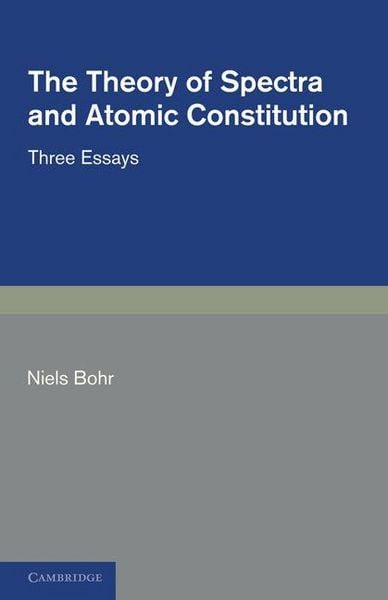
  • Produktbild: The Theory of Spectra and Atomic Constitution
  • Produktbild: The Theory of Spectra and Atomic Constitution

The Theory of Spectra and Atomic Constitution Three Essays

52,99 €

inkl. gesetzl. MwSt., Versandkostenfrei


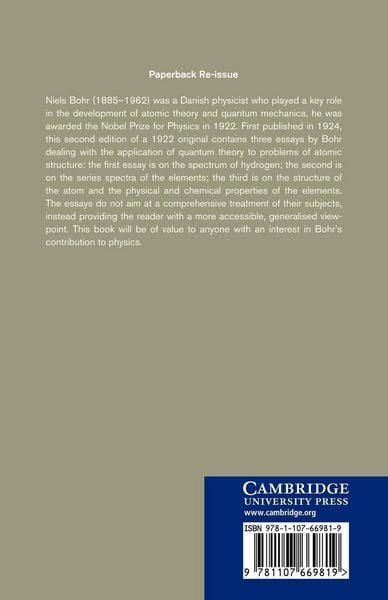
Beschreibung

Produktdetails

Einband

Taschenbuch

Erscheinungsdatum

09.03.2011

Verlag

Cambridge Academic

Seitenzahl

150

Maße (L/B/H)

21,6/14/0,8 cm

Gewicht

200 g

Sprache

Englisch

ISBN

978-1-107-66981-9

Beschreibung

Produktdetails

Einband

Taschenbuch

Erscheinungsdatum

09.03.2011

Verlag

Cambridge Academic

Seitenzahl

150

Maße (L/B/H)

21,6/14/0,8 cm

Gewicht

200 g

Sprache

Englisch

ISBN

978-1-107-66981-9

Herstelleradresse

Libri GmbH
Europaallee 1
36244 Bad Hersfeld
DE

Email: gpsr@libri.de

Noch keine Bewertungen vorhanden

Verfassen Sie die erste Bewertung zu diesem Artikel

Helfen Sie anderen Kundinnen und Kunden durch Ihre Meinung.

Kundinnen und Kunden meinen

Bewertungen (0)

  • Produktbild: The Theory of Spectra and Atomic Constitution
  • Produktbild: The Theory of Spectra and Atomic Constitution
  • Part I. On the Spectrum of Hydrogen: 1. Empirical spectral laws; 2. Laws of temperature radiation; 3. The nuclear theory of the atom; 4. Quantum theory of spectra; 5. Hydrogen spectrum; 6. The Pickering lines; 7. Other spectra; Part II. On the Series Spectra of the Elements; Section 1. Introduction; Section 2. General Principles of the Quantum Theory of Spectra: 8. Hydrogen spectrum; 9. The correspondence principle; 10. General spectral laws; 11. Absorption and excitation of radiation; Section 3. Development of the Quantum Theory of Spectra: 12. Effect of external forces on the hydrogen spectrum; 13. The Stark effect; 14. The Zoeman effect; 15. Central pertubations; 16. Relativity effect of hydrogen lines; 17. Theory of series spectra; 18. Correspondence principle and conservation of angular momentum; 19. The spectra of helium and lithium; 20. Complex structure of series lines; Section 4. Conclusion; Part III. The Structure of the Atom and the Physical and Chemical Properties of the Elements; Section 5. Preliminary: 21. The nuclear atom; 22. The postulates of the quantum theory; 23. Hydrogen atom; 24. Hydrogen spectrum and x-ray spectra; 25. The fine structure of the hydrogen lines; 26. Periodic table; 27. Recent atomic models; Section 6. Series Spectra and the Capture of Electrons by Atoms: 28. Arc and spark spectra; 29. Series diagram; 30. Correspondence principle; Section 7. Formation of Atoms and the Periodic Table: 31. First period. Hydrogen-helium; 32. Second period. Lithium-neon; 33. Third period. Sodium-argon; 34. Fourth period. Potassium-Krypton; 35. Fifth period. Rubidium-xenon; 36. Sixth period. Caesium-niton; 37. Seventh period; 38. Survey of the periodic table; Section 8. Reorganization of Atoms and X-Ray SPectra: 39. Absorption and emission of x-rays and correspondence principle; 40. X-ray spectra and atomic structure; 41. Classification of x-ray spectra; 42. Conclusion; Appendix.