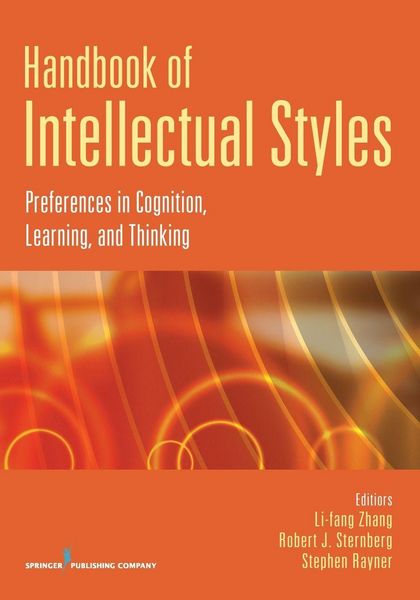
Handbook of Intellectual Styles Preferences in Cognition, Learning, and Thinking
-
- Englisch ausgewählt
123,99 €
inkl. gesetzl. MwSt.,
Beschreibung
Produktdetails
Einband
Taschenbuch
Erscheinungsdatum
20.10.2011
Herausgeber
Li-fang Zhang + weitereVerlag
Springer Publishing CompanySeitenzahl
448
Maße (L/B/H)
25,4/17,8/2,4 cm
Gewicht
840 g
Sprache
Englisch
ISBN
978-0-8261-0667-4
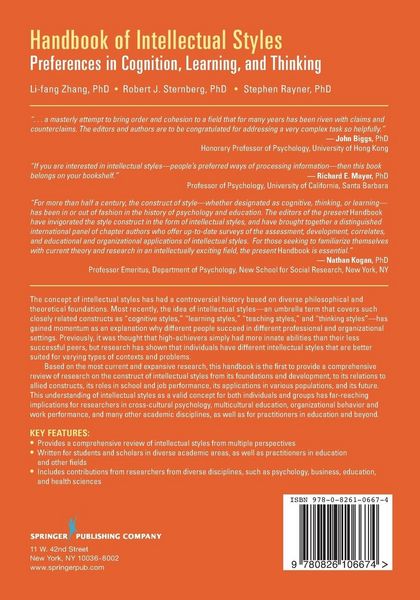
[B]ecause of the thoroughness of the literature reviews and the comprehensive coverage of the chapter topics, [this book] should be required reading for any scholar working in related areas of personality or intelligence."--PsycCRITIQUES "This book is a masterly attempt to bring order and cohesion to a field that for many years has been riven with claims and counterclaims. The editors and authors are to be congratulated for addressing a very complex task so helpfully." John Biggs, PhD Honorary Professor of Psychology University of Hong Kong "If you are interested in intellectual styles真people's preferred ways of processing information真then this book belongs on your bookshelf." Richard E. Mayer, PhD Professor of Psychology University of California, Santa Barbara "For more than half a century, the construct of style真whether designated as cognitive, thinking or learning真has been in or out of fashion in the history of psychology and education. The editors of the present Handbook have invigorated the style construct in the form of intellectual styles, and have brought together a distinguished international panel of chapter authors who offer up-to-date surveys of the assessment, development, correlates, and educational and organizational applications of intellectual styles. For those seeking to familiarize themselves with current theory and research in an intellectually exciting field, the present Handbook is essential." Nathan Kogan, PhD Professor Emeritus, Department of Psychology New School for Social Research, New York, NY The concept of intellectual styles has had a controversial history based on diverse philosophical and theoretical foundations. Most recently, the idea of intellectual styles真an umbrella term that covers such closely related constructs as "cognitive styles," "learning styles," "teaching styles," and "thinking styles"真has gained momentum as an explanation for why different people succeed in different professional and organizational settings. Previously, it was thought that high-achievers simply had more innate abilities than their less successful peers, but research has shown that individuals have different intellectual styles that are better suited for varying types of contexts and problems. Based on the most current and expansive research, this handbook is the first to provide a comprehensive review of research on the construct of intellectual style, from its foundations and development, to its relations to allied constructs, its roles in school and job performance, its applications in various populations, and its future.. This understanding of intellectual styles as a valid concept for both individuals and groups has far-reaching implications for researchers in cross-cultural psychology, multicultural education, organizational behavior and work performance, and many other academic disciplines, as well as practitioners in education and beyond. Key Features: Provides a comprehensive review of intellectual styles from multiple perspectives Written for students and scholars in diverse academic arenas, as well as practitioners in education and other fields Includes contributions from researchers from diverse disciplines, such as psychology, business, education, and health sciences
Kundinnen und Kunden meinen
Verfassen Sie die erste Bewertung zu diesem Artikel
Helfen Sie anderen Kund*innen durch Ihre Meinung
Kurze Frage zu unserer Seite
Vielen Dank für Ihr Feedback
Wir nutzen Ihr Feedback, um unsere Produktseiten zu verbessern. Bitte haben Sie Verständnis, dass wir Ihnen keine Rückmeldung geben können. Falls Sie Kontakt mit uns aufnehmen möchten, können Sie sich aber gerne an unseren Kund*innenservice wenden.
zum Kundenservice