Zitat
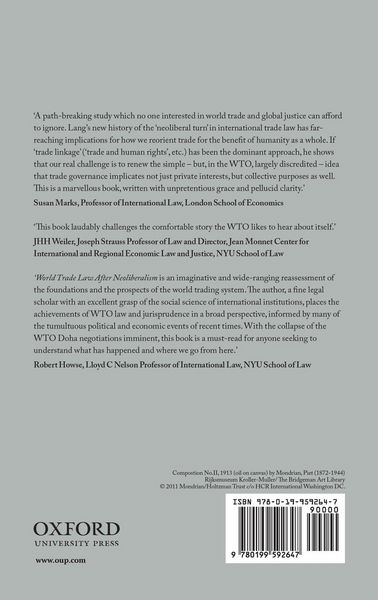
Lang's contribution is one of the most legally far-reaching, methodologically acute, and sociologically attentive accounts thus far. Lang's socio-political sensibility is distinguished because he employs an expansive category of social legal actors, thereby situating trade law within the politics of global struggles. His style is also unique because he parses how history informs the present. And most importantly, he studies how different legal theories are created from this con- text and how those theories affect the practice of trade law. Michael Fakhri, Global Law Books Lang's book is a thorough, original, and quite needed deconstructivist analysis of the "neo-liberal turn" read in a historical and theoretical context. The book nicely deconstructs all prevailing notions in the field, with in-depth reading of the WTO cases and trends, to show how such notions have emerged (and contrasted) historically and used as a means to an end by different groups. This is a rather intelligent exercise that does justice to the bulk of rhetoric which is massively present not only in the media (as predictable), but also (unfortunately) in the scientific literature. Carlo Focarelli, IYIL Lang has pointed us down an important road. Lets go down it. Simon Lester, Journal of International Economic Law This book laudably challenges the comfortable story the WTO likes to hear about itself. Professor JHH Weiler, NYU School of Law A path-breaking study which no-one interested in world trade and global justice can afford to ignore. Lang's new history of the 'neoliberal turn' in international trade law has far-reaching implications for how we reorient trade for the benefit of humanity as a whole. If 'trade linkage' ('trade and human rights', etc.) has been the dominant approach, he shows that our real challenge is to renew the simple - but, in the WTO, largely discredited - idea that trade governance implicates not just private interests, but collective purposes as well. This is a marvellous book, written with unpretentious grace and pellucid clarity. Susan Marks, Professor of International Law, London School of Economics World Trade Law After Neoliberalism is an imaginative and wide-ranging reassessment of the foundations and the prospects of the world trading system. The author, a fine legal scholar with an excellent grasp of the social science of international institutions, places the achievements of WTO law and jurisprudence in a broad perspective, informed by many of the tumultuous political and economic events of recent times. With the collapse of the WTO Doha negotiations imminent, this book is must-reading for anyone seeking to understand what has happened and where we go from here. Robert Howse, Lloyd C. Nelson Professor of International Law, NYU School of Law Lang's contribution is one of the most legally far-reaching, methodologically acute, and sociologically attentive accounts thus far. Lang's socio-political sensibility is distinguished because he employs an expansive category of social legal actors, thereby situating trade law within the politics of global struggles. His style is also unique because he parses how history informs the present. And most importantly, he studies how different legal theories are created from this context and how those theories affect the practice of trade law.