KI-Beratung Beta

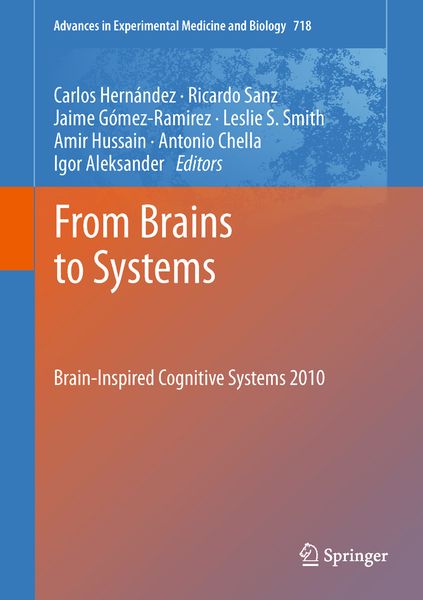
Produktbild: From Brains to Systems
Band 718 - 13%

From Brains to Systems Brain-Inspired Cognitive Systems 2010

13% sparen

189,99 € UVP 219,99 €

inkl. gesetzl. MwSt., Versandkostenfrei


Beschreibung

Brain Inspired Cognitive Systems - BICS 2010 aims to bring together leading scientists and engineers who use analytic and synthetic methods both to understand the astonishing processing properties of biological systems and specifically of the brain, and to exploit such knowledge to advance engineering...

Beschreibung

Brain Inspired Cognitive Systems - BICS 2010 aims to bring together leading scientists and engineers who use analytic and synthetic methods both to understand the astonishing processing properties of biological systems and specifically of the brain, and to exploit such knowledge to advance engineering methods to build artificial systems with higher levels of cognitive competence.

BICS is a meeting point of brain scientists and cognitive systems engineers where cross-domain ideas are fostered in the hope of getting emerging insights on the nature, operation and extractable capabilities of brains. This multiple approach is necessary because the progressively more accurate data about the brain is producing a growing need of a quantitative understanding and an associated capacity to manipulate this data and translate it into engineering applications rooted in sound theories.

BICS 2010 is intended for both researchers that aim to build brain inspired systems with higher cognitive competences, and for life scientists who use and develop mathematical and engineering approaches for a better understanding of complex biological systems like the brain.

Four major interlaced focal symposia are planned for this conference and these are organized into patterns that encourage cross-fertilization across the symposia topics. This emphasizes the role of BICS as a major meeting point for researchers and practitioners in the areas of biological and artificial cognitive systems. Debates across disciplines will enrich researchers with complementary perspectives from diverse scientific fields.

BICS 2010 will take place July 14-16, 2010, in Madrid, Spain.

Produktdetails

Einband

Gebundene Ausgabe

Erscheinungsdatum

12.07.2011

Abbildungen

XV, 253 p. 111 illus., 53 illus. in color.

Herausgeber Carlos Hernández + weitere

Produktdetails

Einband

Gebundene Ausgabe

Erscheinungsdatum

12.07.2011

Abbildungen

XV, 253 p. 111 illus., 53 illus. in color.

Herausgeber
Verlag Springer Us
Seitenzahl

253

Maße (L/B/H)

26/18,3/2 cm

Gewicht

650 g

Sprache

Englisch

ISBN

978-1-4614-0163-6

Herstelleradresse

Springer-Verlag KG
Sachsenplatz 4-6
1201 Wien
AT

Email: ProductSafety@springernature.com

Noch keine Bewertungen vorhanden

Verfassen Sie die erste Bewertung zu diesem Artikel

Helfen Sie anderen Kundinnen und Kunden durch Ihre Meinung.

Kundinnen und Kunden meinen

Bewertungen (0)

  • Produktbild: From Brains to Systems
  • Chapter 1. Introduction- Ricardo Sanz , Carlos Hern´andez and Jaime G´omez.- Chapter 2. Emergent feature sensitivity in a model of the auditory thalamocortical System- Martin Coath, Robert Mill, Susan Denham, and Thomas Wennekers.- Chapter 3. STDP Pattern Onset Learning Depends on Background Activity Introduction 5- James Humble, Steve Furber, Susan Denham and Thomas Wennekers.- Chapter 4. Emergence of small-world structure in networks of spiking neurons through STDP1 plasticity- Gleb Basalyga, Pablo M. Gleiser, and ThomasWennekers.- Chapter 5. Coupling BCM and neural fields for the emergence of selforganization consensus— Mathieu Lefort and Yann Boniface and Bernard Girau.- Chapter 6. Alpha and theta rhythm abnormality in Alzheimer’s Disease: a study using a computational model- Basabdatta Sen Bhattacharya, Damien Coyle and Liam P. Maguire.- Chapter 7. Oscillatory Neural Network for Image Segmentation with Biased Competition for Attention- Tapani Raiko and Harri Valpola.-Chapter 8. Internal Simulation of Perceptions and Actions- Magnus Johnsson and David Gil.- Chapter 9. Building Neurocognitive Networks with a Distributed Functional Architecture- Marmaduke Woodman, Dionysios Perdikis, Ajay S Pillai, Silke Dodel, Raoul Huys, Steven Bressler, and Viktor Jirsa.- Chapter 10: Reverse Engineering for Biologically Inspired Cognitive Architectures: A Critical Analysis¬- Andreas Schierwagen.- Chapter 11. Competition in high dimensional spaces using a sparse approximation of neural fields- Jean-Charles Quinton, Bernard Girau and Mathieu Lefort.- Chapter 12. Informational Theories of Consciousness: A Review and Extension- Igor Aleksander and David Gamez.- Chapter 13. Hippocampal Categories: a mathematical foundation fornavigation and memory- Jaime G´omez and Ricardo Sanz.- Chapter 14.The role of feedback in a hierarchical model of object perception- Salvador Dura-Bernal, Thomas Wennekers and Susan L. Denham.- Chapter 15. Machine Free Will: Is Free Will a NecessaryIngredient of MachineConsciousness?- Riccardo Manzotti.- Chapter 16. Natural Evolution of Neural Support Vector Machines- Magnus Jandel.- Chapter 17. Self-Conscious Robotic System Design Process - from Analysisto Implementation- Antonio Chella and Massimo Cossentino and Valeria Seidita.- Chapter 18. Simulating Visual Qualia in the CERA-CRANIUM Cognitive Architecture- Raúl Arrabales, Agapito Ledezma, and Araceli Sanchis.- Chapter 19. The Ouroboros Model, Selected Facets- Knud Thomsen.