Gutscheinbedingungen

**Gültig nur für Bestellungen an die Wunsch-Poststation bis 10.06.2026 auf Spielzeug, Schreibwaren, Filme, Geschenke & Trends, Musik, tolino eReader & Zubehör, Hörbücher und Hörbuch-Downloads (außer Abo), nicht preisgebundene Bücher und Kalender online auf thalia.at und in der Thalia App. Einzelne Artikel können ausgeschlossen sein. Aufgrund der Buchpreisbindung sind deutschsprachige Bücher und eBooks ausgenommen. Zusätzlich ausgenommen sind preisgebundene Artikel, Abos & Flatrates, eBooks, Games, Geschenkkarten/-boxen, Shelfies, Software, Zeitschriften sowie einzelne Artikel von tonies®. Pro Einkauf einmal einlösbar. Kein Click & Collect möglich. Keine Barauszahlung. Nicht kombinierbar mit anderen Aktionen und Gutscheinen. Gutschein wird auf max. 500€ Bestellwert angerechnet. Nicht gültig für Versandkosten und Services.

  • Produktbild: The Long History of New Media
  • Produktbild: The Long History of New Media
Band 76

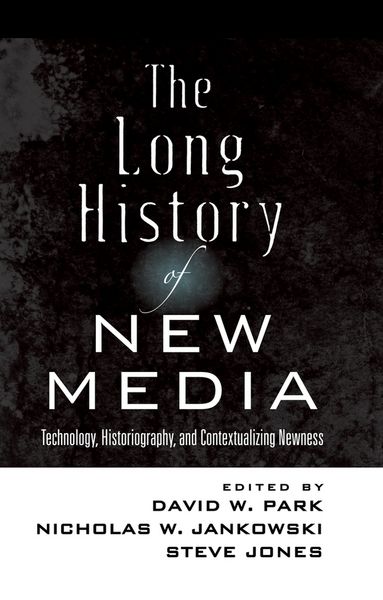
The Long History of New Media Technology, Historiography, and Contextualizing Newness

Aus der Reihe Digital Formations

162,75 €

inkl. gesetzl. MwSt., Versandkostenfrei


Beschreibung

Produktdetails

Einband

Gebundene Ausgabe

Erscheinungsdatum

31.05.2011

Herausgeber

David W. Park + weitere

Verlag

Peter Lang Publishing Inc. New York

Seitenzahl

354

Maße (L/B/H)

23,1/15,5/2,5 cm

Gewicht

630 g

Auflage

1. Auflage

Sprache

Englisch

ISBN

978-1-4331-1441-0

Beschreibung

Rezension

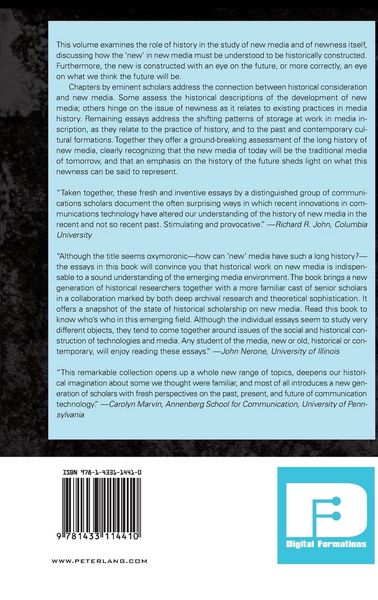
«Taken together, these fresh and inventive essays by a distinguished group of communications scholars document the often surprising ways in which recent innovations in communications technology have altered our understanding of the history of new media in the recent and not so recent past. Stimulating and provocative.» (Richard R. John, Columbia University)
«Although the title seems oxymoronic - how can 'new' media have such a long history? - the essays in this book will convince you that historical work on new media is indispensable to a sound understanding of the emerging media environment. The book brings a new generation of historical researchers together with a more familiar cast of senior scholars in a collaboration marked by both deep archival research and theoretical sophistication. It offers a snapshot of the state of historical scholarship on new media. Read this book to know who's who in this emerging field. Although the individual essays seem to study very different objects, they tend to come together around issues of the social and historical construction of technologies and media. Any student of the media, new or old, historical or contemporary, will enjoy reading these essays.» (John Nerone, University of Illinois)
«This remarkable collection opens up a whole new range of topics, deepens our historical imagination about some we thought were familiar, and most of all introduces a new generation of scholars with fresh perspectives on the past, present, and future of communication technology.» (Carolyn Marvin, Annenberg School for Communication, University of Pennsylvania)

Portrait

David W. Park is Associate Professor of Communication at Lake Forest College. He is the founder and past chair of the International Communication Association’s Communication History Interest Group, and is co-editor of The History of Media and Communication Research: Contested Memories (Peter Lang, 2008).
Nicholas W. Jankowski is Visiting Fellow at the e-Humanities Group of the Royal Netherlands Academy for Arts and Sciences (KNAW). He has co-edited some half-dozen books. Two recent edited volumes are Internet and National Elections: A Comparative Study of Web Campaigning (2007) and e-Research: Transformation in Scholarly Practice (2009). Jankowski is co-editor of the journal New Media & Society.
Steve Jones is UIC Distinguished Professor, Professor of Communication, and Research Associate in the Electronic Visualization Laboratory at the University of Illinois-Chicago. He was the founder and first President of the Association of Internet Researchers and is co-editor of New Media & Society.

Produktdetails

Einband

Gebundene Ausgabe

Erscheinungsdatum

31.05.2011

Herausgeber

Verlag

Peter Lang Publishing Inc. New York

Seitenzahl

354

Maße (L/B/H)

23,1/15,5/2,5 cm

Gewicht

630 g

Auflage

1. Auflage

Sprache

Englisch

ISBN

978-1-4331-1441-0

EU-Ansprechpartner

Zeitfracht Medien GmbH
Ferdinand-Jühlke-Straße 7|99095|Erfurt|DE
produktsicherheit@zeitfracht.de

Herstelleradresse

Peter Lang
Avenue du Théâtre 7|1005|Lausanne|CH
orders@peterlang.com

Kundinnen und Kunden meinen

0 Bewertungen

Informationen zu Bewertungen

Zur Abgabe einer Bewertung ist eine Anmeldung im Konto notwendig. Die Authentizität der Bewertungen wird von uns nicht überprüft. Wir behalten uns vor, Bewertungstexte, die unseren Richtlinien widersprechen, entsprechend zu kürzen oder zu löschen.

Die Bewertungen sind nach Format, Anzahl Sterne und Datum sortiert.

Verfassen Sie die erste Bewertung zu diesem Artikel

Helfen Sie anderen Kund*innen durch Ihre Meinung

Kundinnen und Kunden meinen

0 Bewertungen filtern

  • Produktbild: The Long History of New Media
  • Produktbild: The Long History of New Media
  • Contents: David W. Park/Nicholas W. Jankowski/Steve Jones: Introduction: History and New Media – Devon Powers: The End of New Music? Digital Media, History, and the Idea of Attention – Noah Arceneaux: «All You’ll Need Is a Mobile Couch»: The History of Mobile Television in the United States – Stephanie Ricker Schulte: Cutting the Cord and «Crying Socialist Wolf»: Unwiring the Public and Producing the Third Place – Christian Thorsten Callisen/Barbara Adkins: Pre-digital Virtuality: Early Modern Scholars and the Republic of Letters – D. Travers Scott: Sound Studies for Historians of New Media – Zizi Papacharissi/Elaine J. Yuan: What if the Internet Did Not Speak English? New and Old Language for Studying Newer Media Technologies – Teresa M. Harrison: The Evolving Medium Is the Message: McLuhan, Medium Theory, and Cognitive Neuroscience – Dmitry Epstein: The Analog History of the «Digital Divide» – Michael Dick: Twenty Years of Unnecessary Forward Slashes: Critiquing Narratives of the Development of the Web – Peter Schaefer: Interface: History of a Concept, 1868-1888 – Brian O’Neill: The Long History of Digital Radio: Old Media in a New Century – Benjamin Peters/Deborah Lubken: New Media in Crises: Discursive Instability and Emergency Communication – Holly Kruse: Pipeline as Network: Pneumatic Systems and the Social Order – Gerard Goggin: Telephone Media: An Old Story – Meghan Dougherty/Steven M. Schneider: Web Historiography and the Emergence of New Archival Forms – Fernando Bermejo: The Evolution of Audience Labor: Appropriating Online Activities – Niels Brügger: Digital History and a Register of Websites: An Old Practice with New Implications – Adriana de Souza e Silva/Daniel M. Sutko: Placing Location-Aware Media in a History of the Virtual – Simon Popple: «It’s Not Really Our Content»: The Moving Image and Media History in the Digital Archive Age.