Beschreibung
Produktdetails
Einband
Gebundene Ausgabe
Erscheinungsdatum
18.11.2011
Verlag
John Wiley & SonsSeitenzahl
696
Maße (L/B/H)
25,7/19,7/3,5 cm
Gewicht
1494 g
Auflage
1. Auflage
Sprache
Englisch
ISBN
978-0-470-74555-7
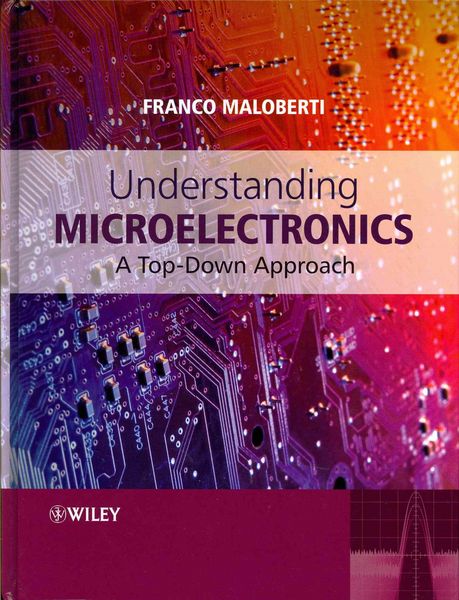
The microelectronics evolution has given rise to many modern benefits but has also changed design methods and attitudes to learning. Technology advancements shifted focus from simple circuits to complex systems with major attention to high-level descriptions. The design methods moved from a bottom-up to a top-down approach.
For today's students, the most beneficial approach to learning is this top-down method that demonstrates a global view of electronics before going into specifics. Franco Maloberti uses this approach to explain the fundamentals of electronics, such as processing functions, signals and their properties. Here he presents a helpful balance of theory, examples, and verification of results, while keeping mathematics and signal processing theory to a minimum.
Key features:
* Presents a new learning approach that will greatly improve students' ability to retain key concepts in electronics studies
* Match the evolution of Computer Aided Design (CAD) which focuses increasingly on high-level design
* Covers sub-functions as well as basic circuits and basic components
* Provides real-world examples to inspire a thorough understanding of global issues, before going into the detail of components and devices
* Discusses power conversion and management; an important area that is missing in other books on the subject
* End-of-chapter problems and self-training sections support the reader in exploring systems and understanding them at increasing levels of complexity
Inside this book you will find a complete explanation of electronics that can be applied across a range of disciplines including electrical engineering and physics. This comprehensive introduction will be of benefit to students studying electronics, as well as their lecturers and professors. Postgraduate engineers, those in vocational training, and design and application engineers will also find this book useful.
For today's students, the most beneficial approach to learning is this top-down method that demonstrates a global view of electronics before going into specifics. Franco Maloberti uses this approach to explain the fundamentals of electronics, such as processing functions, signals and their properties. Here he presents a helpful balance of theory, examples, and verification of results, while keeping mathematics and signal processing theory to a minimum.
Key features:
* Presents a new learning approach that will greatly improve students' ability to retain key concepts in electronics studies
* Match the evolution of Computer Aided Design (CAD) which focuses increasingly on high-level design
* Covers sub-functions as well as basic circuits and basic components
* Provides real-world examples to inspire a thorough understanding of global issues, before going into the detail of components and devices
* Discusses power conversion and management; an important area that is missing in other books on the subject
* End-of-chapter problems and self-training sections support the reader in exploring systems and understanding them at increasing levels of complexity
Inside this book you will find a complete explanation of electronics that can be applied across a range of disciplines including electrical engineering and physics. This comprehensive introduction will be of benefit to students studying electronics, as well as their lecturers and professors. Postgraduate engineers, those in vocational training, and design and application engineers will also find this book useful.
Noch keine Bewertungen vorhanden
Verfassen Sie die erste Bewertung zu diesem Artikel
Helfen Sie anderen Kundinnen und Kunden durch Ihre Meinung.
Kurze Frage zu unserer Seite
Vielen Dank für Ihr Feedback
Wir nutzen Ihr Feedback, um unsere Produktseiten zu verbessern. Bitte haben Sie Verständnis, dass wir Ihnen keine Rückmeldung geben können. Falls Sie Kontakt mit uns aufnehmen möchten, können Sie sich aber gerne an unseren Kund*innenservice wenden.
zum Kundenservice