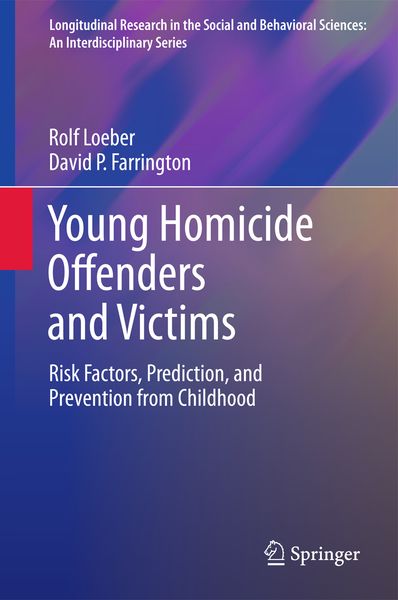
Young Homicide Offenders and Victims Risk Factors, Prediction, and Prevention from Childhood
-
- Hardcover ausgewählt
- Taschenbuch
- eBook
-
Sprache:Englisch
95,99 €
UVP
109,99 €
inkl. gesetzl. MwSt.,
Beschreibung
Produktdetails
Einband
Gebundene Ausgabe
Erscheinungsdatum
02.08.2011
Abbildungen
XXII, 202 p.
Verlag
Springer UsSeitenzahl
202
Maße (L/B/H)
24,2/16,5/2,3 cm
Gewicht
493 g
Auflage
2011 edition
Sprache
Englisch
ISBN
978-1-4419-9948-1
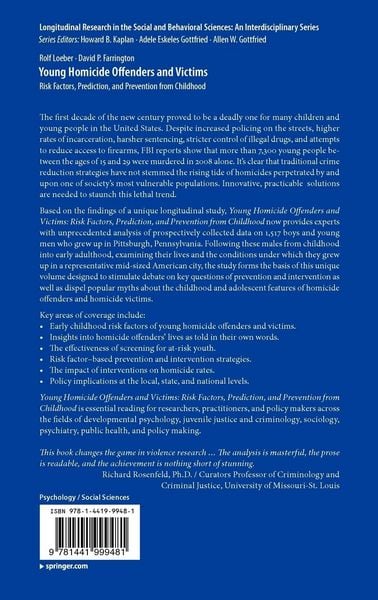
The first decade of the new century proved to be a deadly one for many children and young people in the United States. Despite increased policing on the streets, higher rates of incarceration, harsher sentencing, stricter control of illegal drugs, and attempts to reduce access to firearms, FBI reports show that more than 7,300 young people between the ages of 15 and 29 were murdered in 2008 alone. It’s clear that traditional crime reduction strategies have not stemmed the rising tide of homicides perpetrated by and upon one of society’s most vulnerable populations. Innovative, practicable solutions are needed to staunch this lethal trend.
Based on the findings of a unique longitudinal study,
Young Homicide Offenders and Victims: Risk Factors, Prediction, and Prevention from Childhood
now provides experts with unprecedented analysis of prospectively collected data on 1,517 boys and young men who grew up in Pittsburgh, Pennsylvania. Following these males from childhood into early adulthood, examining their lives and the conditions under which they grew up in a representative mid-sized American city, the study forms the basis of this unique volume designed to stimulate debate on key questions of prevention and intervention as well as dispel popular myths about the childhood and adolescent features of homicide offenders and homicide victims.
Key areas of coverage include:
- Early childhood risk factors of young homicide offenders and victims.
- Insights into homicide offenders’ lives as told in their own words.
- The effectiveness of screening for at-risk youth.
- Risk factor–based prevention and intervention strategies.
- The impact of interventions on homicide rates.
- Policy implications at the local, state, and national levels.
Young Homicide Offenders and Victims: Risk Factors, Prediction, and Prevention from Childhood
is essential reading for researchers,practitioners, and policy makers across the fields of juvenile justice and criminology, developmental psychology, sociology, psychiatry, public health, and policy making.
-------
“This book changes the game in violence research … The
analysis is masterful, the prose is readable, and the achievement is nothing short of stunning.”
Richard Rosenfeld, Ph.D. / Curators Professor of Criminology and Criminal Justice, University of Missouri-St. Louis
“This book will stand the test of time as a landmark homicide study.”
James C. Howell, Ph.D. / Senior Research Associate, National Gang Center
“This is a fascinating, pioneering book … The authors’ sophisticated analyses demonstrate convincingly the considerable value of prospective longitudinal data for enhancing our understanding of the etiology and control of lethal violence.”
Steven F. Messner, Ph.D. / Distinguished Teacher Professor, Department of Sociology, University at Albany, SUNY / President, American Society of Criminology
Noch keine Bewertungen vorhanden
Verfassen Sie die erste Bewertung zu diesem Artikel
Helfen Sie anderen Kundinnen und Kunden durch Ihre Meinung.
Kurze Frage zu unserer Seite
Vielen Dank für Ihr Feedback
Wir nutzen Ihr Feedback, um unsere Produktseiten zu verbessern. Bitte haben Sie Verständnis, dass wir Ihnen keine Rückmeldung geben können. Falls Sie Kontakt mit uns aufnehmen möchten, können Sie sich aber gerne an unseren Kund*innenservice wenden.
zum Kundenservice