KI-Beratung Beta

Gutscheinbedingungen

**Gültig bis 18.11.2026 auf englischsprachige Klassiker (klassiker-32728) online auf thalia.at und in der Thalia App. Einzelne Artikel können ausgeschlossen sein. Ausgenommen sind preisgebundene Artikel & eBooks. Pro Einkauf einmal einlösbar. Click & Collect nur bei Onlinevorabzahlung möglich. Keine Barauszahlung. Nicht kombinierbar mit anderen Aktionen und Gutscheinen. Gutschein wird auf max. 500€ Bestellwert angerechnet. Nicht gültig für Geschenkkarten, Versandkosten und Services.

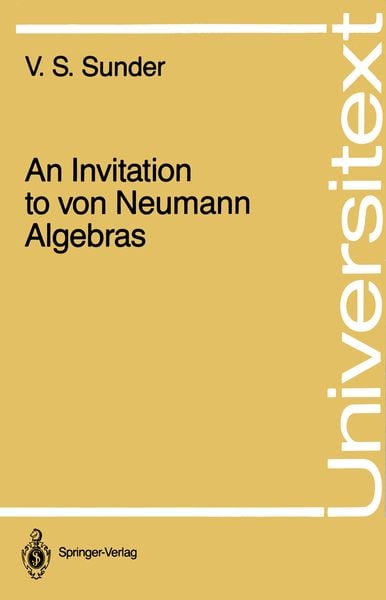
  • Produktbild: An Invitation to von Neumann Algebras
  • Produktbild: An Invitation to von Neumann Algebras
- 11%

An Invitation to von Neumann Algebras

Aus der Reihe Universitext
11% sparen

82,99 € UVP 93,49 €

inkl. gesetzl. MwSt., Versandkostenfrei


Beschreibung

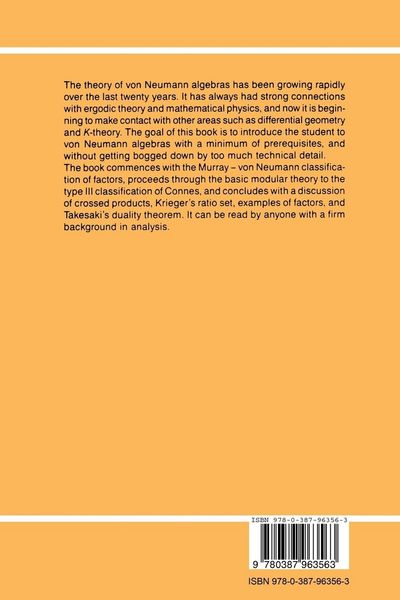
Why This Book: The theory of von Neumann algebras has been growing in leaps and bounds in the last 20 years. It has always had strong connections with ergodic theory and mathematical physics. It is now beginning to make contact with other areas such as differential geometry and K-Theory. There seems...

Beschreibung

Why This Book: The theory of von Neumann algebras has been growing in leaps and bounds in the last 20 years. It has always had strong connections with ergodic theory and mathematical physics. It is now beginning to make contact with other areas such as differential geometry and K-Theory. There seems to be a strong case for putting together a book which (a) introduces a reader to some of the basic theory needed to appreciate the recent advances, without getting bogged down by too much technical detail; (b) makes minimal assumptions on the reader's background; and (c) is small enough in size to not test the stamina and patience of the reader. This book tries to meet these requirements. In any case, it is just what its title proclaims it to be -- an invitation to the exciting world of von Neumann algebras. It is hoped that after perusing this book, the reader might be tempted to fill in the numerous (and technically, capacious) gaps in this exposition, and to delve further into the depths of the theory. For the expert, it suffices to mention here that after some preliminaries, the book commences with the Murray - von Neumann classification of factors, proceeds through the basic modular theory to the III). classification of Connes, and concludes with a discussion of crossed-products, Krieger's ratio set, examples of factors, and Takesaki's duality theorem.

Produktdetails

Einband

Taschenbuch

Erscheinungsdatum

14.11.1986

Abbildungen

XIV, 172 p.

Verlag Springer Us

Produktdetails

Einband

Taschenbuch

Erscheinungsdatum

14.11.1986

Abbildungen

XIV, 172 p.

Verlag Springer Us
Seitenzahl

172

Maße (L/B/H)

23,5/15,5/1,1 cm

Gewicht

295 g

Sprache

Englisch

ISBN

978-0-387-96356-3

Herstelleradresse

Springer-Verlag KG
Sachsenplatz 4-6
1201 Wien
AT

Email: ProductSafety@springernature.com

Noch keine Bewertungen vorhanden

Verfassen Sie die erste Bewertung zu diesem Artikel

Helfen Sie anderen Kundinnen und Kunden durch Ihre Meinung.

Kundinnen und Kunden meinen

Bewertungen (0)

  • Produktbild: An Invitation to von Neumann Algebras
  • Produktbild: An Invitation to von Neumann Algebras
  • 0 Introduction.- 0.1 Basic operator theory.- 0.2 The predual L(H)*.- 0.3 Three locally convex topologies on L(H).- 0.4 The double commutant theorem.- 1 The Murray — von Neumann Classification of Factors.- 1.1 The relation… ~… (rel M).- 1.2 Finite projections.- 1.3 The dimension function.- 2 The Tomita — Takesaki Theory.- 2.1 Noncommutative integration.- 2.2 The GNS construction.- 2.3 The Tomita-Takesaki theorem (for states).- 2.4 Weights and generalized Hilbert algebras.- 2.5 The KMS boundary condition.- 2.6 The Radon-Nikodym theorem and conditional expectations.- 3 The Connes Classification of Type III Factors.- 3.1 The unitary cocycle theorem.- 3.2 The Arveson spectrum of an action.- 3.3 The Connes spectrum of an action.- 3.4 Alternative descriptions of ?(M).- 4 Crossed-Products.- 4.1 Discrete crossed-products.- 4.2 The modular operator for a discrete crossed-product.- 4.3 Examples of factors.- 4.4 Continuous crossed-products and Takesaki’s duality theorem.- 4.5 The structure of properly infinite von Neumann algebras.- Appendix: Topological Groups.- Notes.