Gutscheinbedingungen

**Gültig am 28.06.2026 auf Spielzeug, Schreibwaren, Filme, Geschenke & Trends, Musik, tolino eReader & Zubehör, Hörbücher und Hörbuch-Downloads (außer Abo), nicht preisgebundene Bücher und Kalender online auf thalia.at und in der Thalia App. Einzelne Artikel können ausgeschlossen sein. Aufgrund der Buchpreisbindung sind deutschsprachige Bücher und eBooks ausgenommen. Zusätzlich ausgenommen sind preisgebundene Artikel, Abos & Flatrates, eBooks, Games, Geschenkkarten/-boxen, Shelfies, Software, Zeitschriften sowie einzelne Artikel von tonies®. Pro Einkauf einmal einlösbar. Click & Collect nur bei Onlinevorabzahlung möglich. Keine Barauszahlung. Nicht kombinierbar mit anderen Aktionen und Gutscheinen. Gutschein wird auf max. 500€ Bestellwert angerechnet. Nicht gültig für Versandkosten und Services.

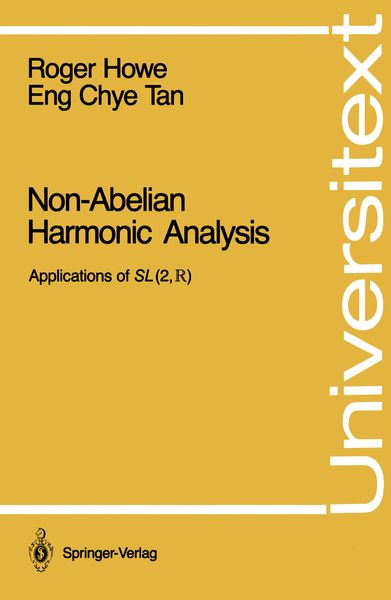
Produktbild: Non-Abelian Harmonic Analysis

Non-Abelian Harmonic Analysis Applications of SL (2,?)

Aus der Reihe Universitext

72,99 €

inkl. gesetzl. MwSt., Versandkostenfrei


Beschreibung

Produktdetails

Einband

Taschenbuch

Erscheinungsdatum

27.02.1992

Verlag

Springer Us

Seitenzahl

259

Maße (L/B/H)

23,5/15,5/1,6 cm

Gewicht

422 g

Auflage

Softcover reprint of the original 1st ed. 1992

Sprache

Englisch

ISBN

978-0-387-97768-3

Beschreibung

Produktdetails

Einband

Taschenbuch

Erscheinungsdatum

27.02.1992

Verlag

Springer Us

Seitenzahl

259

Maße (L/B/H)

23,5/15,5/1,6 cm

Gewicht

422 g

Auflage

Softcover reprint of the original 1st ed. 1992

Sprache

Englisch

ISBN

978-0-387-97768-3

Herstelleradresse

Springer-Verlag KG
Sachsenplatz 4-6
1201 Wien
AT

Email: GPSR Kontakt

Kundinnen und Kunden meinen

0 Bewertungen

Informationen zu Bewertungen

Zur Abgabe einer Bewertung ist eine Anmeldung im Konto notwendig. Die Authentizität der Bewertungen wird von uns nicht überprüft. Wir behalten uns vor, Bewertungstexte, die unseren Richtlinien widersprechen, entsprechend zu kürzen oder zu löschen.

Die Bewertungen sind nach Format, Anzahl Sterne und Datum sortiert.

Verfassen Sie die erste Bewertung zu diesem Artikel

Helfen Sie anderen Kund*innen durch Ihre Meinung

Kundinnen und Kunden meinen

0 Bewertungen filtern

  • Produktbild: Non-Abelian Harmonic Analysis
  • I Preliminaries.- 1. Lie Groups and Lie Algebras.- 1.1. Basic Structure.- 1.2. Representations of Lie Groups.- 1.3. Representations of Lie Algebras.- 2. Theory of Fourier Transform.- 2.1. Distributions.- 2.2. Fourier Transform.- 3. Spectral Analysis for Representations of ?n.- Exercises.- II Representations of the Lie Algebra of SL(2, ?).- 1. Standard Modules and the Structure of sl(2) Modules.- 1.1. Indecomposable Modules.- 1.2. Standard Modules.- 1.3. Structure Theorem.- 2. Tensor Products.- 2.1. Tensor Product of Two Lowest Weight Modules.- 2.2. Formal Vectors.- 2.3. Tensor Product V? ? V??.- 3. Formal Eigenvectors.- 3.1. Action of Other Bases of sl(2).- 3.2. Formal e+-Null Vectors in (V? ? V??)~.- 3.3. Formal h Eigenvectors in U(v+, v-)~.- 3.4. Some Modules in U(v+, v-)~.- Exercises.- III Unitary Representations of the Universal Cover of SL(2, ?).- 1. Infinitesimal Classification.- 1.1. Unitarizability of Standard Modules.- 1.2. A Realization of U(v+, v-).- 1.3. Unitary Dual of SL(2, ?).- 2. Oscillator Representation.- 2.1. Theory of Hermite Functions.- 2.2. The Contragredient (?n*, S(?n)*).- 2.3. Tensor Product ?p ? ?q*.- 2.4. Case q = 0: Theory of Spherical Harmonics.- Exercises.- IV Applications to Analysis.- 1. Bochner’s Periodicity Relations.- 1.1. Fourier Transform as an Element of $$ \mathop{{SL}}\limits^{ \sim } $$(2, ?).- 1.2. Bochner’s Periodicity Relations.- 2. Harish-Chandra’s Restriction Formula.- 2.1. Motivation: Case of O(3, ?).- 2.2. Harish-Chandra’s Restriction Formula for U(n).- 2.3. Some Consequences.- 3. Fundamental Solution of the Laplacian.- 3.1. Fundamental Solution of the Definite Laplacian.- 3.2. Fundamental Solution of the Indefinite Laplacian.- 3.3. Structure of O(p,q)-Invariant Distributions Supported on the Light Cone.- 4. Huygens’ Principle.- 4.1. The Propagator.- 4.2. Symmetries of the Propagator.- 4.3. Representation Theoretic Considerations.- 4.4. O+(n, 1)-Invariant Distributions.- 5. Harish-Chandra’s Regularity Theorem for SL(2, ?), and the Rossman-Harish-Chandra-Kirillov Character Formula.- 5.1. Regularity of Invariant Eigendistributions.- 5.2. Tempered Distributions and the Character Formula.- Exercises.- V Asymptotics of Matrix Coefficients.- 1. Generalities.- 1.1. Various Decompositions.- 1.2. Matrix Coefficients.- 2. Vanishing of Matrix Coefficients at Infinity for SL(n, ?).- 3. Quantitative Estimates.- 3.1. Decay of Matrix Coefficients of Irreducible Unitary Representations of SL(2, ?).- 3.2. Decay of Matrix Coefficients of the Regular Representation of SL(2, ?).- 3.3. Quantitative Estimates for SL(n, ?).- 4. Some Consequences.- 4.1. Kazhdan’s Property T.- 4.2. Ergodic Theory.- Exercises.- References.