Beschreibung
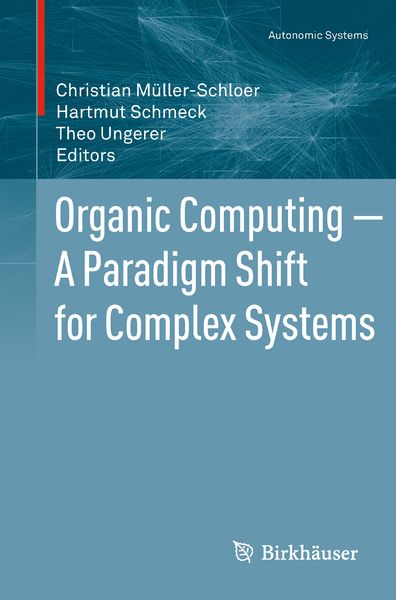
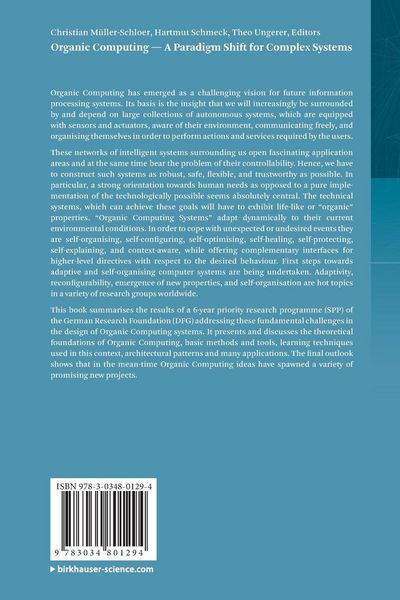
Organic Computing has emerged as a challenging vision for future information processing systems. Its basis is the insight that we will increasingly be surrounded by and depend on large collections of autonomous systems, which are equipped with sensors and actuators, aware of their environment, communicating freely, and organising themselves in order to perform actions and services required by the users. These networks of intelligent systems surrounding us open fascinating ap-plication areas and at the same time bear the problem of their controllability. Hence, we have to construct such systems as robust, safe, flexible, and trustworthy as possible. In particular, a strong orientation towards human needs as opposed to a pure implementation of the tech-nologically possible seems absolutely central. The technical systems, which can achieve these goals will have to exhibit life-like or "organic" properties. "Organic Computing Systems" adapt dynamically to their current environmental conditions. In order to cope with unexpected or undesired events they are self-organising, self-configuring, self-optimising, self-healing, self-protecting, self-explaining, and context-aware, while offering complementary interfaces for higher-level directives with respect to the desired behaviour. First steps towards adaptive and self-organising computer systems are being undertaken. Adaptivity, reconfigurability, emergence of new properties, and self-organisation are hot top-ics in a variety of research groups worldwide. This book summarises the results of a 6-year priority research program (SPP) of the German Research Foundation (DFG) addressing these fundamental challenges in the design of Organic Computing systems. It presents and discusses the theoretical foundations of Organic Computing, basic methods and tools, learningtechniques used in this context, architectural patterns and many applications. The final outlook shows that in the mean-time Organic Computing ideas have spawned a variety of promising new projects.
Rezension
From the reviews:
“This book discusses OC with regard to concepts, algorithms, architectures, hardware/software codesigns, the role of learning, user interactions, methods, and applications. It presents not only the basics of OC, but also the current state of research. … Researchers will find this book to be a good guide for OC, and it can be used as a textbook for a graduate or postgraduate course involving OC systems. Computer architects and managers in the industry will also find the book very useful.” (Maulik A. Dave, ACM Computing Reviews, January, 2012)
Portrait
Hartmut Schmeck ist Universitätsprofessor am Karlsruher Institut für Technologie (KIT). Er ist ein Kernmitglied der Organic Computing Initiative und Koordinator des DFG Schwerpunkprogramms Organic Computing Zudem ist er der Sprecher des KIT-Schwerpunkts COMMputation.
Prof. Dr. Theo Ungerer ist Professor für Systemnahe Informatik mit Schwerpunkt Kommunikationssysteme und Internet-Anwendungen am Institut für Informatik der Universität Augsburg. Zudem ist er wissenschaftlicher Direktor des Rechenzentrums und Mitglied des Lenkungsrates des IT-Servicezentrums der Universität Augsburg.
Seine wissenschaftlichen Interessen gelten den Gebieten der Prozessorarchitektur sowie der eingebetteten und ubiquitären Systeme. Theo Ungerer hat über 150 wissenschaftliche Publikationen und 6 Fachbücher veröffentlicht. Er ist Mitglied des Lenkungsrates und deutscher Koordinator des EU-Exzellenznetzwerkes HiPEAC- High Performance Embedded Architectures and Compilers